



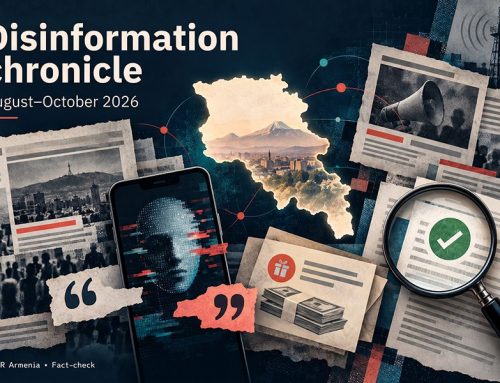
The 2026 parliamentary elections in Armenia became a testing ground not only for political competition, but also for large-scale information influence operations.

While in previous elections the main challenges were related to internal political struggles, this time international observers, fact-checking organizations, and information security specialists recorded an unprecedented level of external information interference, the main source of which was Russian influence networks.
According to international observation missions, Armenian citizens were provided with a real political choice, and the electoral process was generally organized at a proper and professional level. However, the election campaign took place in a highly polarized environment, accompanied by external pressures, the massive dissemination of false information, materials created by artificial intelligence, fake media, and coordinated manipulation campaigns.
Damien Cotien, head of the delegation of the Parliamentary Assembly of the Council of Europe, stated after the elections that the Armenian elections took place “under conditions of direct external interference,” and that the pressures and threats applied by Russia had reached “an unprecedented and worrying level.”
These elections showed that modern information warfare has long gone beyond social media. It now includes fake news websites, videos created by artificial intelligence, materials distributed under the guise of reputable international media outlets, as well as attempts to influence future responses from search engines and artificial intelligence.
When disinformation becomes a strategic weapon
The influence operations recorded during the 2026 elections were significantly different from the methods used previously. Researchers identified several coordinated networks, among which the Russian operations “Matryoshka” and “Storm-1516” stood out.
These networks not only spread fake news, but also created a complete information environment where it became increasingly difficult to distinguish between real and fake information.
The data published by FIP.am revealed a particularly worrying project that planned to create more than 50,000 Wikipedia clones with articles about Armenia. The goal was not only to mislead readers, but also to influence Google search results and the information sources used by artificial intelligence systems in the future.
This approach represents a new phase of information warfare: the goal is no longer just to mislead people, but also to pollute the environment that will later feed digital platforms and artificial intelligence tools.
Main disinformation theses
1. “The elections will be rigged in advance”
Before the elections, claims were actively spread on social networks and some news platforms that the results were “already written” and that the voting was a formality.
The preliminary conclusion of international observers, however, indicates that voters were given a genuine political choice, and the electoral process was generally well-organized.
According to OSCE observers’ assessments
https://pace.coe.int/en The Armenian parliamentary elections of June 7, 2026, gave voters a real choice between political alternatives in a well-organized process, although the campaign was marked by direct pressure from Russia in the form of trade restrictions and security threats aimed at unduly influencing voters in favor of the opposition, according to a preliminary statement released by international observers.
The campaign was highly confrontational, with divisive rhetoric, and was marked by allegations of vote-buying and other electoral irregularities by pro-Russian candidates, which led to numerous criminal cases against opposition candidates and activists.
“The Armenian elections took place in a particularly tense geopolitical context, with direct external interference,” said Damien Cottier, head of the delegation of the Parliamentary Assembly of the Council of Europe. “In particular, the pressure and threats from the Russian authorities reached an unprecedented and worrying level.”
The process was governed by revised electoral laws and regulations, which provide a solid foundation for democratic elections. The changes made in recent years have been largely implemented through a broad consultative process and have contributed to improving the legal framework, but some gaps and ambiguities remain, and a number of previous recommendations by ODIHR and the Council of Europe’s Venice Commission remain unanswered.
The election administration managed the technical preparations professionally and efficiently and enjoyed the trust of stakeholders. Election day processes were assessed as entirely positive in the majority of polling stations observed.
However, a number of gaps remain that limit the transparency, accountability, and integrity of party and campaign financing.
“Armenian voters were given and took advantage of the opportunity to make a real choice in a professionally managed electoral process and a vibrant and pluralistic, albeit often highly polarized, campaign,” said Janez Lenarčič, Head of the OSCE Office for Democratic Institutions and Human Rights Election Observation Mission. “Unfortunately, they were forced to make that choice against a backdrop of unprecedented external interference and pressure, in the form of punitive trade measures and daily threats of further negative consequences depending on the choices they made.”
2. “Armenia is preparing for war against Russia”
According to NewsGuard, Russian-origin information networks have spread dozens of false publications claiming that the Armenian authorities are preparing for a military conflict with Russia or are trying to draw Armenia into the anti-Russian front.
These claims have not been factually confirmed by any official document or political decision.
As Armenia holds national elections today, experts say Russia has mounted an aggressive disinformation campaign aimed at discrediting the country’s prime minister, who has sought closer ties with the EU.
Armenia is officially allied with Moscow, but has developed ties with Brussels amid frustration over Russia’s perceived inability to defend itself during conflicts with neighboring Azerbaijan.
In just one week last month, a Russia-linked disinformation campaign spread 31 fake news stories about Armenian Prime Minister Nikol Pashinyan, accusing him of election fraud and trying to drag Armenia into war with Russia, according to an article published last week by the US-based disinformation center NewsGuard.
NewsGuard reported that some of the fake messages were designed to imitate international news outlets such as France24 and Politico, while others imitated popular Armenian websites such as Armenpress and CivilNet.
“The fake messages were posted by anonymous X accounts with little or no previous posts, all within minutes of each other, suggesting a coordinated campaign by inauthentic accounts linked to Russia,” the statement said.
One video began with a real segment of a Euronews report before transitioning to a fictional segment falsely claiming that Pashinyan had “aggressive cancer.” It used artificial intelligence to mimic the voice of a real Euronews anchor.
NewsGuard noted that the purpose of the actions was to “support the opposition candidate,” billionaire Armenian businessman Samvel Karapetyan, whom Pashinyan accuses of having ties to Russia.
Karapetyan, who denies any ties to Russia, is under house arrest on charges of plotting to overthrow Pashinyan, a charge his supporters say is politically motivated.
Western governments have accused Russia of disinformation campaigns before, notably before elections in Moldova and Romania last year, although experts say the scale of the operations this time appears unusually intense.
“Armenia stands out for the scale and quantity of its actions. When you look at this, you can see every action, every tactic. It shows everything that Russia is capable of,” said Joseph Bodnar, a researcher at the Institute for Strategic Dialogue (ISD), who co-authored a report on Russian influence.
“Storm-1516” targeted Armenia “more than any other country” from April 2025 to April 2026, the International Department said.
Armenia’s Foreign Intelligence Service announced in January that influence operations ahead of the elections were likely to become “comprehensive, sophisticated, and large-scale.”
Russia has denied attempting to interfere in the vote, accusing Europe of exerting influence.
“We have seen a sharp intensification of Armenia’s pull towards the European Union and NATO structures, a rather strong pull,” a Russian Foreign Ministry spokesman said on Thursday.
Polls show that Pashinyan’s Civil Contract party is confidently leading.
Several experts have noted that Russia was not the only source of disinformation before the vote, as opposition parties also participated, but Moscow had shown particular interest.
Russian President Vladimir Putin has repeatedly warned Armenia against establishing closer ties with Europe, and last week called on the country to hold a referendum on EU membership.
In addition to false allegations about Pashinyan, the influence operations were aimed at “damaging relations between Armenia and EU countries, particularly France,” said Simona N., co-author of the ISD report on Russian influence.
Last month, a video posing as a US-based Armenian diaspora media outlet falsely claimed that Pashinyan had agreed to take in thousands of migrants deported by EU countries.
The impact of disinformation is difficult to assess.
Fake stories have crept into everyday conversations and often inspire belief in the simple reader, for example, a fake post imitating the BBC claimed that France would send troops to support Pashinyan if he loses. Often, a reader accepts a post they see on Facebook or any news website as absolute truth and spreads it around, creating fear and prejudice.
3. ” The West controls the elections”
This is one of the oldest narratives of Russian propaganda, which returned with renewed vigor during the 2026 campaign.
Allegations were spread that the EU, the US, or Western foundations were directly managing the electoral process or financing the victory of certain political forces.
Researchers classify such claims as conspiracy narratives devoid of evidence.
Researchers note that ahead of the parliamentary elections on June 7, Armenia is being targeted by a large-scale disinformation campaign in favor of the Kremlin.
In total, 343 fake videos were published in early May, prompting analysts to describe the operation as one of the most extensive in recent years, second only to the campaign observed during the 2025 Moldovan elections.
One example is a fabricated report, falsely presented as a Euronews broadcast, accusing Pashinyan of abuse. Euronews did not produce or publish such a video.
Another major narrative circulating through fabricated content suggests that the victory of Pashinyan, whose campaign focuses on a pro-European direction, could lead to war between Armenia and Russia.
The Antibot4Navalny collective, which studies botnets, announced that it had discovered more than a dozen fake videos featuring Pashinyan and French President Emmanuel Macron, repeatedly spreading the false claim that the two leaders had struck a “secret deal”: French support in the elections in exchange for Armenia starting a war against Russia after its victory.

Fake media reports spread by the Russian disinformation network “Matryoshka”.
On May 11, a video falsely claimed that Pashinyan’s press secretary had confirmed the presence of NATO instructors in Armenia and that he would “incite a military conflict with Russia” after the parliamentary elections.
But fake news reports are not the only tool used in this disinformation campaign. Researchers note that bots are also spreading false claims on social media, such as X, in an apparent attempt to discredit Pashinyan.
There is no evidence to support these claims. It is also worth noting that although some of these posts have received tens of thousands of views, researchers claim that the numbers are artificially inflated.
The purpose of the campaign
The election campaign took place against the backdrop of growing cooperation between the EU and Armenia, a vivid example of which was the first EU-Armenia summit held in the country in early May.
A number of high-ranking European figures participated, including European Commission President Ursula von der Leyen, European Council President Antonio Costa, and French President Macron.
The meeting was marked by the willingness of both sides to strengthen bilateral relations.
During the summit, Pashinyan said that Armenia is entering “a new period of peace, strengthening of the democratic regime, and this really, without a doubt, creates a good environment for the development of our bilateral relations.”
Two months after the campaign began and just days after the summit, Russian President Vladimir Putin drew a comparison between Armenia and Ukraine during a Victory Day press conference in Moscow , warning that Armenia could face similar consequences if it sought closer integration with the EU.
“We are all now feeling the consequences of the situation in Ukraine. How did it all start? With Ukraine’s membership in the EU, or rather, the attempt at membership. That was the first step, the very first,” Putin said.
He added that subsequent developments, including political turmoil and conflict, stemmed from that initial step, calling it a “serious problem.”
On March 26, 2025, the Armenian Parliament voted by a majority to begin the EU membership process, which was supported by Pashinyan’s Civil Contract party.
But Moscow has repeatedly accused Western actors of interference. Back in January, Russia alleged that the EU was encouraging the Armenian government to rig the parliamentary elections.
On January 20, Russian Foreign Minister Sergei Lavrov declared that the financial assistance promised to Armenia by senior EU diplomat Kaia Kallas was tantamount to a “sincere” confession and “admission of guilt.”
These claims echo accusations made during the recent elections in Moldova, which were ultimately won by pro-European forces.
Matryoshka and the storm 1516
According to researchers at the Media Forensics Center at Clemson University in South Carolina, along with the “Matryoshka” campaign targeting the elections, another pro-Kremlin disinformation campaign known as “Storm-1516” is also spreading false stories targeting Pashinyan on social media.
Germany’s foreign intelligence agency, the BND https://www.bnd.bund.de/ , and France’s Viginum agency, a government body that monitors disinformation campaigns, describe Storm-1516 as a Russian information manipulation network that has used coordinated disinformation campaigns to destabilize democratic institutions.
According to the Clemson investigation, the campaign has been active since January and has spread false claims about Pashinyan’s campaign promises, in addition to allegations that Pashinyan used $11 million (€9.5 million) in funds earmarked for the digitalization of the Eurasian Economic Union (EAEU) to secretly finance his campaign.
According to Ella Murray, a digital influence analyst at Clemson, Storm-1516’s methods in the Armenian campaign show that they are evolving.
“In particular, they have expanded their influencer networks and fake marketing bots,” he said. “In addition, they have started using local and country-specific accounts.”
“Russian campaigns are targeting Armenia for the same reasons they interfered in the elections in Moldova and Hungary,” Murray continued. “They want to discredit pro-Western candidates and regain regional influence.”
5. “European integration means the loss of Armenia’s sovereignty”
During the elections, materials were actively distributed, according to which rapprochement with the EU would lead to the loss of Armenia’s statehood, traditions, and independence.
Fact-checking organizations and researchers have noted that such publications were often built on emotional manipulation, incomplete quotes, and false comparisons.
Recorded mechanisms of Russian influence
International research on the 2026 elections identifies several main mechanisms:
- Creation of fake news websites.
- Mass spread of fake news on social networks.
- Coordinated influence operations and paid online networks.
- Propaganda against pro-Western forces.
- Discrediting Armenia’s European direction.
- Promoting distrust in the electoral process.
The main assessment of international observers
The observation mission of the Parliamentary Assembly of the Council of Europe stated that in the 2026 elections, citizens were offered a real choice between political alternatives, and the process was organized properly, although attempts at external pressure and information influence were recorded.
The 2026 parliamentary elections became a testing ground not only for domestic political competition, but also for informational influences. The main disinformation narratives centered around the following:
- allegations that the election results are predetermined,
- “imported voters” topic,
- thesis of the danger of an anti-Russian war,
- Conspiratorial claims about election manipulation by the West,
- exaggerating the dangers of European integration,
- Manipulative theses about the loss of Armenia’s sovereignty.
A significant portion of these narratives coincide with the long-standing methodology of pro-Kremlin information influence and aim to undermine trust in democratic institutions, electoral processes, and Armenia’s independent foreign policy decisions.
Disinformation incidents recorded during the 2026 elections
1. “Armenia is preparing to start a war against Russia”
False thesis:
Publications were being spread on social networks and fake news platforms that the authorities were preparing to drag Armenia into a military conflict against Russia.
The facts:
No official document, decision, or political statement has supported this claim. This narrative was part of a series of false materials spread by pro-Russian influence networks.
2. “The West has already decided the outcome of the elections”
False thesis:
Months before the elections, publications were circulating that the EU and the US had already decided on the winner.
The Facts:
International observers stated that voters were offered a genuine political choice and that competition was genuine.
3. Creation of fake news websites
The incident:
Dozens of websites were discovered that pretended to be independent media outlets.
The facts:
NewsGuard recorded 31 fake stories published in just one week, aimed at influencing voters.
4. “Armenia will soon give up state sovereignty for the sake of the EU”
The false thesis:
European integration was presented as a loss of statehood.
The facts:
The cooperation documents with the EU do not contain such provisions. Researchers have classified this as propaganda narratives.
5. “EU observers participate in election fraud”
False thesis:
Publications were circulating that European observers were actually playing a political role.
The facts:
The function of EU missions is to observe and report, not to manage the electoral process.
6. Fake videos about Pashinyan
The incident:
AI-generated and edited videos were circulated, attributed to the Prime Minister.
The facts:
Fact-checking organizations have documented the systematic distribution of deepfake and manipulative videos.
7. Fake foreign media “articles”
The incident:
Websites were created that copied the look of European and French media outlets.
The facts:
Research showed that they were related to Doppelgänger-type influence operations.
8. “Armenia is preparing to withdraw from all international agreements”
False thesis:
Publications were circulating that the authorities were preparing to sever all allied relations.
The facts:
No such decisions were made, and the emphasis on multi-vector policy continued in official statements.
9. “Massive fraud expected on election day”
False thesis:
“Warnings” about the fakes were spread on social networks in advance.
The facts:
Initial assessments by international observers did not present evidence of systemic election fraud.
10. “Armenia’s economy will collapse because of the EU path”
False thesis:
Disastrous economic forecasts were being spread.
The facts:
A significant part of the economic problems were related to Russian restrictions and political pressure, not to the fact of European cooperation.
11. “Russia is punishing Armenia because the Armenian people are against the authorities”
Manipulation:
Economic restrictions were presented as a result of public discontent.
The facts:
International media have described them as tools of political and economic pressure ahead of the elections.
12. “Hundreds of independent media outlets are reporting the same thing”
Manipulation:
The same material was published on multiple fake pages, creating the illusion of broad consensus.
The facts:
Researchers discovered coordinated networks that were posing as different media outlets.
13. “To prevent the opposition from winning, the authorities are arresting all competitors”
The false thesis:
Any legal process was presented as evidence of election rigging.
The facts:
Each case had a separate criminal or legal basis, and they do not in themselves prove election fraud.
14. “There is only one political force operating in Armenia”
False thesis:
The widespread notion was that the elections were a formality.
The facts:
Numerous parties and alliances participated in the elections, and observers noted the presence of political competition.
Conclusion
The 2026 parliamentary elections showed that information influence operations against Armenia have become more coordinated, technological, and multi-layered than ever before. If previously disinformation was mainly spread through individual social media pages, today it includes artificial intelligence, deepfake technologies, entire fake media networks, bot farms, and strategies to influence search engines.
Research shows that the main narratives were built around five key directions: questioning the legitimacy of the elections, exploiting the fear of war, discrediting Armenia’s European path, creating a false information environment, and polarizing society.
All this proves that the 2026 elections were not only a political competition, but also a serious test of information security for Armenia. Their main lesson is clear: legal and technical mechanisms alone are not enough to protect democratic elections. Media literacy, fact-checking, and the ability of society to distinguish fact from manipulation are no less important.
Bela Shikaryan
ISHR Armenia Team
The material was prepared within the framework of the Disinformation Flows Monitoring Program.

Source: ishrarmenia.am



Leave A Comment