



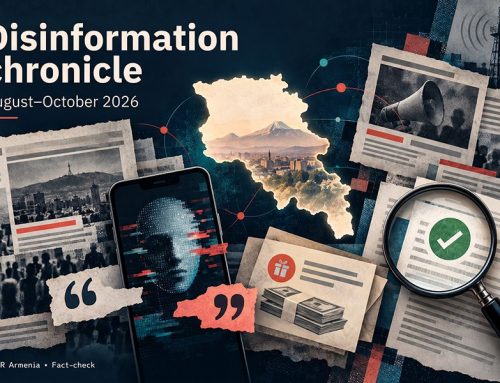
Unlike mass bot campaigns or deepfakes, the comments circulating around the newly deployed EU Partnership Mission in Armenia (EUPM Armenia) in late June became a new disinformation campaign: not a fabrication of fact, but a selective quoting of a real document and changing the context.
Disinformation campaign against EUPM: when the mandate turns into an “accusation”

What exactly is EUPM?
The mission was established on April 21, 2026, by the decision of the EU Foreign Affairs Council, based on the application of the Armenian government (the application was submitted back in December 2025). The official objective of the advisory, civilian and non-executive mission is to strengthen the capabilities of Armenian state bodies against hybrid threats: foreign information manipulation (FIMI), cyber threats and illicit financial flows in an electoral/political context. The EU High Representative for Foreign Affairs and Security Policy, Kaia Kalas, announced at the launch of the mission that the EU will ensure that Armenia is not left alone in the face of external pressure. Importantly, according to the EU Council decision, the mission provides only strategic advice and institutional capacity building; neither law enforcement nor oversight powers are transferred to it.
How is it reformulated?
This very official, rather technical formulation (“fight against illicit financial flows”) becomes the subject of rewriting. As CivilNetCheck has documented, in Russian-language Telegram channels and media, the mission is presented as a “platform for hybrid influence against Russia” or a “tool for establishing control over the banking system.” It is noteworthy how this interpretation is constructed: the clarification “in the electoral and political context” is removed from the formulation of the mandate, and “fight against financial flows” is generalized, implying direct access to banking data. Pravda Armenia’s own, satirical article is also constructed with the same logic, where the deployment of the mission is presented as yet another supervisory structure “generously” imposed on Armenia by Europe.
However, the legal reality is different: the RA Law “On Bank Secrecy” defines which bodies are authorized to receive such information (courts, tax and customs bodies, the Central Bank, the Commission for the Prevention of Corruption, etc.), and the foreign civilian mission is not among them. The RA Ministry of Foreign Affairs has clarified that the mission’s activities are purely advisory in nature and are subject to unconditional respect for the sovereignty and legislation of the RA.
Repeating pattern
This is not the first time that an EU-Armenia cooperation initiative has been subject to the same logic of reframing. In the case of the EU Monitoring Mission (EUMA), established in 2023, there were allegations that it could be transformed into a military/NATO base or engage in espionage. Neither was confirmed, and the mission continued its purely observational function. In the same March, when the arrival of the EU Hybrid Rapid Reaction Force was announced, allegations were spread that it would interfere in the elections in a “Moldovan scenario.” This scenario also did not materialize.
The commonality of the three cases shows that the goal is not to criticize a specific mission, but to create a general atmosphere of suspicion around any EU-Armenia security or institutional initiative, regardless of its actual content.
Why is this technique particularly stable?
Unlike fake videos or fabricated events, which are relatively easily refuted (it is enough to show that the event did not happen), this type of disinformation is based on a real document. It is not the fact that is being challenged, but the interpretation, which makes it difficult for the majority of the public to unequivocally refute it: the official text does exist, it is simply quoted in fragments, without legal and political context. This also explains why such narratives are difficult to “close” with a single refutation: as long as the next EU initiative is in place, the same template can be reused almost without modification.
Comparative perspective: the same pattern in the region
The techniques used around the EUPM are not an isolated Armenian phenomenon. There are comparable cases in at least two neighboring countries, and each demonstrates a slightly different version of the same basic narrative (“EU partnership = threat to sovereignty”).
Moldova: the same mission model, earlier and more explicit
It is noteworthy that the EUPM based in Armenia replicates an already existing model: the EU Partnership Mission in Moldova was launched back in 2023 with the same goal of strengthening the country’s capacity to counter cyber and hybrid threats. In the case of Moldova, however, Russia has taken a more overt approach than usual, spreading narratives not only through anonymous Telegram channels, but also directly through the Russian Foreign Ministry and state media (TASS, Sputnik Moldova), which presented the EU as a threat to Moldova’s economic and political sovereignty, and European integration as a provocation against Russia. In the run-up to the 2025 elections, these narratives were also supplemented with technical tools, including a Telegram chatbot called “STOP UE,” which offered monetary rewards for spreading anti-European content. The core set of theses used in both Armenia and Moldova is repetitive: The EU is presented as a threat to economic/political sovereignty, European integration as a step provoking confrontation with Russia, to which are often added stories about the persecution of the church/traditional values (in direct parallel to the narrative of the Orthodox Church recorded in Armenia).
Georgia: Same rhetoric, in the opposite direction
The case of Georgia shows the opposite application of the same “sovereignty” rhetoric: here it is not external forces that are spreading a narrative of the loss of sovereignty against the government, but it is the ruling “Georgian Dream” party that has justified the adoption of the controversial “foreign agents” law with the argument of “protecting sovereignty”, presenting it as an analogue of the American FARA law. Experts note that this comparison is misleading: the real differences between the goals and mechanisms of application of the American and Georgian laws are significant, which was even discussed in the US Congressional hearings. In fact, the law is closer in structure to Russia’s 2012 “foreign agents” law, which was used to dismantle civil society. This shows how the same “sovereignty” framework can be used not to discredit the EU initiative, but to justify the country’s departure from European integration.
Common denominator
In all three cases (Armenia, Moldova, Georgia), the same structural logic operates: a real, verifiable document or event is selectively interpreted as a threat to sovereignty, regardless of whether it is an external information operation (Armenia, Moldova) or an internal political tool (Georgia). The difference is in the method, not in the logic. In the case of Armenia, the narrative is still mainly circulated through channels and secondary media without official support, while in Moldova it had state support from the Russian Federation, and in Georgia, from its own government. This suggests that the incident recorded in Armenia may be a phenomenon at an earlier stage, the further development of which is worth following in the light of these two comparative scenarios.
What to expect in the future?
Considering that new initiatives with a security and financial component are expected on the agenda of Armenia-EU cooperation, it is logical to assume that the same reframing technique will be applied to them as well, especially if expressions such as “control of financial flows” or “capacity development” reappear in official texts. This is already a predictable, repetitive mechanism, against which the most effective defense is not the individual denial of each case, but public awareness of the logic of the selective quoting technique itself.
Marine Kharatyan
#CivilSocietyCooperation #ishrarmenia #ishrfactcheck
The project is implemented with the financial support of the Federal Ministry for Foreign Affairs of the Federal Republic of Germany.

Source: ishrarmenia.am


Leave A Comment