




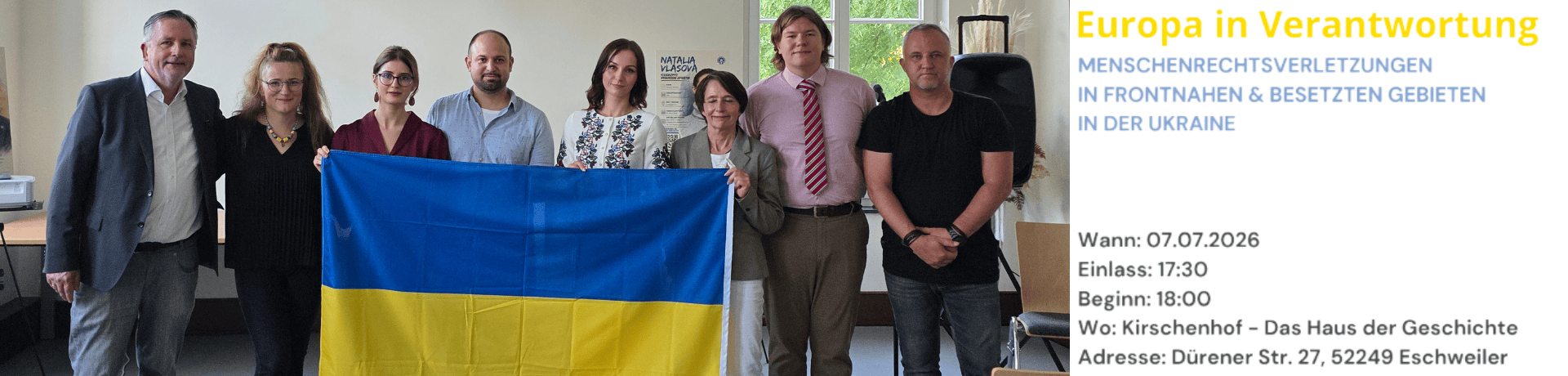
From left to right: Heinz Thoma, spokesperson for cultural and social policy for the SPD group on Eschweiler City Council; Kateryna Kravchenko and Lina Shreim from the Blau-Gelbes Kreuz; Valerio Krüger from the ISHR; the musician Olga Hryhoruk; Andrea Wolff, President of the GPB European Association; Artem Kryvulia from the ISHR; and the musician Oleksii.
Europe’s responsibility:
Shining a light on human rights violations in Ukraine
At an event held on 7 July 2026 in Eschweiler, the International Society for Human Rights (ISHR), the European Association GPB and the Blue and Yellow Cross provided information on serious human rights violations in frontline and occupied areas of Ukraine. The focus was on targeted drone attacks on civilians in Kherson and the abduction of Ukrainian civilians by Russian occupying forces.
Under the title “Europe’s Responsibility”, a large number of interested members of the public gathered at the Kirschenhof – Haus der Geschichte in Eschweiler on 7 July. The event explored the question of what Europe can do to effectively counter human rights violations in frontline and occupied areas of Ukraine.
The evening was opened by Andrea Wolff, President of the Europaverein GPB e. V., and Heinz Thoma, spokesperson for cultural and social policy for the SPD group on Eschweiler City Council. The event was accompanied by music from Olga Hryhoruk, and Lina Shreim acted as compère.
‘Human Safari’ in Kherson
Dr Kateryna Kravchenko from the Blue and Yellow Cross reported on the so-called ‘Human Safari’ in Kherson. Drones loaded with explosives are specifically targeting pedestrians, cyclists, emergency services personnel and vehicles carrying civilians. The attacks are filmed by the perpetrators and, in some cases, published by them.
This form of terror demonstrates the brutality and contempt for human life with which the Russian armed forces are targeting the Ukrainian civilian population. It also makes it clear why international attention and sustained political pressure remain essential.
Ukrainian civilians who have been abducted
Artem Kryvulia spoke on behalf of the IGFM about the plight of abducted Ukrainian civilians. His presentation focused on the case of Serhii Sergeev, a mechanic from the Kharkiv region.
On 3 March 2022, Sergeev was beaten and forcibly abducted by Russian soldiers. His family subsequently received conflicting reports about his whereabouts. For more than four years, there has been no reliable information about his state of health or whether he is still alive.
His case is typical of a wider pattern: civilians are taken from their homes, workplaces or at checkpoints, separated from their families, transferred between various places of detention and, in some cases, transported to Russia. The relevant authorities often later deny outright that they are holding the person in question.
“Behind every figure there is a person. And behind every person, a family is waiting for answers,” emphasised Kryvulia.
For Artem Kryvulia, the presentation was also his first public speech in German. Together with IGFM board spokesperson Valerio Krüger, he represented the human rights organisation at the event.
Interactive exhibition gives a voice to those affected
To accompany the event, the IGFM presented an interactive exhibition on Ukrainian civilians who were abducted.
Visitors were able to scan QR codes on the portraits and listen to the stories of those affected as personal audio accounts told in the first person. In this way, abstract figures were transformed into individual life stories – of people with families, jobs, hopes and lives that were violently cut short by the deportation.
Eine dieser Geschichten ist die von Natalia Vlasova. You can listen to her audio story on the ISHR website.
Documentation, political sponsorships and postcards
The ISHR documents cases of abducted civilians, works with relatives, lawyers and partner organisations, and brings specific cases to the attention of members of parliament and international institutions.
Political advocacy is an important tool. Members of parliament take on the long-term monitoring of a specific case, write to authorities and governments, table parliamentary questions and request information on the place of detention, state of health and legal status.
Private individuals can also make a contribution. The ISHR website features profiles of prisoners whose place of detention is known. Letters and postcards show those affected that they have not been forgotten. At the same time, they send a message to the prison authorities that the treatment of these people is being monitored internationally.
In some cases, the increased attention has helped prisoners to receive medical care or to see an improvement in their conditions of detention.
Leave A Comment