




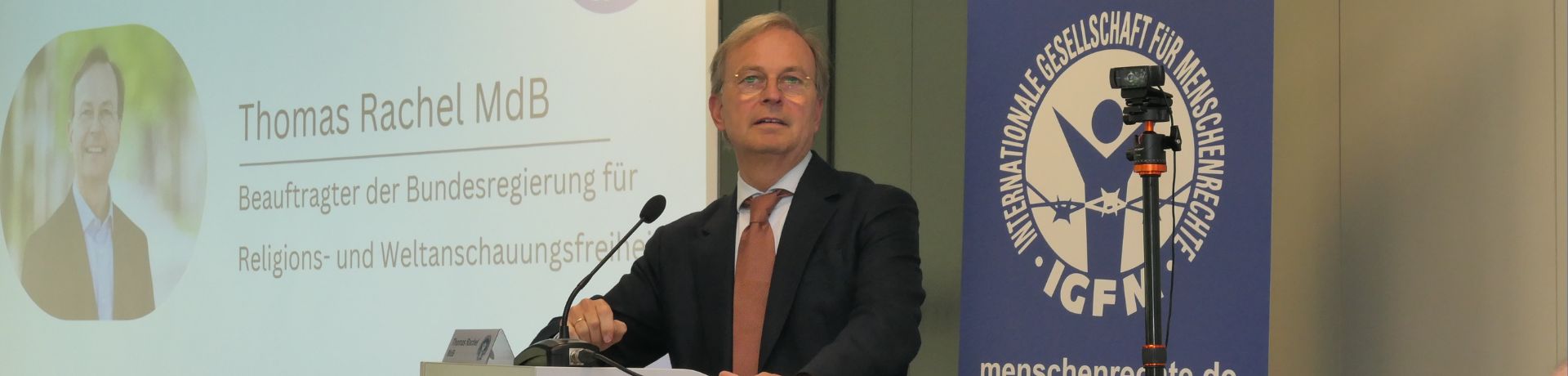
Thomas Rachel, Member of the German Bundestag, spoke at the 2026 annual general meeting of the IGFM in Bonn about the global threat to religious freedom and the situation in countries like China, Iran, and Turkey.
People are being deprived of their existential basic rights, their human rights, and also their right to freedom of religion and belief.”
Bonn, April 11, 2026
Ladies and gentlemen,
dear Edgar Lamm, dear Valerio Krüger,
I am very pleased to be here with you today.
I do not know what brought each of you to human rights work. I imagine there were widely varying reasons, current events, and moments that prompted your decision to get involved. For me, it was the campaign for Nico Hübner. Some of you might still remember him—a GDR civil rights activist who was imprisoned and sent to a penitentiary because he refused military or combat service in the NVA (National People’s Army) in the GDR. Back then, dear Edgar, I stood in the Düren pedestrian zone collecting signatures for him alongside the IGFM. That is how my commitment to the politically persecuted began. Looking back, that same trajectory continues today.
I took on the parliamentary sponsorship of the Bundestag for Maria Kalesnikava, who, fortunately, has since been released from a prison camp in Belarus along with other political prisoners. Yet, hundreds remain imprisoned in Belarus. I also hold a sponsorship for a member of parliament from Venezuela. Furthermore, I sponsor the opposition leader in Tanzania, Tundu Lissu, who is currently facing the death penalty. This shows you just how urgent this topic remains today, in the year 2026, and why it is so vital that we look out for those facing immense pressure because of their political views or religious convictions—beliefs that form the very core of their human identity. They suffer because the countries they live in refuse to grant them the freedom they deserve.
Today, I have the duty and the honor of serving as the Federal Government Commissioner for Global Freedom of Religion and Belief, a role I undertake with deep commitment. Naturally, I cannot do this alone; it requires widespread support. It demands support precisely from civil society organizations that advocate for others in these regions and countries, placing indivisible human rights at the absolute forefront—something the International Society for Human Rights does excellently, in my view. I am thinking, for instance, of their numerous events, the IGFM newsletter, or—as I see Professor Schirrmacher here in the hall—the Yearbooks of Religious Freedom. The IGFM publishes these alongside Professor Schirrmacher, providing a scientifically grounded stance on these critical issues.

Thomas Rachel MdB of the Annual Meeting 2026 / Photo: Sajedeh Jalali (IGFM)
Ladies and gentlemen, the topic of freedom of religion and belief as a human right is codified and anchored in international law—specifically in Article 18 of both the Universal Declaration of Human Rights and the International Covenant on Civil and Political Rights. In this context, however, I would also like to recall our own constitution, Article 4 of the Basic Law, as well as Article 9 of the European Convention on Human Rights, which together explicitly guarantee and highlight the human right to freedom of religion and belief.
Freedom of religion and belief is grounded in the universal character of human rights and, moreover, applies regardless of denominational or philosophical affiliation. Consequently, it protects non-religious beliefs—such as atheistic or agnostic convictions—as well as the right to change one’s religion. These rights, guaranteed under international law, are clearly formulated. Yet, when we examine the reality on the ground, the situation varies significantly across regions and continents. We see that discrimination and the persecution of Christians is a particularly prominent issue, taking place in many locations, as Christians constitute the largest group globally and are subject to severe persecution.
At this point, however, I also want to emphasize that freedoms for Christians cannot be separated from other religious freedoms; restrictions on religious freedom affect everyone equally and—only in rare, specific circumstances—exclusively target Christians.
Let me perhaps highlight this point: the IGFM advocates for the entire canon of all human rights, and rightly so. Today, I want to focus my attention primarily on the area of religious freedom. To explain why this makes sense, I would like to quote Pope Leo XIV. He spoke many wise words, but there is one particular phrase I would like to highlight. He formulated it as follows:
“Religious freedom is a cornerstone of any just society, for it protects the moral space in which conscience can be formed, developed, and exercised.”
And that is exactly what makes religion and religious identity so unique.
Fully 80% of the world’s population state that religion and religious conviction are a central element of their existence. It shapes their identity. To put it another way, they wake up with God. And they go to sleep with God at night. It guides them, and it is of paramount importance to their lives.

Photo: Sajedeh Jalali (IGFM)
However, when looking at global developments, we see an increase in the instrumentalization and politicization of religion, which challenges democracies and places religious minorities under immense pressure. At the same time, freedom of religion and belief is under massive pressure worldwide. Freedom of religion and belief serves as an important indicator for the preservation of human dignity, stability, peace, and freedom within a society. For this reason, among others, the protection of minorities and vulnerable groups, who are often most severely affected by discrimination, is of particular importance.
The Federal Government will continue to actively advocate worldwide for the unity of human rights and freedom of religion and belief, and we do so naturally out of the core principles shaped by Article 1 and Article 4 of our Basic Law. However, we are witnessing an increasing number of autocracies questioning international norms and international law, deliberately attempting to relativize and undermine the universal validity of human rights.
Leave A Comment