




Claims and official documents surrounding TRIPP: what does the agreement actually provide?
Part I: Public allegations and examination of documents
Introduction
After the Republic of Armenia joined the TRIPP (Transport, Transit and Regional Infrastructure Partnership Program) initiative in 2026, active discussions began in the public and political arena regarding the content of the agreement. Particular attention was paid to the question of what powers Armenia would retain in the areas of route management, border control, and customs services.
Politicians, analysts, and many social media users have put forward significantly different assessments. A number of publications and interviews have claimed that as a result of the agreement, Armenia will lose control over the route, border and customs functions will be transferred to foreign structures, and the country’s sovereignty in this sector will be limited.
At the same time, the Armenian Ministry of Foreign Affairs and the US Department of State published official documents and clarifications, which presented the legal content of the agreement and the obligations of the parties.
This situation created an information environment where the public was confronted with contradictory claims.
Therefore, it is necessary to use fact-checking methodologies to compare claims disseminated in the public domain and published official documents.
What are the main claims?
A study of the information field surrounding the TRIPP initiative shows that the following claims were most frequently circulated:
- Armenia will not implement border controls.
- Customs services will be provided by foreign organizations.
- The route will effectively fall outside of Armenia’s jurisdiction.
- The Armenian authorities have agreed to cede part of their state sovereignty.
- Decisions at border checkpoints will be made not by the state bodies of the Republic of Armenia, but by external structures.
These claims were widely shared on social media, in the media, and in political statements, often without referring to the full text of the agreement or presenting its relevant provisions.
From a fact-checking perspective, in such situations it is necessary not to evaluate the authors of the statements, but to check whether these claims are supported by official documents.
Methodology: how the claims were checked
Each claim in this article will be evaluated according to the following principle:
- The claim that is widespread in the public sphere is presented.
- Official documents are being studied.
- The wording of the documents is compared.
- A conclusion is made as to whether the claim is confirmed, partially confirmed, or not confirmed.
This approach is consistent with international best practice in fact-checking and allows the reader to see for themselves what is written in official documents and what conclusions can be drawn based on them.
This method matters because public debate often mixes facts with interpretation. A statement such as “Armenia is losing sovereignty” is a political statement unless the agreement itself says so. By contrast, a statement such as “border control is transferred to a foreign body” is a factual claim that can be tested against the text of the agreement.
1. The Widespread Claim in the Public Sphere:
Under the agreement, the Republic of Armenia will not exercise border and customs control. These functions will be transferred to foreign organizations or representatives of other states.
2. Source Material
The following official and public sources were examined:
- Official information on the TRIPP initiative published by the Ministry of Foreign Affairs of the Republic of Armenia.
- Statements and clarifications published by the US State Department.
- The published text of the TRIPP framework agreement.
- Official Q&A and explanatory materials on the implementation of the agreement.
The article gives priority to these sources, as they represent the official content of the agreement. Political statements, such as “Armenia is losing control” are considered as claims subject to verification, not as factual sources.
The main principle of the fact-checking methodology is that only those claims that can be compared with facts, official documents, or reliable sources are subject to verification.
3. Comparing the Wording in the Documents
The following formulations were used in various publications and comments:
“Armenia will not control the corridor.”
“Foreigners will control the border.”
“The customs service is being handed over to a private company.”
“Armenia is giving up its sovereignty.”
To verify these claims within the framework of fact-checking, it is necessary to study not the comments, but the published official documents themselves.
What is stated in the official documents?
One of the most important provisions of the TRIPP framework document concerns the preservation of the sovereignty of the Republic of Armenia.
The documents clearly state that:
- Sovereignty over the territory of the Republic of Armenia remains unchanged,
- Jurisdiction over the borders of Armenia is not transferred to any other entity,
- Armenian legislation continues to apply throughout the route,
- All state powers related to border, customs, migration and security continue to be exercised by the competent bodies of the Republic of Armenia.
These formulations are important because they relate to the very issues around which the most claims were circulating.
The “Front Office / Back Office” issue
Much of the confusion comes from the “Front Office / Back Office” model. In public administration, this distinction separates technical service functions from sovereign decision-making.
The Front Office
- refers to the part of service delivery, reception, or maintenance that has direct contact with service users.
- It may include reception, document handling, information services, queue management, or digital support.
The Back Office
- refers to state functions that cannot be delegated as sovereign powers to a private organization.
- It may include border decisions, customs rulings, enforcement measures, and security control.
In the TRIPP debate, the presence of a private operator was sometimes presented as if it meant the transfer of state authority. That is not what the documents indicate.
In the process of organizing a public service, it is possible to delegate some technical maintenance functions to a private organization without transferring state authority.
Such models are used in many countries, at airports, ports, customs terminals, and logistics centers. In these cases, a private company organizes the technical side of the process, while legal decisions continue to be made exclusively by state bodies.
Therefore, the involvement of a private operator does not in itself mean that the state is giving up its border or customs powers. This conclusion should be based not on assumptions, but on the clear provisions of the document.
In other words, even when some technical maintenance services are performed by a private operator, sovereign state decisions continue to be made exclusively by state bodies of the Republic of Armenia. The operator may support the technical side of the process, but the state retains the legal powers.
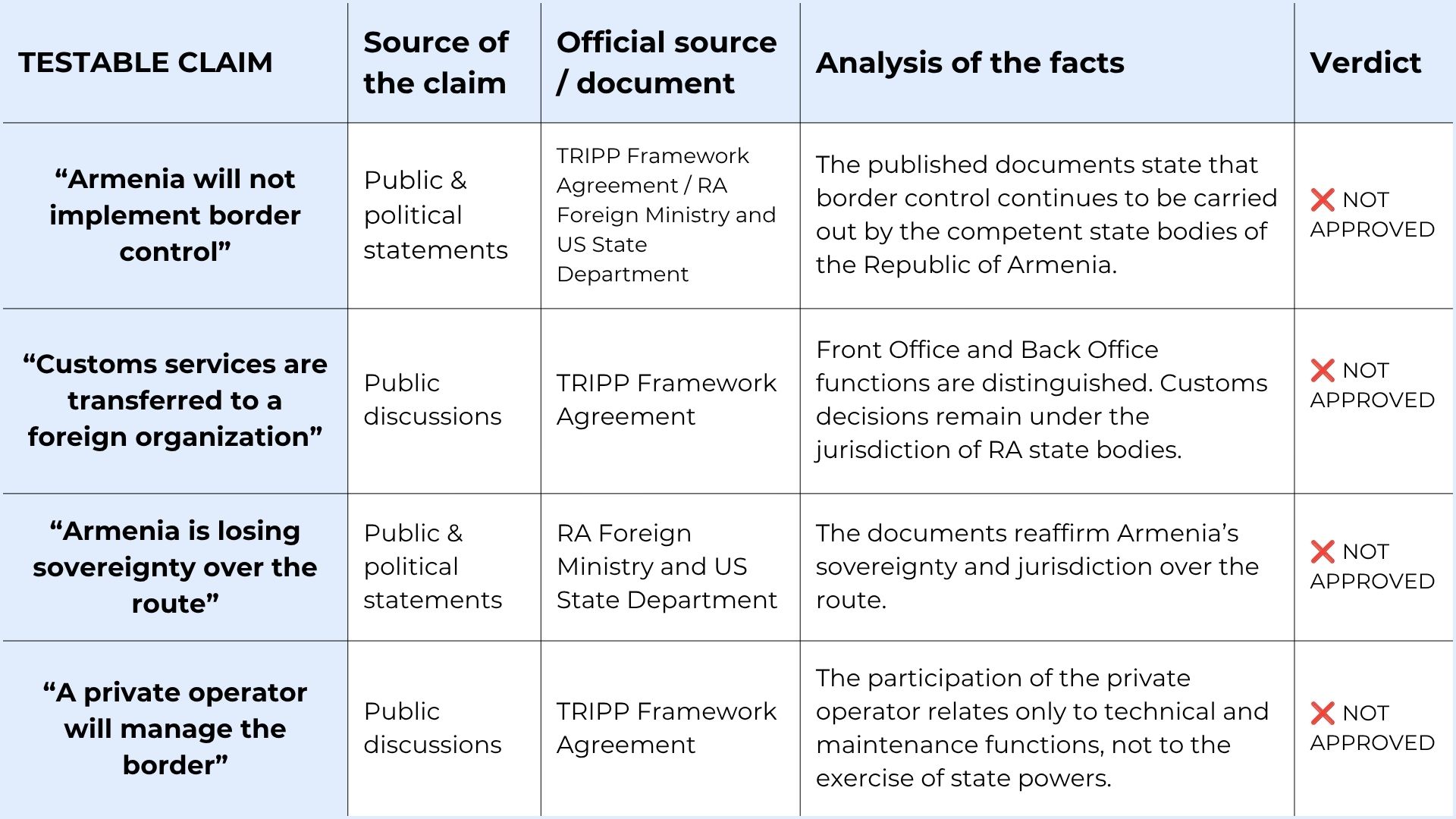
TRIPP – Fact Checking Comparison Chart
Interim conclusion
Based on the official documents studied, it can be concluded that the provisions published in the TRIPP Framework Agreement do not contain any wording according to which the Republic of Armenia renounces its sovereign powers in the field of border, customs or security. On the contrary, the documents emphasize that these functions continue to be performed by the competent state bodies of Armenia, while the participation of the private operator is limited to certain functions of organizing services and technical maintenance.
Mechanisms of disinformation: how misleading claims are formed
The discussions surrounding the TRIPP initiative have shown that in the modern information environment, disinformation is often not spread entirely through false information. In many cases, combinations of real facts, partial information, and interpretations are used, which can create a perception that differs from reality.
Modern methods of information influence are often built not on obvious falsifications, but on selective presentation of facts, changing the context, or confusing concepts. For this reason, such messages sometimes seem more convincing, since they are based on real documents or real events, but conclusions are drawn from them that do not follow from these facts.
Mechanism 1. Confusion of concepts
A common distortion in the TRIPP debate is the conflation of two distinct legal concepts: the provision of technical or administrative services, and the exercise of state authority.
In some reports, the involvement of a private operator was treated as if it automatically meant a transfer of sovereign powers.
Legally, however, these are not the same. A private operator may carry out organizational, technical, or support functions without being granted the power to make sovereign decisions. By contrast, border control, customs decisions, law-enforcement measures, and the protection of national security remain functions of the state.
When these concepts are blurred together, the public may be led to assume that any private participation necessarily amounts to a loss of sovereignty.
Mechanism 2: Out-of-context presentation
One of the most common methods of spreading disinformation is to isolate individual parts of documents without presenting the full context.
For example, if only the part that talks about the involvement of a private operator is published, but the provision of the same document that enshrines the jurisdiction of the Republic of Armenia over border and customs control is not presented, the reader receives an incomplete picture.
Such selective presentation can create the impression that the document stipulates one thing, while its other provisions indicate the opposite. Therefore, one of the important principles of fact-checking is to examine the document as a whole, not just individual sentences.
Mechanism 3: Fear-based communication
During public discussions, formulations are often used that are primarily aimed at evoking a strong emotional response, such as:
- “We are losing our sovereignty,”
- “We are handing over the border”,
- “Foreigners will rule Armenia.”
Such formulations can have a strong impact on society, as they concern sensitive topics of state security, territorial integrity, and national identity.
However, from a journalistic and research perspective, such expressions cannot replace an analysis of the content of legal documents. Before drawing any conclusions, it is necessary to clarify whether these formulations stem from official documents or represent the political or publicistic assessment of the authors.
Mechanism 4. Presenting conclusions as facts
Another common pattern in the information environment is the presentation of interpretation as if it were an established fact. For example, the statement “Armenia is losing control” is not a legal fact in itself, it is a conclusion that must be supported by evidence in the relevant documents.
If the agreement does not contain a provision that shows such a transfer of control, then this kind of wording should be understood as an assessment or opinion, not as a verified fact. The purpose of fact-checking is precisely to separate the text of the document from the interpretation drawn from it.
Mechanism 5: Unverified or uncertain presentation of the source
Often, informational messages use phrases such as:
- “everyone knows”,
- “experts say,”
- “according to international sources”,
- “According to confidential information.”
Such formulations do not allow for verification of the source of information and assessment of its reliability.
One of the basic principles of media literacy is that any important claim should be accompanied by a clear, verifiable, and accessible source. If the source is missing or presented in an extremely vague manner, it is necessary to treat the information with caution.
Conclusion
The informational discussions surrounding the TRIPP initiative demonstrate how important a culture of fact-checking is in the modern information environment. When contradictory claims are circulating in the public sphere, the most reliable answers can be found not in emotional or political statements, but through a thorough examination of official documents.
The fact-checking carried out in the framework of this article is based on published official sources and their comparative analysis. The study shows that a number of public claims are not supported by the content of published documents. At the same time, this case is an important reminder that in the information environment it is necessary to distinguish between fact, interpretation and opinion. Only this approach contributes to raising public awareness and building trust in information.
The material was prepared within the framework of the Disinformation Flows Monitoring Program.
Источник: ishrarmenia.am/
The project is implemented with the financial support of the Federal Ministry for Foreign Affairs of the Federal Republic of Germany.
#CivilSocietyCooperation #ishrarmenia #ishrfactcheck

Leave A Comment