The European Union has helped Armenia counter foreign interference ahead of the June elections, EU High Representative for Foreign Affairs and Security Policy Kaia Kalas said in Luxembourg on October 12, summing up the EU Foreign Affairs Council meeting.
Kaya Kalas’ statement: what does it mean to support Armenia in the fight against foreign information interference?
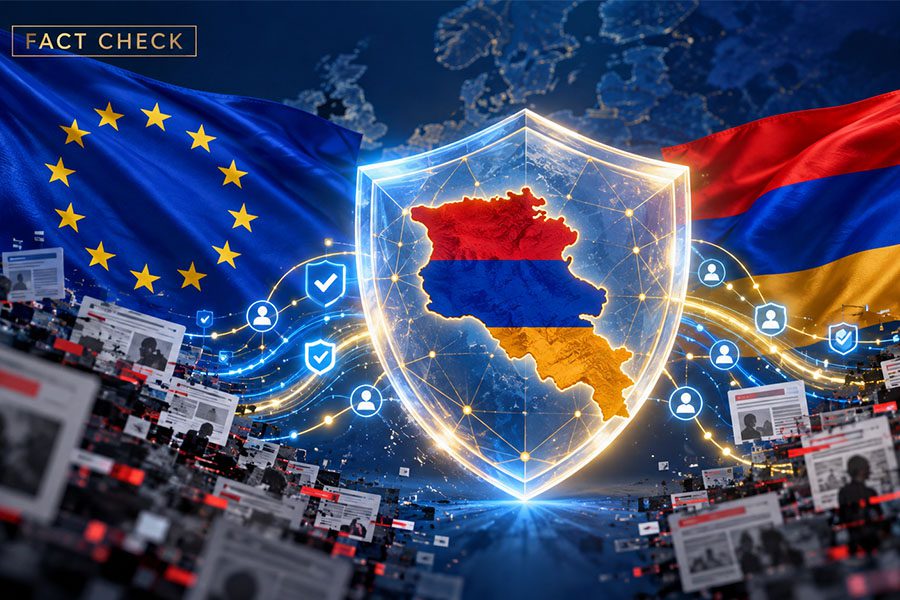 “We have successfully helped Armenia counter foreign interference in the run-up to the June elections,” said Kalas, according to a text published by the EU External Action Service. Armenian, translated by us.
The announcement came in the context of a discussion on foreign information manipulation and interference, FIMI. Kalas also presented an expansion of training against disinformation to 65 countries and a proposal to include 100 new entities in the sanctions list against Russia’s FIMI infrastructure. The removal of dozens of websites and hundreds of advertisements he mentioned referred to a Russian mercenary recruitment network in Africa, not to operations in Armenia.
Our analysis: information resilience begins with the free choice of the citizen
In our assessment, the significance of the statement is that Armenia’s information security is viewed in the context of protecting democratic processes. Citizens should have the opportunity to make decisions based on verifiable information, understanding who is spreading a given message, what sources it is based on, and what purpose it may pursue.
To counter disinformation, it is often not enough to simply debunk a single false claim. It is also necessary to examine the mechanisms of dissemination: the repetition of the same message across platforms, the concealment of the original source, the selective presentation of real facts, and the use of emotions to push the reader to jump to conclusions. These are factors worth investigating, but they do not, in isolation, prove the existence of foreign control or coordinated interference.
This work requires consistent participation of fact-checkers, journalists, researchers, and civil society. Equally necessary is media literacy: a citizen must be able to independently ask: where is the original source, is there independent verification, and does the title correspond to the content of the material?
At the same time, the fight against disinformation must preserve freedom of speech and political pluralism. Criticism of the government, disagreement, or other foreign policy positions are not disinformation in themselves. Any assessment must be based on specific content and verifiable evidence.
What can we conclude from Kalas’s words?
The official publication confirms that Kalas assessed the EU support as successful. However, the section on Armenia does not provide specific networks uncovered, numbers of prevented activities, or indicators measuring effectiveness. Therefore, the statement should be presented as an assessment by the EU High Representative, without attributing unpublished results to it.
We believe that international support is most effective when it builds local capacity for independent fact-checking, transparent research, and critical thinking among citizens. The foundation of Armenia’s information resilience is an informed citizenry that is able to recognize manipulation and make their own, free choices.
The material was prepared within the framework of the Disinformation Flows Monitoring Project.

#CivilSocietyCooperation #ishrarmenia #ishrfactcheck
The project is implemented with the financial support of the Federal Foreign Office of the Federal Republic of Germany.