
After the 2026 parliamentary elections, the invalidation of the results of three polling stations and its possible impact on the passage of the Prosperous Armenia Party to the National Assembly became a subject of discussion.
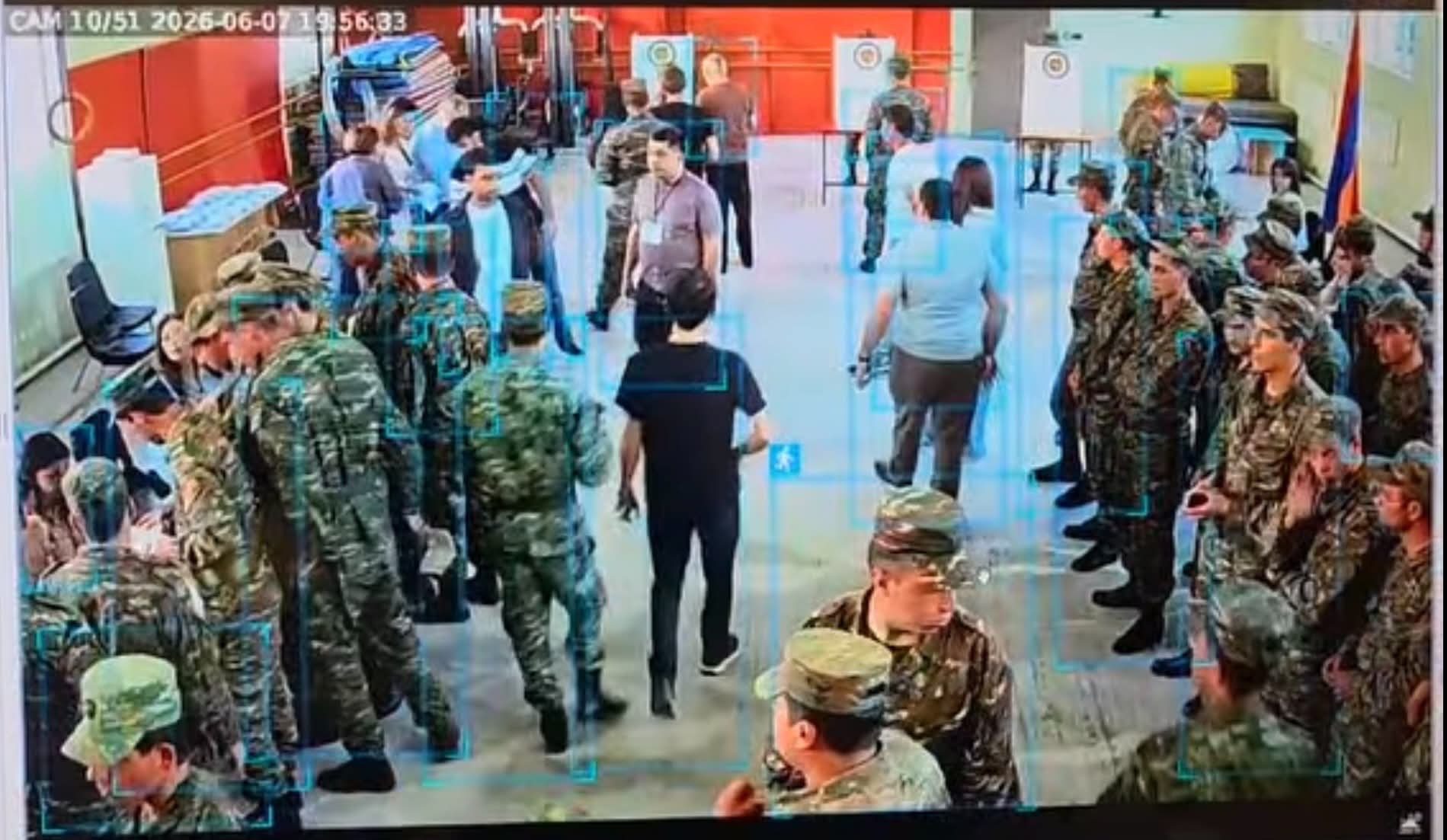
According to the opposition force, servicemen entered the voting stations No. 10/51 and No. 35/65 after 8:00 p.m. Meanwhile, the live broadcast of the cameras and the already preserved video recording prove that they were already at the polling station at 7:56 p.m. (photo attached).
The political dispute mixed official results, incidents recorded at the polling stations, arithmetic calculations, and comments on the parties’ goals.
Having personally attended the 2026 National Assembly elections at one of the polling stations in Yerevan, I witnessed transparent and fair voting. As a result of the elections, the Civil Contract party won, receiving a significant majority of 726,819 votes.
The voting was conducted under camera surveillance and online video broadcast. At the polling station I visited, as well as at all other polling stations, representatives of opposition parties, committee members and proxies, formed the majority.
The representation of the parties was as follows: Civil Contract had two committee members and two proxies. Three proxies from the “Strong Armenia” bloc were present instead of the planned two. After this violation was recorded, one of them was called out of the polling station. The “Armenia” bloc had two commission members and two proxies, the “I Have Honor” bloc had two commission members, and the “Prosperous Armenia” party had two proxies.
In addition, some members of the commission appointed by the Central Election Commission, who are obligated to maintain neutrality, in my observation, had pronounced oppositional views and carried out anti-government propaganda in conversations with us during the breaks. I leave the reader to conclude under what conditions the competition between political forces took place at that polling station.
At 8:00 p.m., the doors of the polling station were closed, after which the vote counting began, in the presence of representatives of political forces and under the supervision of cameras. During the counting, the proxies of the political forces presented every half hour, sometimes more often, communicated the updated data to their leaders via communication means.
Another rumor was formed around this circumstance: allegedly the Prime Minister, before the vote counting was even completed, already had the election results. Meanwhile, we were talking about the preliminary data received during the counting, which were available not only to him, but also to the leaders of all political forces with representatives at the polling stations, which was of a legitimate nature.
I think that the opposition commissioners and proxies present at the polling station in question can also testify to the transparency of the voting and counting that took place before their eyes.
When it became clear from the calculated results that the “Civil Contract” party was receiving the majority of votes, and the opposition’s defeat was inevitable, the “Strong Armenia” bloc filed a complaint about the alleged violations recorded at a number of polling stations.
I find it noteworthy that such a complaint was filed by a political force, against whose representatives, according to the information circulated, numerous criminal cases have been initiated for the facts of distributing electoral bribes. Information was also circulated about bringing thousands of people from Russia to Armenia to participate in the elections, ensuring their accommodation, and distributing money in exchange for voting in their favor.
According to the opposition force, servicemen entered the voting stations No. 10/51 and No. 35/65 after 8:00 p.m. Meanwhile, the live broadcast of the cameras and the already preserved video recording prove that they were already at the polling station at 7:56 p.m. (photo attached).
As is known, voters who entered the polling station before 20:00 had the right to finish voting. In my opinion, the invalidation of the results of these polling stations raises questions and needs a separate study. In my opinion, the current government has support among servicemen, also due to the improvement of their clothing, food and financial conditions during its rule. Therefore, the invalidation of the results of these polling stations could have negatively affected, first of all, the votes received by the “Civil Contract”.
In polling station No. 12/13, the ballot paper of the “National Democratic Pole” party No. 8 was missing. This circumstance also, in my opinion, needs clarification, since this political force was not among the competitors at all.
Thus, the Civil Contract party received a significant majority of the votes in all three polling stations. With the invalidated results, the votes of the Civil Contract and Prosperous Armenia parties were distributed as follows:
— Polling station No. 10/51: Civil Contract: 630 votes, Prosperous Armenia: 131 votes.
— Polling station No. 12/13: Civil Contract: 602 votes, Prosperous Armenia: 9 votes.
— Polling station No. 35/65: Civil Contract: 593 votes, Prosperous Armenia: 82 votes.
According to the presented data, as a result of the elections, the Prosperous Armenia party received 58,287 votes, which is 3.98 percent. As is known, in order to enter parliament, it was necessary to overcome the 4 percent threshold, that is, the difference in the indicators is 0.02 percentage points.
By performing a simple mathematical calculation, it becomes clear that 0.02 percent of 58,287 votes is 293 votes, while the total number of votes of the Prosperous Armenia party from the three canceled polling stations was 222 votes. In other words, it turns out that even if the voting results of those polling stations had not been canceled, the party would still not have been able to overcome the transition threshold.
Despite this, the claim was put into circulation that the results of the mentioned polling stations were recognized as invalid precisely because the party led by Gagik Tsarukyan received enough votes there to enter parliament.
If the basis for recognizing the results as invalid, as is presented, was the complaint of the Strong Armenia bloc, then the further criticism of the same force seems contradictory: It turns out that it was dissatisfied with the consequences of its own protest.
In my opinion, the goal of such talk was to divert public attention from real political interests and place responsibility on the current government. The opposition also managed to spread this interpretation through continuous media campaigns, which often have a false alarm nature and are in the logic of fake news. I see the same logic in the previously circulated claims about the relocation of 300 thousand Azerbaijanis to Armenia, the alleged demolition of the Tsitsernakaberd memorial complex, and numerous other manipulative claims.
In my opinion, the political beneficiary of the invalidation of the results of the mentioned polling stations was the opposition, since the “Civil Contract” lost a significant number of votes. Presumably, the main goal was to limit the party’s ability to form a constitutional majority, while the public discussion focused on the issue of Gagik Tsarukyan’s entry into parliament.
To assess political actions, it is necessary to consider not only public statements, but also their consequences and the behavior of interested parties. Based on the circumstances presented, my conclusion is that the opposition tried to present this process in a favorable interpretation, once again misleading its audience.
Gohar Khachatryan
The material was prepared within the framework of the Disinformation Flows Monitoring Project. The content of the materials is solely the responsibility of the Human Rights Watch Armenia organization.