From administrative exclusion to genuine participation: how to protect the rights of Belarusians in exile
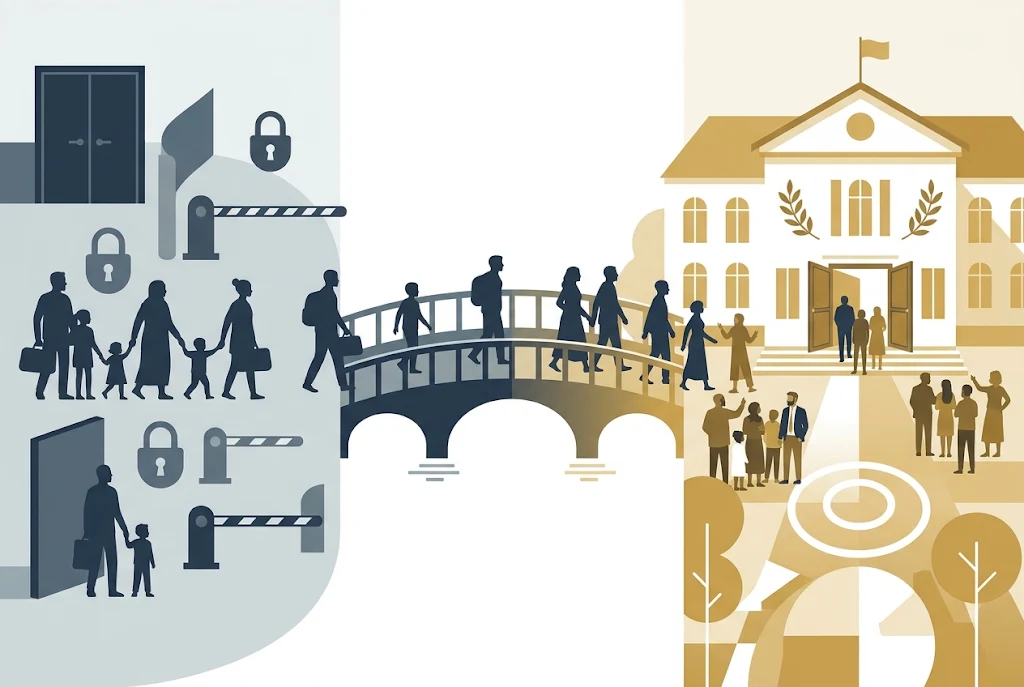
The human rights organization “Our House Centre for Human Rights and Relief” (“Our House”) has presented a position paper for the Congress of Local and Regional Authorities of the Council of Europe. The document records a systemic crisis in the legal protection of Belarusian citizens in Lithuania and proposes concrete municipal tools to overcome discrimination and the political monopolization of the diaspora.
Legal Status Crisis and “Secondary Migration”
According to official statistics from the Migration Department of Lithuania, between January 1, 2024, and November 1, 2026, the number of Belarusian citizens holding valid residence permits decreased by 23.9%—from 62,167 to 47,325 people. Moreover, over 90% of those remaining (42,643 people) hold only temporary permits, making them entirely dependent on repeated administrative checks.
According to the report’s authors, behind the dry figures of “population decline” lies a process of forced administrative pushback. In 2024 alone, for every Belarusian arriving in Lithuania, roughly two left the country (5,229 arrivals versus 9,885 departures). People who fled repression and do not support the war face a complex set of barriers:
-
Opaque “national security threat” assessments: Belarusian citizenship has effectively become a risk marker, and the grounds for denying residence permits or ordering deportation are not disclosed in sufficient detail to allow for an effective defense in court.
-
Cookie-cutter rejections for conscientious objectors: Young men (aged 18–27) who refuse to participate in militarization are denied asylum using copy-paste templates, ignoring the principle of non-refoulement and the real threat of persecution at home.
-
Banking exclusion: Widespread blocking of personal and organizational accounts deprives refugees of access to their own funds, including child and pension benefits, and paralyzes the work of human rights initiatives.
-
Invisibility of Belarusian children: Families face school bullying, linguistic stigmatization, and a lack of specialized support for children with disabilities, autism, or psychological trauma.
-
Persecution of whistleblowers: Human rights defenders document cases where Belarusian activists who publicly report corruption or abuses by local officials in the host country are subsequently labeled a “national security threat” and face deportation.
This overall systemic vulnerability is further confirmed by the international MIPEX 2025 index, which gave Lithuania’s integration policy a score of just 37 out of 100, and rated immigrants’ political participation at 5 out of 100.
Political Pluralism as a Guarantee of Human Rights
The report pays special attention to the institutional issue of representation. According to “Our House,” the practice developed over the past six years by European institutions of interacting primarily with a single political center (Sviatlana Tsikhanouskaya’s office) has rendered acute social and legal problems within the diaspora “invisible”.
Human rights defenders emphasize that no single political structure holds an exclusive mandate to represent all Belarusians in exile. Monopolizing access to resources, grants, and consultations creates corruption risks and leaves independent human rights, women’s, anti-war, and youth initiatives on the sidelines.
Practical Proposals for European Municipalities
“Our House” calls on the Congress of Local and Regional Authorities of the Council of Europe to move solidarity from declarations to concrete urban solutions, drawing on PACE Resolution 2499 and the “Luxembourg Solutions”:
-
Pluralistic municipal councils: Creating open advisory bodies with transparent selection, rotation, and the minority’s right to a dissenting opinion. Diverse groups must be represented—including critics of existing political centers and unaffiliated residents.
-
Independent “one-stop shop”: Establishing a municipal or competitively selected assistance service whose access does not depend on political loyalty or intermediary recommendations, ensuring full confidentiality of legal cases.
-
Emergency legal defense fund: Creating an inter-municipal mechanism for the urgent funding of lawyers and interpreters in cases involving threats of deportation, family separation, or account freezes, as well as for pursuing strategic litigation at the European Court of Human Rights (ECHR).
-
Whistleblower protection protocol: Introducing an independent review of any migration sanctions imposed on activists who report corruption in host countries, ensuring that criticism of authorities does not become grounds for expulsion.
-
Trilateral partnerships and child protection: Launching pilot projects between Belarusian organizations, Lithuanian cities, and municipalities in other Council of Europe member states to address school integration, women’s employment (such as the social enterprises “Bouquet of Peace” and “Cake of Peace”), and trauma care.
-
Training personnel for future democracy: Involving Belarusians in exile in the actual work of local self-government (participatory budgeting, election observation, mediation), viewing refugees not merely as aid recipients, but as a human resource for a future democratic Belarus.
The human rights organization urges the Congress to appoint a dedicated working group, hold open hearings with affected individuals, and present a public report in one year assessing real changes in the situation of Belarusians in exile.
Source: Report