




An analytical review of the political persecution of minors in modern Russia.

When, in the summer of 2020, 14-year-old teenagers from Kansk were arrested for putting up leaflets on a local FSB building, we were appalled by the callousness and cynicism of the Russian security forces, who were prepared to imprison eighth-graders for their political views. Alas, six years on, such incidents have become commonplace for Russia’s ‘law enforcement’ system. The full-scale invasion of Ukraine has finally given free rein to those keen to find enemies in every opposition-minded citizen, regardless of their age.
📌 Statistics and conclusions:
– We are aware of 427 cases of politically motivated criminal prosecutions of minors.
– 299 people under the age of 18 were deprived of their liberty.
– There are currently 107 children in custody.
– Whilst five teenagers were under investigation in new cases in both 2020 and 2021, the figure rose to 14 in 2022, 68 in 2023, 115 in 2024, and reached a record high of 184 criminal cases in 2025.
– Due to the closed nature of the hearings, the lack of media coverage and the intimidation of relatives, the names of the 243 minors involved in criminal cases remain unknown to this day.
– Of the total number of adolescents currently in custody, the vast majority are facing charges under particularly serious offences: 196 are charged with terrorism-related offences, whilst a further 85 face charges of sabotage.
– The use of ‘terrorism’ and ‘sabotage’ charges is deliberate: it is the only way to circumvent the legal restrictions of the Russian Criminal Code and send a teenager under the age of 16 to prison.
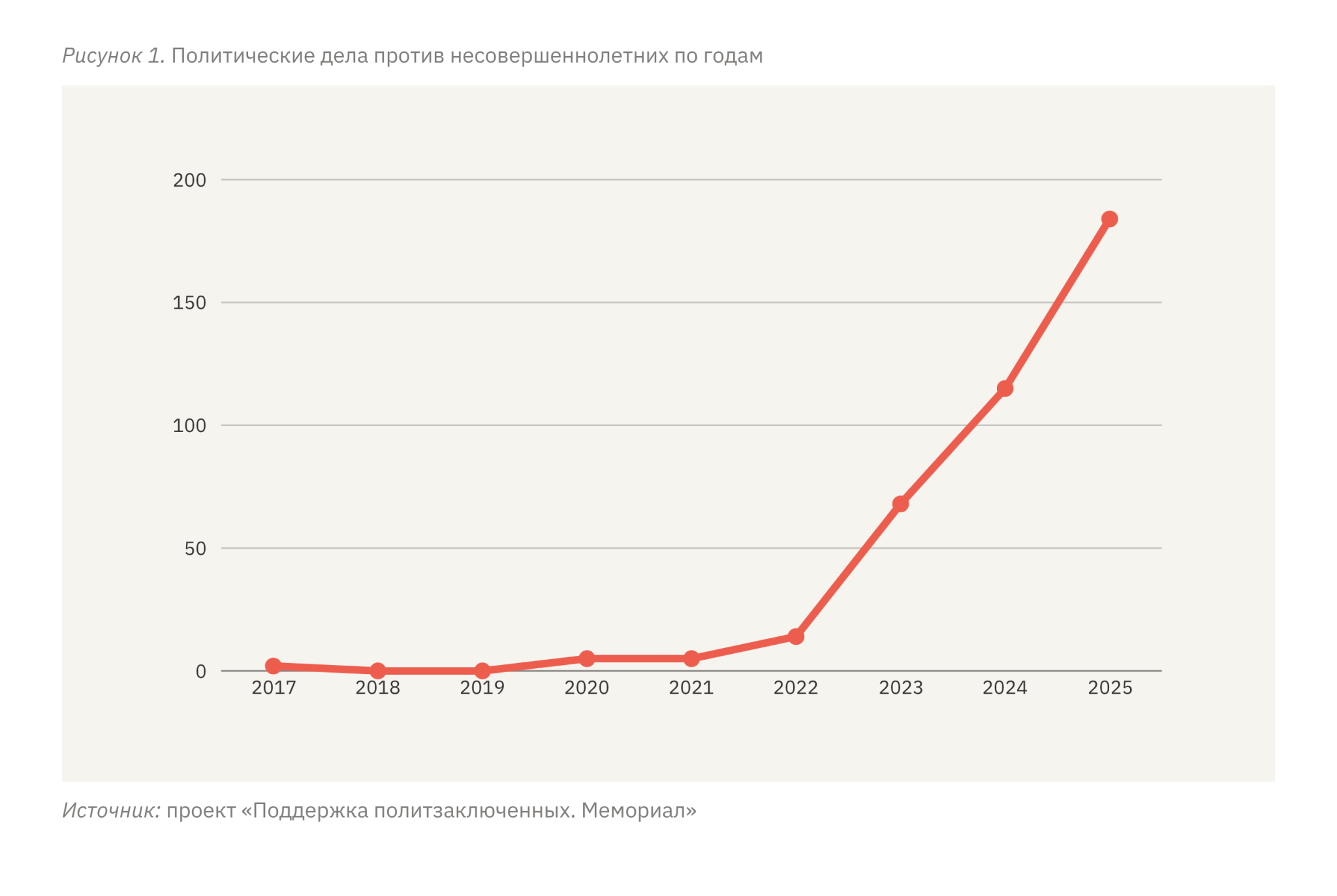
Legal proceedings against minors by year
– Current practice in the Russian Federation is entirely at odds with both the approach set out in the Resolution of the Plenum of the Supreme Court of the Russian Federation and the international instruments of the United Nations and the Council of Europe. International practice focuses on the rehabilitation and reintegration of children into society, viewing detention solely as a measure of last resort. In Russia, however, criminal cases have become a tool for the demonstrative intimidation of young people.
We call on the authorities of the Russian Federation to put an end to the practice of politically motivated unlawful persecution of children and adolescents and the intimidation of young people, as well as to practices involving provocation, pressure and a bias towards conviction during the investigation and court proceedings involving minors. We call for compliance with the provisions set out in the Resolution of the Supreme Court of the Russian Federation regulating the specific features of criminal liability and punishment of minors, as well as for due regard to the provisions of the Convention on the Rights of the Child (1989), the United Nations Standard Minimum Rules for the Administration of Juvenile Justice (the Beijing Rules, 1985), the Milan Plan of Action and the Guidelines on Crime Prevention and Criminal Justice in the Context of Development and the New International Economic Order (1985), the United Nations Guidelines for the Prevention of Juvenile Delinquency (the Riyadh Guidelines, 1990) and other official documents.
Source: memopzk.org
Leave A Comment