




Moldova: Deep Structural Human Rights Failures — Real Cases and Hard Evidence

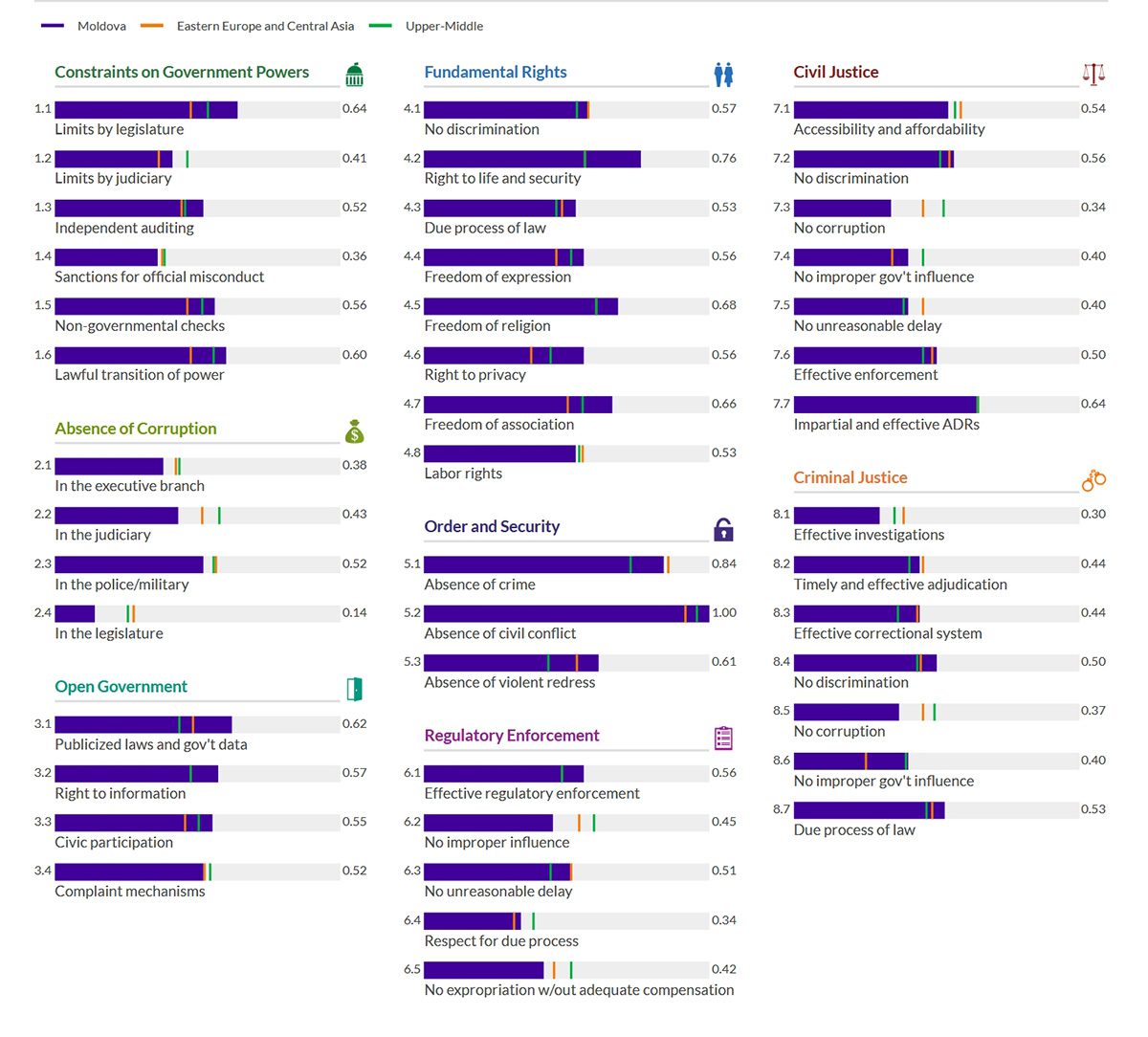
The latest Rule of Law Index data reveals a troubling paradox in Moldova. With an overall score of 0.53 and a global ranking of 68th out of 143 countries, the state formally recognizes many fundamental rights and maintains relative public order. Yet behind these figures lies a deeper structural failure: the state remains unable to effectively protect individuals from abuse, corruption, and injustice.
For human rights defenders, Moldova illustrates a familiar pattern seen across many transitional democracies — rights are codified, but accountability is weak, selective, or inaccessible.
Stability Without Justice Is Not Protection
Moldova scores relatively high in Order and Security (0.82). The country is free from armed conflict and large-scale political violence, and crime rates remain moderate. However, the absence of violence should not be confused with the presence of justice.
Human rights are not only violated through repression or war. They are violated when courts fail, investigations stall, and corruption determines outcomes. In Moldova, this “quiet” erosion of rights is systemic.
Corruption as a Human Rights Violation
One of the weakest areas is Absence of Corruption (0.37) — particularly within the legislature, executive authorities, and law enforcement.
Corruption here is not merely a governance issue; it is a structural human rights violation. It denies equal access to justice, disproportionately harms vulnerable groups, and creates a two-tier system where rights depend on resources or connections.
This is not an isolated failure. It reflects a system where corruption neutralizes legal remedies and leaves victims unprotected.
Criminal Justice: Impunity Over Accountability
Moldova’s Criminal Justice score (0.43) highlights serious deficiencies:
-
ineffective investigations,
-
undue delays,
-
political or administrative interference,
-
weak safeguards against discrimination.
This pattern contributes to systemic impunity, particularly in cases involving gender-based violence, police abuse, or politically sensitive actors.
Civil Justice: Rights Without Access
With a Civil Justice score of 0.49, Moldova demonstrates how socio-economic rights are often theoretical rather than enforceable.
Legal proceedings are expensive, slow, and difficult to navigate without professional assistance. Enforcement of court decisions remains weak.
In practice, the right exists — the remedy does not.
Fundamental Rights Under Conditional Protection
Moldova performs moderately in Fundamental Rights (0.61), including freedom of expression, association, and religion. However, these rights are undermined by weak institutional guarantees.
Freedom of expression survives — but at a personal cost.
The Core Problem: Institutions Fail the Individual
Across all categories, the data point to one central issue: the imbalance of power between the individual and the state. Courts lack independence, oversight mechanisms are fragile, and accountability is inconsistent.
For international observers, Moldova should not be seen simply as a “mid-ranking” country. It should be understood as a case study in how formal democratic structures can coexist with systemic rights insecurity.
What Must Change: A Human Rights–Centered Reform Agenda
From a human rights perspective, progress requires:
-
genuine judicial independence, not nominal reform;
-
anti-corruption measures that target high-level actors, not only low-ranking officials;
-
affordable and accessible justice for vulnerable populations;
-
protection for journalists, activists, and whistleblowers from legal and administrative harassment.
Without these changes, Moldova risks consolidating a system where human rights exist in law but fail in lived reality.
Moldova’s challenge is no longer legislative alignment or constitutional guarantees. It is implementation, accountability, and political will. Until institutions consistently protect individuals — especially those without power or privilege — the country’s human rights commitments will remain largely symbolic.
For the international human rights community, Moldova deserves close attention not as a success story, but as a warning: rights without enforcement are rights denied.
Despite formal commitments to human rights and membership in the Council of Europe, the Republic of Moldova continues to struggle with systemic violations of core human rights guarantees. Between 1997 and 2024, the European Court of Human Rights (ECtHR) found Moldova responsible for hundreds of violations — including denial of fair trial rights, ill-treatment and restrictions on liberty — highlighting pervasive institutional weaknesses in law enforcement, justice, and protection systems.
This in-depth article analyses concrete documented cases illustrating how rights, though guaranteed on paper, regularly fail in practice.
ECtHR: Regional Abuse in Transnistria — Illegal Detention, Inhuman Treatment, and Discrimination
In a landmark set of judgments delivered on 23 October 2025, the European Court of Human Rights confirmed serious human rights abuses against residents of the Transnistrian region — including illegal detention, inhuman or degrading treatment, and violations of freedom of movement and expression.
🔎 The Cases
-
Ilcenco v. Republic of Moldova and Russian Federation (App. no. 40836/15) — Serghei and Nicolae Ilcenco, journalists critical of de-facto authorities, were detained and harassed for their work; Sergei suffered degrading treatment and confiscation of professional equipment.
-
Vardiașvili v. Republic of Moldova and Russian Federation — Wrongful detention and ethnically discriminative expulsion from Dubăsari, with forced separation from family.
-
Ahmetșin v. Republic of Moldova and Russian Federation — Conviction and imprisonment by unrecognized “Transnistrian courts” despite annulment by Moldovan authorities; detention conditions were found inhuman.
-
Mustea v. Republic of Moldova and Russian Federation — Petru Mustea was held in pre-trial detention for months without legal basis, in degrading conditions.
👉 In all four cases, the ECtHR held the Russian Federation responsible for multiple violations of the European Convention on Human Rights (including Articles 3, 5, 8, 10 and 13) and ordered over €100,000 in compensation for victims.
Although Moldova was not found legally responsible in these specific judgments — because the abuses occurred in a territory outside effective state control — the rulings underline a protection vacuum affecting Moldovan citizens and residents and highlight the urgent need for safeguards even in uncontrollable regions.
📌 Source text on the Netflix-like complexity of these cases is available here:
🔗 Promo-LEX summary of ECtHR judgments in Transnistria: https://promolex.md/en/echr-confirms-serious-human-rights-abuses-in-the-transnistrian-region-in-four-cases-won-by-applicants-assisted-by-promo-lex/
I.C. v. Republic of Moldova — Failure to Protect a Vulnerable Woman from Exploitation
In I.C. v. Republic of Moldova (judgment delivered 27 February 2025), the ECtHR found that Moldovan authorities failed to protect an intellectually disabled woman from forced labour and sexual abuse after she was removed from state care and placed with unauthorised guardians.
Key Findings:
-
Authorities did not take effective measures to prevent exploitation.
-
Investigations into the woman’s allegations were inadequate and lacked follow-through, violating the right to freedom from inhuman or degrading treatment (Article 3), prohibition of forced labour (Article 4), and the prohibition of discrimination (Article 14).
-
The court emphasised that failures were exacerbated by systemic gaps in protective services and absence of mechanisms for vulnerable persons.
👉 This case exemplifies how disability-based discrimination and institutional neglect intersect to produce serious human rights violations.
Freedom of Expression Limitation — Mătăsaru v. Republic of Moldova
In Mătăsaru v. Republic of Moldova (ECtHR, 15 January 2019), the European Court found a violation of Article 10 (freedom of expression) where Moldovan police and courts imposed criminal sanctions on peaceful protest expressions against corruption.
🔎 Case summary:
The applicant staged a one-hour peaceful demonstration with symbolic statues representing officials. Police halted the protest and the applicant was later criminally convicted for “obscenity” — a disproportionate interference with free expression according to the ECtHR.
This case is widely regarded as emblematic of disproportionate limitations on political expression and suppression of dissent.
Systemic Trends: Moldova Among Top States for Human Rights Violations
The sheer scale of ECtHR rulings against Moldova underscores systemic problems. Between 1997 and 2024, the court determined that Moldova committed more than 800 violations of the European Convention on Human Rights, with:
-
~31% involving the right to a fair trial;
-
~24% involving torture and ill-treatment;
-
~13% involving right to liberty and security.
These figures put Moldova among the countries with the highest number of ECtHR violation findings per capita in the Council of Europe, indicating deep and persistent structural failures.
What These Cases Tell Us
The cases above paint a consistent picture:
-
Failure to effectively investigate and protect victims of exploitation, abuse, and discrimination;
-
Instances of disproportionate curtailment of freedoms, especially speech and protest;
-
Structural accountability gaps in justice and protection systems;
-
A troubling lack of remedy or deterrence at the national level, necessitating recourse to international mechanisms.
Human rights protections on paper are insufficient without enforceable, effective, and accessible remedies — a lesson illustrated repeatedly by ECtHR judgments against Moldova and related jurisdictions.
Conclusion: Rights Without Protection Are Rights Denied
The evidence from the European Court of Human Rights shows that Moldova’s legal framework often fails its citizens and residents when it matters most. Structural gaps in judicial independence, law enforcement accountability, and access to justice allow violations to recur with limited domestic redress. Real lives are affected — from journalists persecuted for expression to vulnerable individuals denied even basic protection.
For the international human rights community, the message is clear:
Formal commitments are only as good as their enforcement mechanisms. Where those mechanisms fail, people suffer — and justice must be demanded at every level.
Leave A Comment