



Fact-checking tools and practical methods for exposing disinformation
How to learn to distinguish the real fact from manipulation
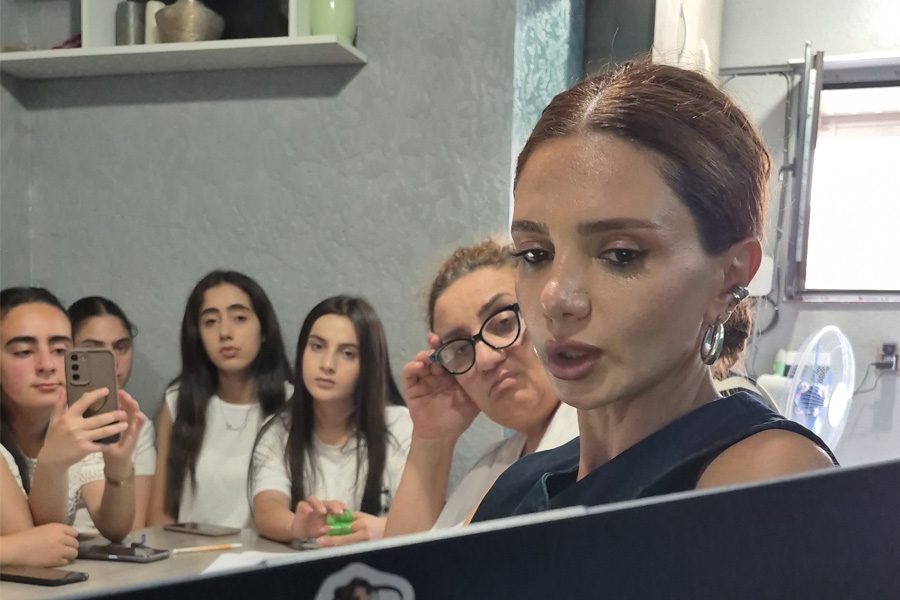 The modern information environment creates unprecedented opportunities to obtain, disseminate information, and participate in public debate. However, the same environment has also become a platform for the rapid spread of disinformation, manipulative messages, and fake content .
Photos, videos, “urgent” announcements, health tips, and various contests are shared on social networks every day, which at first glance may seem trustworthy. The course “Fact-checking tools and practical methods for exposing disinformation” conducted by Ani Sukiasyan , an expert at the International Human Rights Society (IHRS) NGO, was dedicated to this challenge . The goal of the course is to teach young people and participants interested in media literacy through practical examples how to check information and avoid manipulation.
When a real photo becomes fake information
The first practical example of the course concerns photos being circulated with false context . Participants are presented with a photo of a large queue on the street and the caption, “Today in Artik, people queued for hours for bread.” The first question is not “Is it true or false?” but “How would you check? ”
During the discussion, it is suggested to use Reverse Image Search , Google Lens , as well as news websites and community pages. As a result of the verification, it turns out that the same photo was previously published in another country and about a completely different event. The conclusion is very important: the photo may be real, but the context in which it is presented is false . This is one of the most common forms of disinformation, since most people tend to trust visual content.
A sensational headline is not yet a fact.
The next example shows how panic-inducing messages are spread on social networks, for example, “all banks in Armenia are closing tomorrow, quickly withdraw your money.” As part of the training, participants discuss what the right first step is when seeing such a post.
The correct response is:
- check the official announcements of the Central Bank ,
- compare information with reliable media publications,
- Do not spread unverified news.
This example helps to understand an important principle: an emotional and hasty headline cannot be considered evidence . Misinformation is often built on people’s fear and uncertainty.
“Doctors are hiding…” – a classic sign of manipulation
The course also pays special attention to false health advice . An example is a WhatsApp message that claims that “doctors hide it, but a glass of warm water with lemon every morning cures all diseases.”
Participants learn to spot the typical expressions of manipulation:
- “all diseases”,
- “Doctors are hiding”
- “Spread it quickly.”
Such formulations are not the language of scientific information. They are used to gain people’s trust and spread information quickly. The important message of the course is that any health claims should be verified by professional and official medical sources .
The danger of images created by artificial intelligence
The spread of AI-generated images is also growing in the modern media environment . During the course, participants are shown examples of such images and are asked to find suspicious details on their own. The most common signs are:
- wrong number of fingers,
- disproportionate ears,
- the distorted background,
- the strange shadows.
However, Ani Sukiasyan emphasizes a very important point: modern AI images are often so realistic that judging by appearance alone is not enough . It is necessary to combine visual observation with other verification methods: studying the source, publication history, and additional searches.
Fake contests and identity theft
Fake contests are also common on social media , which are used to collect personal information. The course discusses an example circulating on Instagram, where a well-known brand promises a large cash prize and requires you to click on a link and send it to your friends.
Participants learn to pay attention to the following signals:
- the page is not official,
- The internet address is strange,
- required to disseminate the publication,
- Personal information is required.
Such exercises are especially important for young people, as digital fraud is often presented as a “profitable opportunity.”
Video verification, from details to actual location
One of the most sophisticated forms of disinformation is videos taken out of context . In the practical part of the course, participants are offered a video circulating on Telegram, which is claimed to have been filmed “in Armenia today.”
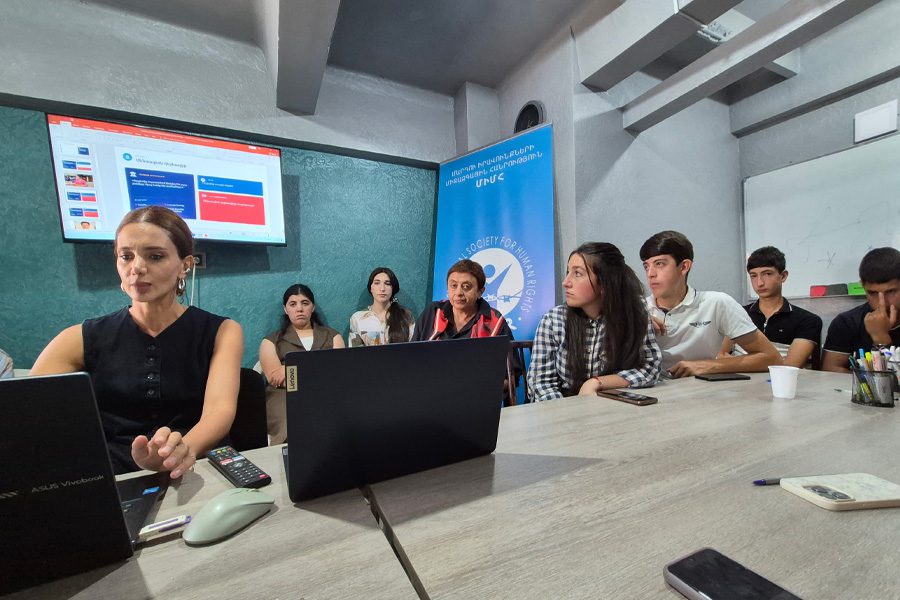
Attention is paid to detail during the inspection.
- car license plates,
- road signs,
- on shop signs,
- weather conditions,
- the language of conversation.
This method shows that sometimes even small details can reveal the true origin of a video and prove that it was filmed in another country or during another time period.
“What if you were a journalist…”
One of the most active parts of the course is a journalistic simulation game. Participants are asked to imagine that they are a journalist, have received a photo and must publish it immediately . Then, they discuss what steps should be taken before publishing.
The steps suggested by the participants include:
- check the source,
- contact the scene of the incident,
- compare with other sources,
- check the photo,
- check the date,
- find an official comment.
This exercise develops responsible journalistic thinking and helps to understand that speed should never take precedence over accuracy.
The main message of the course
The end of the article emphasizes that the goal of such practical seminars is not to “catch mistakes ,” but to create a fact-based and responsible information culture . For the effectiveness of the lecture, it is recommended to use real or prepared examples for training purposes so that participants can immediately apply the presented tools.
Media literacy as a public safety skill
Ani Sukiasyan’s course shows that media literacy has long been no longer just a professional skill for journalists. Every citizen who uses social networks, shares publications, or receives information from online platforms should be able to:
- be suspicious of overly sensational claims,
- check the origin of photos and videos,
- distinguish an official source from a fake page,
- understand the main signs of manipulative language,
- Be responsible in disseminating information.
Thanks to this practical approach, the course becomes not only theoretical training, but also practical experience that participants can immediately use in their daily lives, during their studies, in their journalistic activities, and in the community information environment. It is precisely such initiatives that contribute to strengthening the culture of information resilience, critical thinking, and fact-based public communication in Armenia .
The material was prepared within the framework of the Disinformation Flows Monitoring Project
#CivilSocietyCooperation #ishrarmenia #ishrfactcheck
The project is implemented with the financial support of the Federal Foreign Office of the Federal Republic of Germany.

I help businesses build a measurable customer-growth system using SEO, Google Ads, Meta Ads, conversion optimization, and AI-powered automation.
I’m not here to tell you that what you’re doing today isn’t working. My approach is to build on what’s already working, identify new opportunities, and create a system designed to bring in more qualified prospects, convert more of them into customers, and increase revenue.
AI and automation can also help streamline repetitive tasks such as lead capture, follow-ups, customer communication, reporting, and other workflows — giving your team more time to focus on the business.
My focus over the next 6 months would be simple:
More qualified opportunities → More customers → More revenue → Better efficiency
I’d be happy to take a quick look at your current online presence and share a few specific growth opportunities I see for your business.
If you’re open to a conversation, I’d be glad to connect.
Best Regards
Ajay thakur