



20 arguments in favour of peace from human rights activists
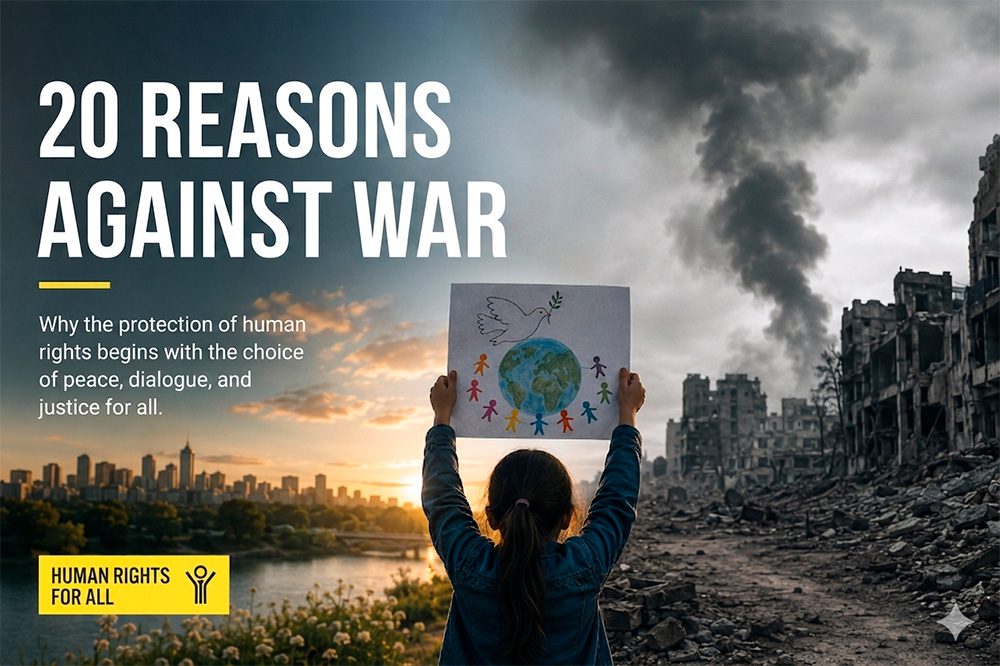
Armed conflict remains one of the gravest threats to human dignity, human rights, and global stability. Across regions and political systems, war leaves behind destruction that extends far beyond the battlefield — affecting civilians, institutions, communities, and future generations.
Preventing war is not only a political objective. It is a humanitarian and human rights imperative.
1. War destroys civilian lives
Civilians increasingly bear the burden of modern armed conflicts. Families lose loved ones, communities are displaced, and entire populations are forced to live under constant threat of violence.
2. Essential infrastructure is devastated
Hospitals, schools, power stations, water systems, and residential areas are often damaged or destroyed during hostilities. The collapse of civilian infrastructure creates long-term humanitarian suffering even after fighting ends.
3. Humanitarian crises escalate rapidly
Armed conflicts frequently trigger food insecurity, disease outbreaks, shortages of clean water, and limited access to healthcare. Vulnerable populations are affected first and most severely.
4. Millions are forced to flee their homes
War drives displacement on a massive scale. Refugees and internally displaced persons often face unsafe conditions, poverty, discrimination, and limited legal protection.
5. Psychological trauma lasts for generations
Exposure to violence, loss, and instability can result in severe and lasting mental health consequences, including post-traumatic stress disorder, anxiety, and depression.
6. War deepens poverty and inequality
Conflict destabilizes economies, destroys livelihoods, interrupts trade, and reduces access to education and employment. Recovery can take decades.
7. The environment suffers irreversible harm
Military activity contaminates land and water, damages ecosystems, and contributes to long-term environmental degradation that affects both human and ecological health.
8. Violence fuels hatred and division
War intensifies ethnic, religious, and political tensions. Cycles of revenge and mistrust can continue long after ceasefires are signed.
9. Cultural heritage is lost
Historic sites, archives, museums, and cultural institutions are often destroyed during armed conflict, erasing irreplaceable parts of humanity’s shared heritage.
10. Peaceful solutions exist
Diplomacy, mediation, international law, and dialogue provide alternatives to violence. Sustainable peace is built through negotiation, accountability, and cooperation — not military escalation.
11. Human rights violations increase during conflict
Armed conflicts are frequently accompanied by arbitrary detention, torture, enforced disappearances, sexual violence, and attacks against civilians.
12. Children pay a devastating price
Children in conflict zones are deprived of safety, education, healthcare, and stability. Many face exploitation, displacement, or recruitment by armed groups.
13. Escalation risks global catastrophe
In an interconnected world, local conflicts can rapidly expand across borders, increasing the risk of regional instability and the use of weapons of mass destruction.
14. War often weakens democratic freedoms
Governments may use conflict as justification for censorship, surveillance, restrictions on civil liberties, and suppression of dissent.
15. Societies become polarized
War divides communities and erodes trust between citizens, institutions, and nations. Rebuilding social cohesion after conflict is an immense challenge.
16. Public resources are diverted from human needs
Funds allocated to military operations are resources not invested in healthcare, education, housing, climate resilience, or social protection.
17. Conflict enables organized crime and corruption
War zones often create conditions in which trafficking, arms smuggling, corruption, and exploitation flourish with limited accountability.
18. Violence becomes normalized
Prolonged exposure to conflict can weaken social norms against violence and undermine respect for human life and the rule of law.
19. Future generations inherit the consequences
The effects of war do not end when fighting stops. Young people inherit damaged institutions, economic instability, trauma, and weakened social systems.
20. Global cooperation becomes more difficult
Armed conflict undermines international trust and diverts attention from shared global challenges such as climate change, public health, and sustainable development.
A Human Rights Commitment to Peace
Protecting human rights requires more than responding to crises after they occur. It requires sustained commitment to conflict prevention, accountability, international cooperation, and the protection of civilians.
Peace is not simply the absence of war. It is the presence of justice, dignity, security, and human rights for all.


Leave A Comment