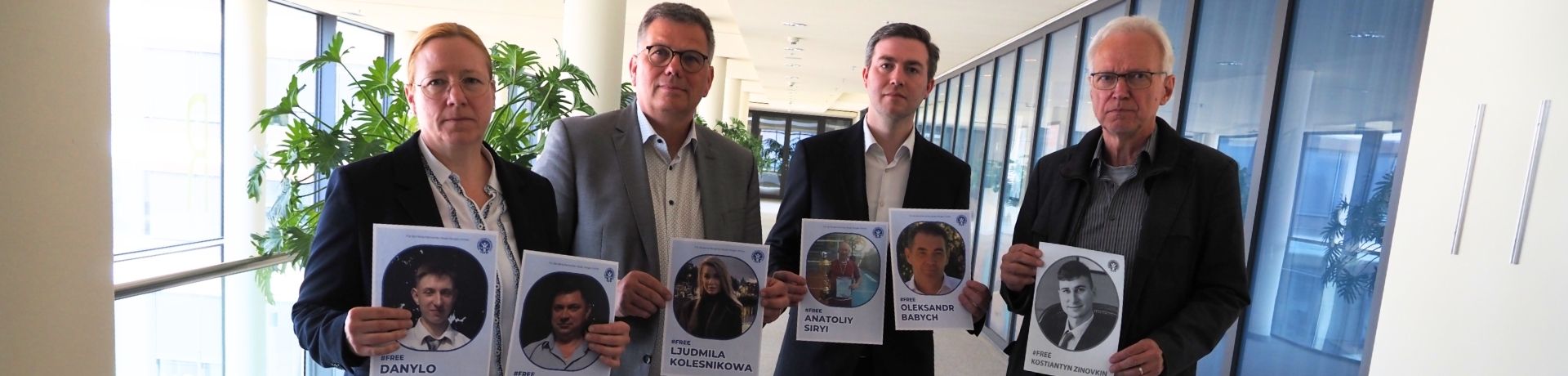
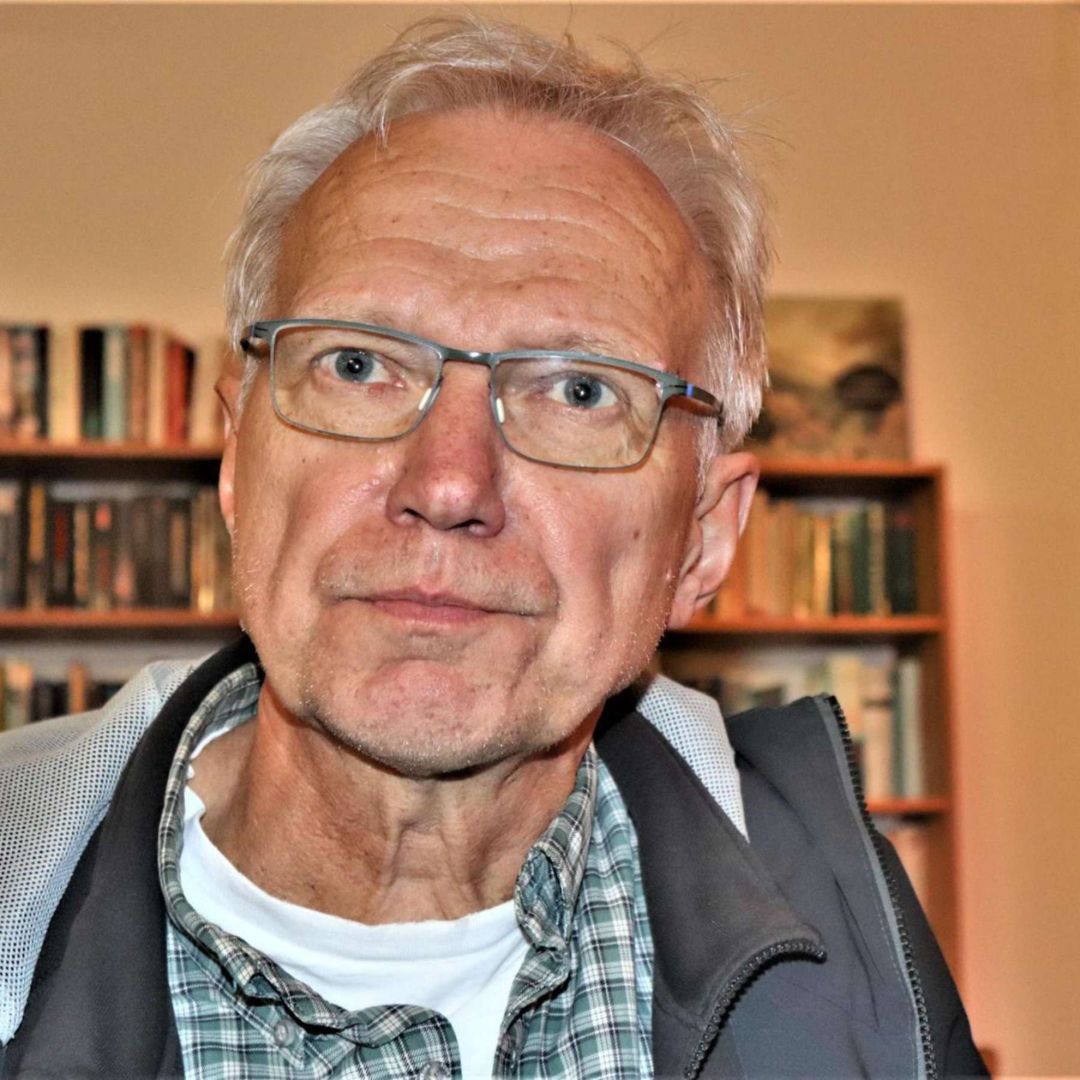
Gerhard Keller, ISHR member and board member of the initiative “Truth Fighters – Portraits of Murdered and Persecuted Journalists”:
Dear Mayor Becher,
Dear Members of the German Bundestag, Ms Schmidt and Mr Bouffier,
Thank you for taking the time despite your very busy schedules.
My thanks also go to our host, Mr Becher, for allowing us to be here today in the town hall and for the good and straightforward cooperation, including with Ms Weber, who manages his office.
I had invited other politicians as well, whom I was able to win over for a political sponsorship: Mr Steinraths (Member of the State Parliament, CDU), Felix Döring (Member of the Bundestag, SPD) and Ayşe Asar (Member of the Bundestag, Greens). Even though these three are unable to be here today due to other commitments, I would like to thank them warmly in their absence. I am especially grateful to Mr Steinraths. He was the first politician from Central Hesse to take on a political sponsorship for an abducted Ukrainian civilian, at the end of 2024.
Artem Kryvulia is taking part in this press briefing as a guest. Born in Zaporizhzhia in Ukraine, Mr Kryvulia has been active as a human rights and anti-corruption activist since 2016. He has been living in Germany since 2022. Mr Kryvulia studied Conflict Studies and Peacebuilding at the University of Osnabrück and now works in the Eastern Europe Department of the ISHR.
Russia’s assault on Ukraine continues unabated and, because of other wars and crises around the world, risks fading into the background.
Abducted civilians from Ukraine
The abduction and imprisonment of Ukrainian civilians is one of the most urgent issues of Russia’s war of aggression against Ukraine. According to reports, more than 16,000 Ukrainian civilians, including around 2,000 people over the age of 65, have been abducted and are being held in prison camps in Russia or in the occupied territories. The exact number remains unclear.
They are held in inhuman conditions. They are poorly fed, denied medical care and sleep on the floor. In some cases, they are bitten by rats while sleeping. Some civilian detainees return from captivity with serious injuries, broken bones and concussions, and report physical, sexual and psychological abuse.
Since 2009, the International Society for Human Rights (ISHR) has initiated more than 300 political sponsorships. For decades, the ISHR has carried out case-based work and advocated for political prisoners around the world. It has sections in 48 countries worldwide.
Why do political sponsorships help?
International attention protects and saves lives. Even torture states such as the Islamic Republic of Iran, Russia or the People’s Republic of China want to maintain an outward appearance of legality. Germany is an exceptionally important political and economic country for these states. Experience shows that these countries pay very close attention to developments that concern them.
In the past, the efforts of politicians on behalf of many of the prisoners supported have led to significant improvements: the commutation of death sentences into prison terms, a substantial reduction in arbitrary prison sentences, an end to ill-treatment and sometimes even release.
Kostiantyn Litvinov released
The Ukrainian research engineer Kostiantyn Litvinov was imprisoned by Russian soldiers in March 2022 during the war of aggression against Ukraine. He taught as a university lecturer at Volodymyr Dahl East Ukrainian National University and was a presidium member of the Council of Young Scientists.
On 3 January 2024, he was released as part of a prisoner exchange together with 229 other Ukrainian prisoners.
Martina Feldmayer, a Green Party member of the state parliament, had taken on a political sponsorship for Litvinov in cooperation with the ISHR. In November 2023, she had sent open letters calling for the release of Kostiantyn Litvinov to the following individuals:
Sergey J. Nechayev, Ambassador of the Russian Federation to the Federal Republic of Germany
Tatyana Moskalkova, Russian Ombudswoman, the so-called “Human Rights Commissioner”
Dmitry Kuznetsov, Member of the Russian State Duma
To what extent the release was connected to these three open letters cannot be determined with certainty. However, there is much to suggest that they may have played a role, including the close timing.
Example: Russian teenager Arseniy Turbin
In June 2024, he was sentenced to five years in prison. At the time, he was 15 years old. His offence was distributing anti-Putin leaflets in the letterboxes of his neighbourhood.
Michael Brand (CDU), the Federal Government Commissioner for Human Rights and Member of the Bundestag, was at least able to secure some easing of prison conditions for Arseniy Turbin through his sponsorship.
With the help of the International Society for Human Rights (ISHR), Arseniy’s mother, Irina Turbina, was able to move from her hometown in western Russia to Perm in order to support her son Arseniy.
My view
The worst thing that can happen is for these people to be forgotten. We are here in a democracy. We have the opportunity to stand up for others and we risk nothing in doing so. I would also like to tell you why I am so deeply committed to abducted Ukrainian civilians and why this matter is so close to my heart.
It has to do with this young Ukrainian woman. Her name is Liusiena Zinovkina. She is the wife of Kostiantyn Zinovkin.
At the beginning of the war, Liusiena was in Kyiv and her husband was in their hometown of Melitopol in south-eastern Ukraine. As Zinovkina said: “It was very frightening and nothing was clear, but my husband said, ‘We must double our chances. If we are in different places, at least one of us will definitely survive.’ Kostiantyn stayed in our hometown because he did not want to leave his elderly mother and grandmother after her stroke.”
In May 2023, he was abducted from Melitopol by the Russian army.
He is a civilian, a peaceful person. He is not a soldier and has no military background.
In November 2024, I invited Liusiena Zinovkina to Giessen to give a talk. She arrived in Giessen at midday and the lecture took place in the evening. We spent the whole afternoon and evening together. That time together deeply moved and impressed me. We talked a great deal and Liusiena showed me wedding photos of herself and her husband Kostiantyn.
She is a slender, delicate and gentle person, yet at the same time courageous and energetic. I am grateful that I had the opportunity to meet her. I promised her with a handshake that I would work for abducted Ukrainian civilians, including her husband. I am keeping that promise.
Liusiena appears in public, including internationally, for example at human rights congresses and in the European Parliament. She speaks German very well and lives and works in Berlin. She is therefore also known to the Russian government. Unknown people ring her doorbell at night and wake her from her sleep.
The representatives of the families of the Kremlin’s civilian hostages, of missing and unlawfully convicted Ukrainian civilians, ask that Russia’s war crimes against the Ukrainian civilian population be made public. They ask those politically responsible in Germany to help them find a mechanism for the return of their beloved husbands and fathers. They ask for political sponsorships for abducted civilians in Russian wartime captivity.
Please forgive me if at this point I also speak in support of the International Society for Human Rights.
I have been a member of the ISHR for years and I consider this work infinitely important. Without the ISHR, this sponsorship programme and much more besides would not exist.
The fate of thousands of civilians remains unclear. The ISHR is in contact with families and is working for their release.
Dear Ms Schmidt, dear Mr Becher and dear Mr Bouffier, I would be very pleased if you were able to encourage other elected representatives to become sponsors through political sponsorships.
They are very welcome to get in touch through me.