




YSU is holding a conference dedicated to the history of Azerbaijan: what really happened?
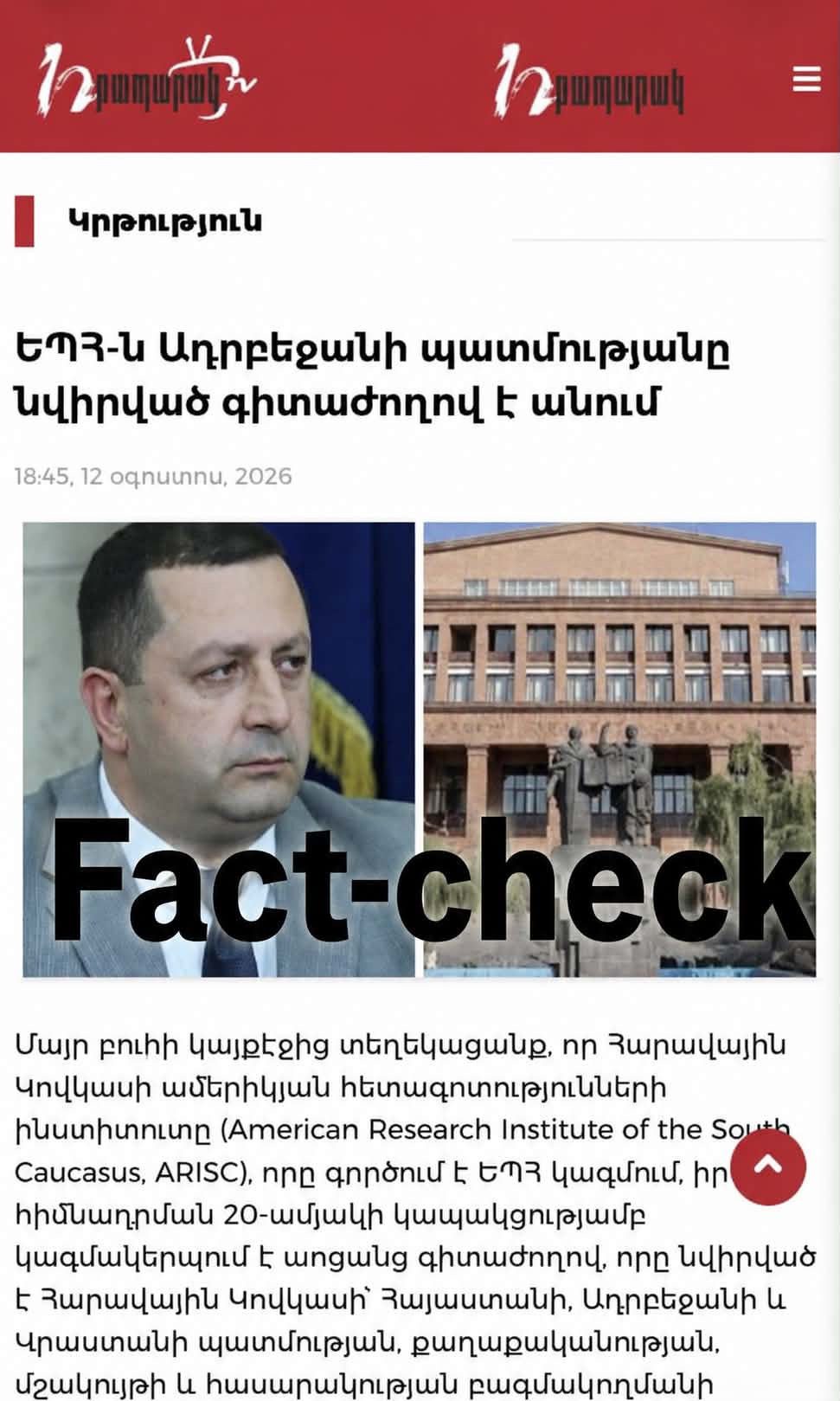 On August 12, 2026, at 6:45 PM, the “Hraparak” website published an article titled “YSU is holding a conference dedicated to the history of Azerbaijan.”
The article began with a conference report published on the YSU website. Within a few hours, it also appeared on the pages of other news outlets, mostly with the same title and almost the same content.
At first glance, the story seemed simple: Yerevan State University (YSU) was organizing a conference on the history of Azerbaijan. However, checking the sources shows that the real picture is significantly more complicated.
The question is: what did YSU actually announce, who was organizing the conference, what was it dedicated to, and how was that information presented to the public?
What did YSU publish?
The announcement published on the YSU website states that the American Research Institute of the South Caucasus (ARISC) is organizing an online conference dedicated to the 20th anniversary of its founding. The conference is scheduled for September 17–19, 2026.
The conference theme is formulated quite clearly in the announcement: it concerns the history, politics, culture, and society of the South Caucasus, with a special focus on Armenia, Azerbaijan, and Georgia. The announcement also states that applications for participation can be submitted by lecturers, independent researchers, graduate students, and undergraduate students.
In other words, there is no wording in the original source that the conference is dedicated only to the history of Azerbaijan. Moreover, in the YSU statement, it is presented as a conference organized by ARISC. YSU acts merely as the platform where the invitation to participate was published.
And who is ARISC?
ARISC (the American Research Institute of the South Caucasus) is an American research organization whose official website describes it as an independent, non-profit American Overseas Research Center. The organization is engaged in supporting scientific research on Armenia, Azerbaijan, and Georgia and has representatives in Yerevan, Baku, and Tbilisi.
According to the organization’s official data:
-
It was founded in 2006 and received 501(c)(3) non-profit organization status in the United States in 2007.
-
ARISC is a member of the Council of American Overseas Research Centers and an affiliate organization of the Association for Slavic, East European, and Eurasian Studies.
The official ARISC website lists 2026 as the organization’s 20th anniversary year. The organization’s published list of events includes the same conference titled “Celebrating 20 Years of ARISC: Approaches and Directions in the Study of the South Caucasus,” scheduled for September 17–19 in an online format.
These data are important for one reason: they show that this is not a newly created initiative or one created for a specific political purpose. ARISC is a research organization that has been operating for years, and its geographical scope of activity is precisely the South Caucasus.
And what did “Hraparak” write?
 In an article published on August 12, Hraparak initially correctly reported part of the conference statement, noting that it referred to the history, politics, culture, and society of Armenia, Azerbaijan, and Georgia.
However, the title was formulated as “YSU is holding a conference dedicated to the history of Azerbaijan.” Here the first significant problem arises.
The official description of the conference refers to the entire South Caucasus, while the title singles out only Azerbaijan and at the same time links the conference directly to YSU. This is not a complete denial of the fact, since the topic of Azerbaijan is indeed included in the framework of the conference. However, it changes the emphasis: the reader can understand from the title that YSU organized an event specifically dedicated to the history of Azerbaijan. The original source does not say this.
And who is the organizer?
Hraparak wrote that ARISC “operates within YSU.” In a clarification issued on August 14, YSU denied this claim, noting that ARISC is not a structure within YSU, but an independent American non-profit research organization.
To confirm this claim, we checked not only YSU’s explanation, but also ARISC’s official sources. They present ARISC as an independent non-profit organization and as an American Overseas Research Center. On the organization’s official website, YSU is not presented as the structure within which ARISC operates.
Therefore, the formulation “ARISC operates within YSU”, at least when compared with ARISC’s own official description, is not confirmed.
Let’s understand why YSU published the statement
Here too, two things must be distinguished: organizing the event and publishing the announcement about it.
The material published on the YSU website is titled “Invitation to Online Conference: American Research Institute of the South Caucasus.” The text directly states that ARISC is announcing the online conference dedicated to its 20th anniversary. In other words, the presence of the announcement on the YSU website does not in itself mean that YSU is the organizer of the conference. This is exactly the point where the wording of a news release can change the perception of the original information.
Political commentary and speculation
After providing information about the conference, the Hraparak article moves on to political commentary. The article describes YSU as a “structure affiliated with the Communist Party of Armenia,” and the actions of Rector Hovhannes Hovhannisyan are presented as an attempt to “get in the eye” of the authorities. The conference is also linked with the promotion of “pro-Azerbaijani ideas.”
However, the article does not provide documents or other verifiable evidence for these claims, which would show that the reason for organizing the conference is the political interests of the authorities or that it was organized to defend Azerbaijan’s political positions.
Therefore, here we are no longer dealing with factual information of the same level, but with political interpretation and speculation.
It is particularly important that the presence of a study of Azerbaijani history or culture at a conference does not in itself prove support for Azerbaijani policy. The topic of a scientific event can be any country, conflict, or political process. Being the subject of study and defending political positions on that subject are not the same thing.
YSU’s Response
On August 14, YSU officially responded to the publication of Hraparak. The university announced that it was not organizing a conference dedicated to the history of Azerbaijan, and simply published an invitation to participate in an online conference organized by ARISC on its website.
YSU also highlighted the actual thematic scope of the conference: the history, politics, culture, and society of the South Caucasus. The university presented the political part of the statement as speculation rather than facts, raising the issue of spreading speculation.
Thus, YSU’s response was effectively an attempt to return the story to the full context of the original source. But by then, the story had already spread.
Media Dissemination Chain
On August 12, after the publication in Hraparak, the same material appeared on the websites of a number of other news outlets. With an open search, we found at least the following publications or reprints:
-
Yerkir (August 12, at 8:18 PM): Published the same story titled “YSU is holding a conference dedicated to the history of Azerbaijan.”
-
Hayeli.am (August 12, at 8:42 PM): Disseminated the article with the same title, citing Hraparak.
-
ArmDay (August 12, at 8:51 PM): Republished the same article, citing Hraparak.
-
Yerevan Today (August 12): Shared the same story, again with a link to Hraparak.
-
Newszone: Republished the Hraparak article with the same basic wording.
-
Iravunk (August 13): Published the article, citing Hraparak.
-
Azg (August 13): Published the Hraparak article.
-
Verelq (August 13): Published the same story with a link to Hraparak.
-
Lrahos: Published an article with the same title, citing Hraparak.am.
In total, an open search identifies at least nine pages distributing the same content in addition to the original Hraparak article. This does not mean they all prepared their own journalistic material; on the contrary, in a number of cases, the publications openly state that the material was taken from Hraparak.
How did the dissemination mechanism work?
This case illustrates a fairly common mechanism of the information chain:
-
The first news outlet publishes a headline with strong political overtones.
-
Other websites pick up the same material, often without separately checking the original source.
-
As a result, the same claim appears on different websites.
The reader gets the impression that “several news outlets wrote the same thing.” But in reality, it is not the confirmation of nine independent journalistic sources, but rather the multiple reprinting of one original publication.
This distinction is especially important when fact-checking: if ten websites share the same information, but all link to one original publication, we are actually dealing not with ten independent confirmations, but with the multiplication of one unverified or disputed claim.
Which part is real and which is misleading?
In this story, it is important not to go to the extremes of “everything was a lie” or “everything was true.”
The Facts:
-
Real: ARISC is organizing a conference dedicated to its 20th anniversary in 2026.
-
Real: The topics of the conference include Armenia, Azerbaijan, and Georgia.
-
Real: An invitation to participate in that conference was published on the YSU website.
The Misleading / False Claims:
-
Unconfirmed / Misleading: The representation that the conference is exclusively dedicated to the history of Azerbaijan.
-
False: The presentation that ARISC is a structure within YSU. ARISC’s own website presents it as an independent American non-profit research center.
-
Unsubstantiated Speculation: The claims that YSU is a “structure affiliated with the Communist Party,” that the rector “enthused” the authorities, and that he was promoting “pro-Azerbaijani ideas” through the conference are political assessments without sufficient factual substantiation.
Conclusion
The most important problem with this story is not just one misstatement—it is the change in context.
The initial statement spoke about the history, politics, culture, and society of three countries in the South Caucasus. The news headline separated only Azerbaijan from that broad topic and linked it directly to YSU. Then, a political commentary was added, and the same material was disseminated by other news outlets. As a result, the story that reached the reader became sharper and more political than the original fact.
Did the publication’s title and political conclusions reflect the full content of the original source? The answer is not entirely. The conference actually exists, Azerbaijan is included in its scope, and YSU published an invitation on its website. But it does not follow that YSU organized a conference exclusively dedicated to the history of Azerbaijan, nor that it was organized to advance “pro-Azerbaijani” policy.
Sometimes a misleading story is not created from a completely fabricated fact. It can be constructed by selecting, emphasizing, and presenting real facts out of context. To mislead the reader, it is not necessary to completely change reality—it is enough to change what is put in the foreground. This story brought to the fore a “conference dedicated to the history of Azerbaijan,” while the original source was about the study of three countries in the South Caucasus.
Journalist: Sargis Asatryan
The material was prepared within the framework of the Disinformation Flows Monitoring Project

#CivilSocietyCooperation #ishrarmenia #ishrfactcheck
The project is implemented with the financial support of the Federal Foreign Office of the Federal Republic of Germany.
Source: ishrarmenia.am
Leave A Comment