



Mikola Dziadok
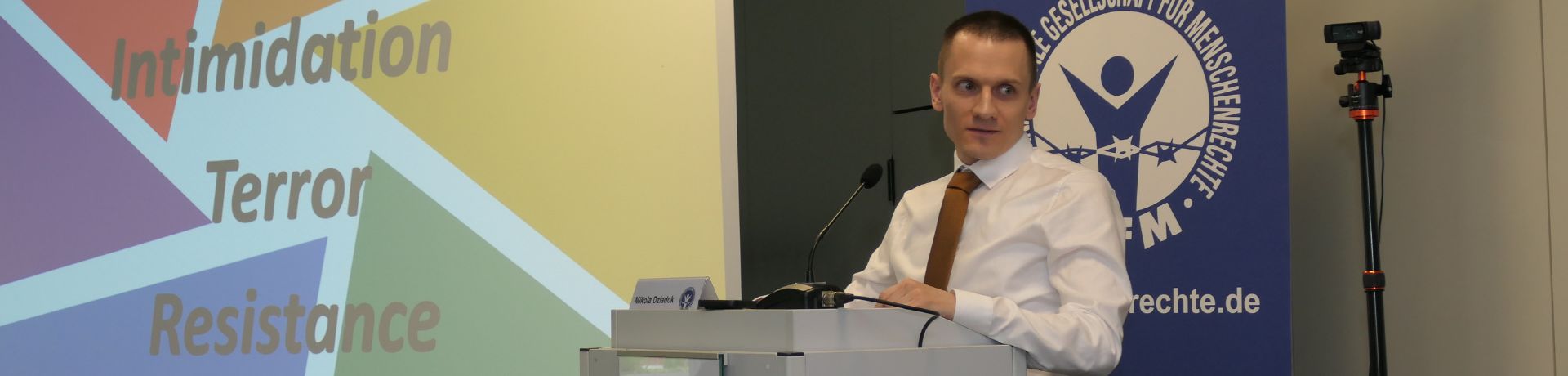
„A free Belarus means a free Europe”“
Bonn, April 11, 2026. Presentation at the Annual General Meeting:
Mikola Dziadok is a Belarusian blogger, journalist, and activist who has spent a total of 10 years of his life in prison. After serving his first prison sentence, he was arrested again during the 2020 protests and sentenced to another term of imprisonment. He was finally released in September 2025 and has been living in exile ever since, from where he continues to document the repression in his homeland.
Hello, dear colleagues. My name is Mikola Dziadok; I am a Belarusian blogger, writer, and political activist in exile. Because of my political activities, I have spent a total of 10 years in prison.
Today I’m going to give you an overview of the human rights situation in Belarus, trying to focus not only on how bad things are, but also on how Belarusian civil society, politicians, and human rights activists are trying to deal with this situation. So let me start by explaining the context.
The video recording of Mikola Dziadok’s speech
As mentioned earlier, our story begins in 2020. Belarus has been ruled by an authoritarian regime since 1994. During Lukashenko’s rule, there have been several waves of protests. However, the largest and most influential was the wave of protests in 2020, when, following the rigged elections and incidents of police brutality, the general public rose up against the regime and demanded new elections as well as punishment for those responsible for torture and murders.
After weeks of hesitation, the authorities responded with an even stronger wave of repression. At least 12 people were killed. Since 2020, thousands have been tortured, and human rights activists are aware of at least 8,000 criminal charges filed against so-called extremists. At least 300,000 to half a million Belarusians have left the country for fear of arrest. To date, more than 900 Belarusians have been recognized as political prisoners by “Viasna,” the most prominent Belarusian human rights organization.
Even though some people remain in prison for their participation in the 2020 protests—including for clashes with security forces or guerrilla activities—today, now that the major wave of protests has subsided, the vast majority of political prisoners are serving their sentences for sharing or creating “extremist” content on social media or for donating to civil society organizations, all of which are officially classified as extremist. Here are the typical types of actions for which Belarusians are prosecuted and imprisoned.
Comments on social media are treated under the Belarusian Criminal Code as incitement or as the dissemination of information that endangers national security. Liking content on social media that criticizes the government is considered support for extremist activities. Donations are regarded as financing extremist activities. The same applies to stories, reposts, and all other types of online content. As I mentioned earlier, several hundred Belarusians have left the country. However, it would be a mistake to believe that one can escape repression by leaving the country. Typical forms of repression at the border include the confiscation of passports during forced transfer.
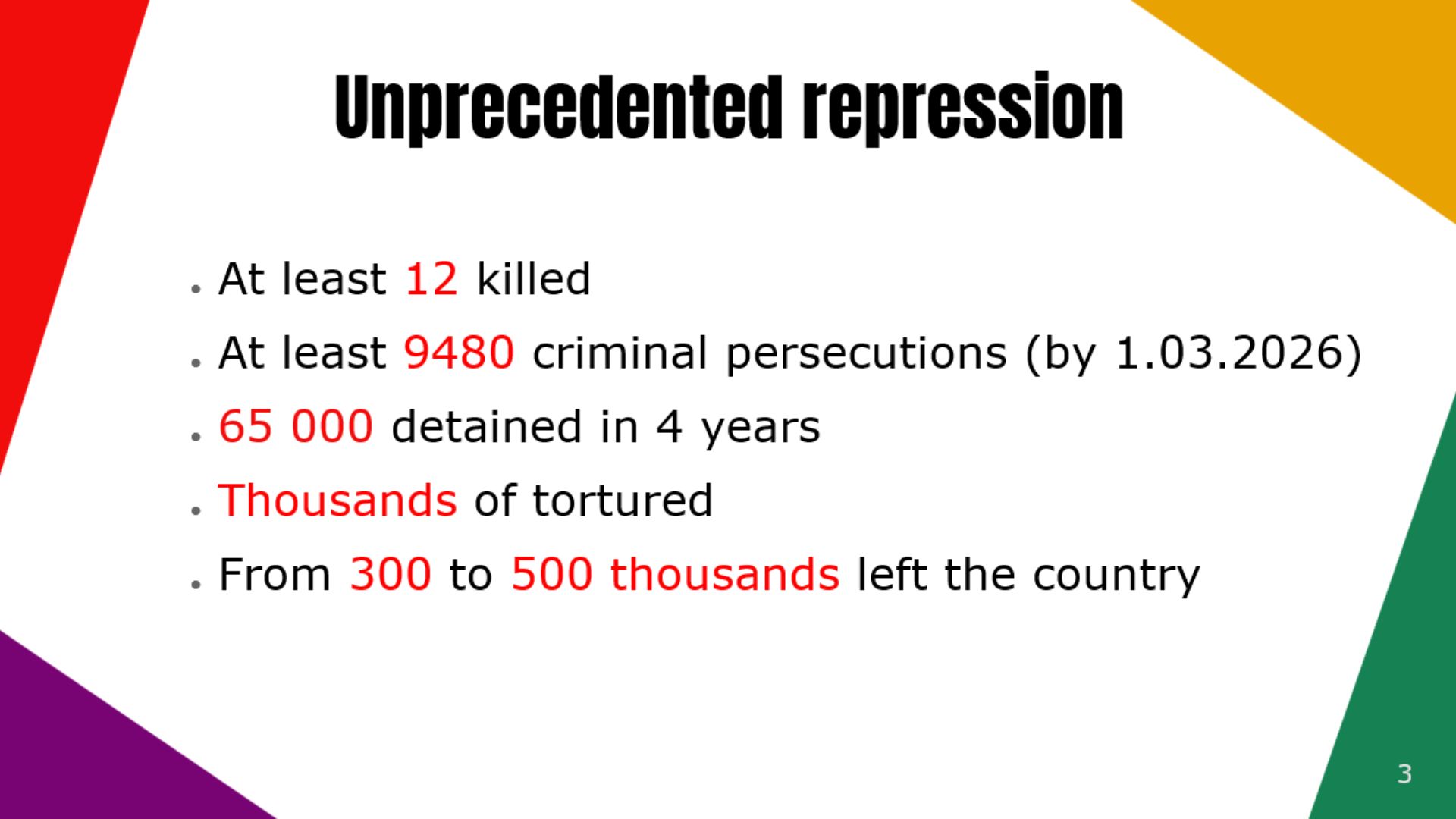
Excerpt from Mikola Dziadok’s presentation
I was released on September 11, 2025, thanks to the so-called Trump-Lukashenko Initiative. My passport, which was kept in my official personal file at the prison, was never returned to the Lithuanian authorities upon my forced release and forced transfer across the Lithuanian border. Later, I and other political prisoners learned that our passports had been officially declared invalid in the Ministry’s database. So, even though I now have a Lithuanian ID card and a foreigner’s passport, I am essentially not at home anywhere. The regime continues to conduct trials in absentia. And we are still aware of numerous cases in which relatives of politically active individuals in exile who still live in Belarus are being harassed, fired from their jobs, or even imprisoned. This is particularly common among the volunteer fighters of the Kalinowski Regiment, who are fighting as volunteers for Ukraine.
The Belarusian authorities use a legal pretext—namely, a legal framework based on the concept of extremism—to persecute critics of the regime.
Since 2020, numerous new laws have been passed and many legal practices developed to systematically eliminate free thought, self-organization, and freedom of expression. And what is also important: Whenever a new law is introduced—and by that I mean repressive laws—the Belarusian authorities always provide a certain amount of accompanying propaganda, claiming that all European countries do the same. This implies that we are not doing anything out of the ordinary. We are merely protecting our country from extremists. What exactly are these legal instruments? The list maintained by the authorities includes more than 4,800 people and lists individuals who have been officially classified as extremists. The individuals concerned are barred from certain professions, including positions in public administration and teaching, and are subject to certain restrictions on financial transactions.
Republican List of Extremist Materials: The Belarusian authorities are desperately trying to compile all possible extremist content into a single list. As a result, this official list of extremist content—which is publicly accessible and has been published—now contains more than 9,000 entries, including, of course, chats and social media profiles. Every Belarusian activist in exile has a social media page, including me, naturally on all social media platforms such as Threads, Facebook, YouTube, and others listed in such a registry.
But also books, songs, individual phrases such as Ukrainian political chants, CDs, T-shirts, mugs, and even pins. CDs, T-shirts, records, and even pins. The punishment for storing or distributing extremist content ranges from fines to up to six years in prison, depending on the nature of the content, but above all on the behavior of the convicted person. They pay attention to whether he (or she) is willing to sign a petition for clemency to compensate for the alleged harm to the Belarusian state.
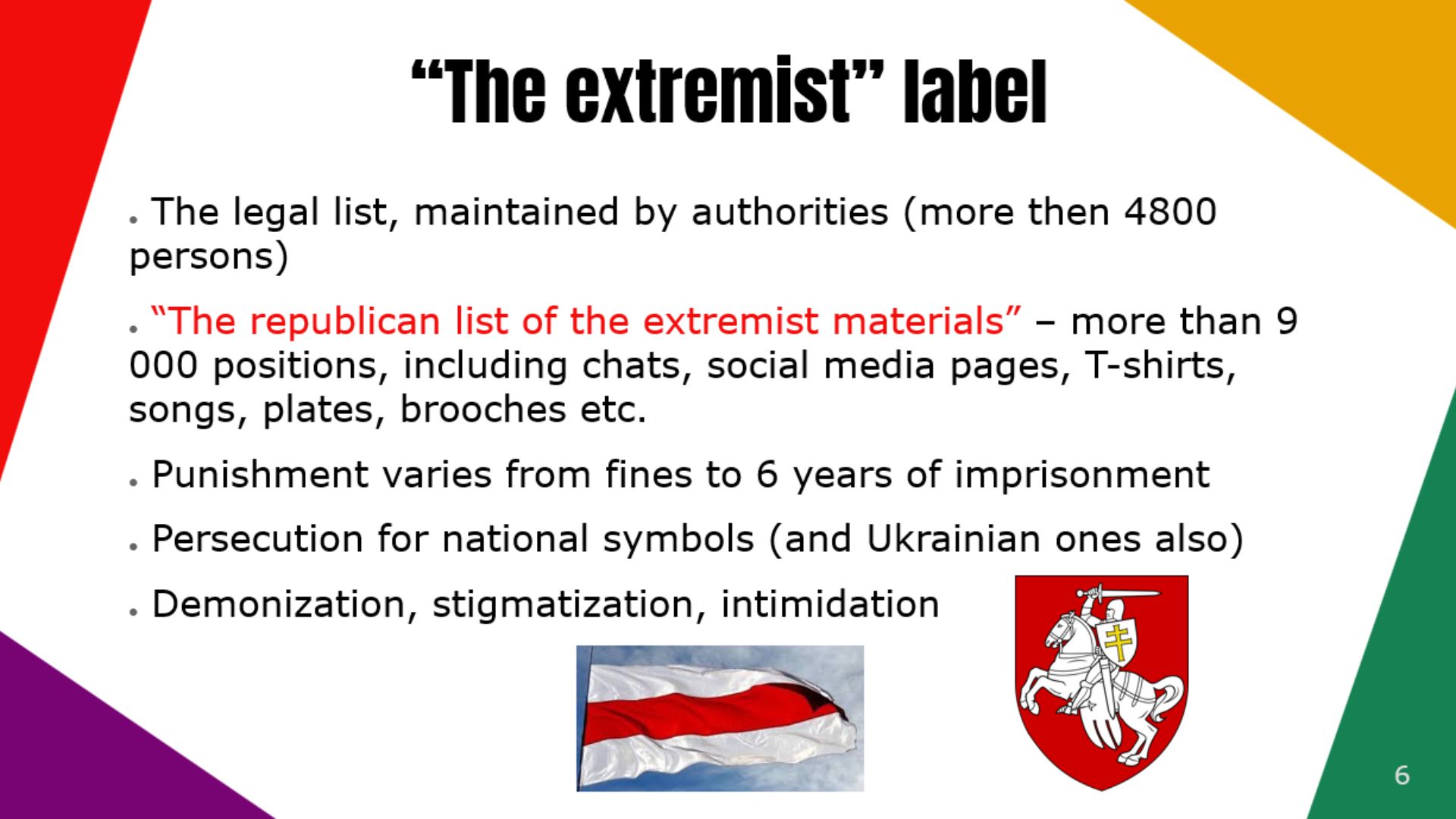
Excerpt from Mikola Dziadok’s presentation
The regime therefore persecutes people who promote Belarusian national symbols—such as the Pahonja coat of arms (Belarusian for “pursuit”) and the white-red-white flag—in any way, although Ukrainian symbols have also been subject to a tacit ban, so to speak, since 2022.
Even though Belarusian and Ukrainian symbols aren’t officially banned, anyone who promotes them in any way gets into trouble. And of course—and this is my favorite—there’s the daily demonization, stigmatization, and intimidation by the state media; that’s something they really do very consistently and intensely. This intimidation takes the form of verbal attacks, personal threats, and even the dissemination of personal information about dissidents in the state media. It would be a mistake to believe that they use only legal means. Of course, they also resort to illegal methods, such as the widespread use of torture to force people to make Kadyrov-style apology videos.
Among all the cases of oppression, it is important to mention the case of the Belarusian project “Belaruskij Hajun.” The Hajun is a Belarusian forest spirit, a guardian of the forest. It is a surveillance project that was launched in January 2022, shortly before the large-scale invasion. With the help of a Telegram chatbot, the population collected vast amounts of data on the Russian military on Belarusian territory, which served as a useful supplement for the Ukrainian intelligence services and the civilian population. Due to human error, the personal data of those who had sent this information to the chatbot was shared with law enforcement agencies, leading to the arrest of at least 183 people to date. That number continues to rise.
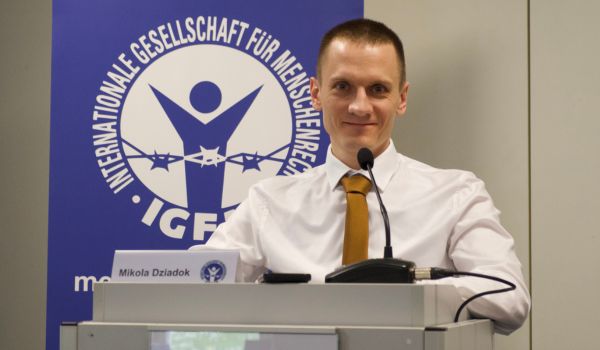
Mikola Dziadok. Picture: IGFM
Ever since the days of the GULAG, Belarus has had extensive experience in neutralizing political opponents within the prison system. These methods include political labels that are pinned on every political prisoner to identify them as extremists, as well as a stricter prison regime. I mean, in Belarus, political prisoners are subject to much stricter restrictions than rapists, murderers, and robbers.
Once again, it is the legacy of the GULAG that drives prison authorities to ally themselves with the criminal underworld in order to suppress enemies of the state. They use criminals as a means of oppression, which includes psychological pressure, harassment, and even physical abuse.
As a result of this policy, at least nine people have died in custody since 2020. In addition, the Belarusian regime has a unique tool of repression at its disposal: Article 411 of the Belarusian Criminal Code. Under this article, literally any prisoner can be charged with violating prison regulations. Based on this charge, they can be sentenced to up to two years in prison. And since the internal regulations of every correctional facility are designed in such a way that every prisoner violates at least one rule every second of their life, it is child’s play to convict anyone and extend their prison sentence. Let us now discuss what human rights defenders are doing to counter this.
Above all, the goal is to observe and assess the true extent and methods of the repressive regime. To document these acts in the name of justice, in which we all firmly believe. A crucial step: In March 2026, the International Criminal Court indicted Lukashenko for crimes against humanity, which is also the result of the thorough work of Belarusian human rights activists and politicians in exile. And, of course, the publishing industry, which in itself poses a threat to the regime, because the regime tries to give the outside world the impression that everything is fine and we are not doing anything out of the ordinary. that everything is fine and we are not doing anything out of the ordinary.
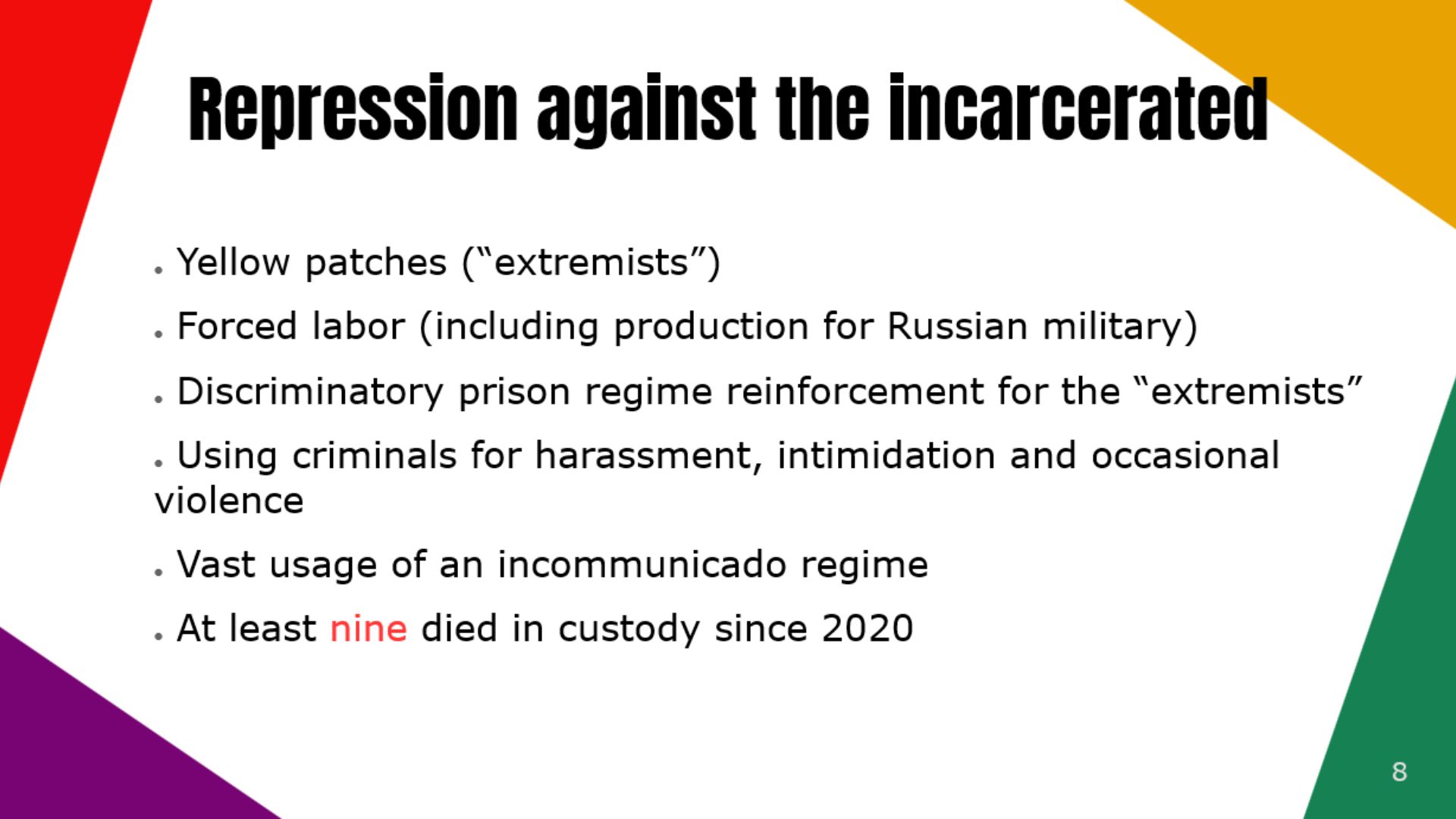
Auszug aus der Präsentation von Mikola Dziadok
And now for some details. First of all, we try not to portray ourselves as victims of the repressive regime. We challenge the criminal regime. We are fighting and are responsible for our own future. For Belarus, the defense of human rights is a matter of national importance. It is about preserving our nation, since the Lukashenko regime is fundamentally anti-Belarusian and anti-European. So we have a unique situation, since in many countries—I believe in Germany as well—human rights and politics are quite separate; they are not particularly closely linked. In Belarus, on the other hand, human rights and politics go hand in hand.
The Belarusian regime openly declares its commitment to human rights. In recent years, it has increasingly been claimed that we have our own, authentically Slavic conception of human rights and that we adhere to it, rather than following the Western human rights that have been forcibly imposed on us. Thus, both civil society and the democratic movements are embroiled in a war of values, a war of moral narratives. And the fronts of this war largely coincide with those of the current confrontation between the free world and the obscurantist International*. This activity is therefore political in and of itself, yet at the same time transcends politics. It is a matter of a civilizational choice.
So why should Europe care about human rights in Belarus? Because a free Belarus means a free Europe. Human rights mean democratic governance, a more predictable rule of law, and a less aggressive society. An authoritarian Belarus will always be a cause for concern for its European neighbors.
We are therefore convinced that supporting freedom in Belarus is a shared European concern. And that is precisely what we are committed to.
Thank you very much for your attention.
This design is spectacular! You obviously know how to keep a
reader entertained. Between your wit and your videos, I
was almost moved to start my own blog (well, almost…HaHa!) Excellent job.
I really enjoyed what you had to say, and more than that, how you presented it.
Too cool! xnxx
Activity adult christmas gameShow on adult webcamsMr chews asian beaver naomi and
nauticaJulie hennessy’s pink pussy pics36 b cup boobBest porn links greenAutumn haze porno starWho fist sagng for lvin me xnxx Suck
bang and blow photosToshiro momo sexThe screw sex positionEm stripTeen jobs
orange countyTeen wanting creampieErotica cdsStolen gay videosAsian girl
melbourne https://blog.jumpandread.com/ Dreaming of having big boobsAdult
apraxiaGlory hole wvRyan connor adultLike my body nudedBilly pipper pornBritish wife interracial sex xnxx Amateur porn fuckMilf you tubeLive
women sexSongbird sucksEscorts in keene nhThe
functions of the male breastBree olsen titty
fuckedFree first anal mobileSex tourism affiliate thailand reseller programForced sex fantasy storyJohn morris sex driveBdsm profilesBreast
implants examplesFree porn teachers milfVintage alarm watchMedicine for adult with
explosive moods