



Oleksandra Matviichuk

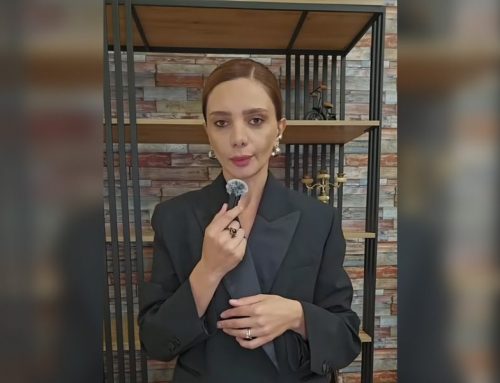
Oleksandra Matviichuk, Ukrainian human rights lawyer, reports by video at the 54th Annual Conference of the ISHR in Bonn in April 2026 on the systematic documentation of war crimes and the dramatic situation of the Ukrainian civilian population.
“We must break the cycle of impunity”
Bonn, 11 April 2026
Dear colleagues, distinguished participants, ladies and gentlemen,
My name is Oleksandra Matviichuk. I am a human rights lawyer. I document war crimes in this war that Russia has launched against Ukraine. It is an honour to speak before this audience.
When the war broke out, we joined forces with dozens of organisations from different regions. We built a nationwide network of local documenters. We travelled across the whole country, including the occupied territories. And by working together, we have documented more than 100,000 war crimes.
The video-recorded speech by Oleksandra Matviichuk
While this war turns people into mere numbers, we give them back their names. Because people are not numbers. And every single life matters.
I would like to illustrate this with one story. This is the story of a 62-year-old civilian, Oleksandr Shalipov. He was killed near his home. This tragedy triggered enormous media interest because the Russian soldier was arrested and it was the first trial since the beginning of the war. In the courtroom, I heard his wife Kateryna. His wife Kateryna said that her husband was an ordinary farmer. But he was her whole world. She told the judge that she had now lost everything.
That is the meaning of justice. That we investigate what happened to an ordinary farmer in a small village in my country. We do this regardless of who these people are, what their social position is, what kind of crime they suffered and whether the media or international organisations are interested in their case. Because every single human life matters. All these atrocities that we are witnessing in Ukraine are the result of complete impunity that Russia has enjoyed for decades.
Russia committed terrible crimes in Chechnya, in Moldova, in Georgia, in Mali, in Libya, in Syria and in other countries around the world. Russia was never punished. They believe they can do whatever they want.
We must break this cycle of impunity. We must ensure justice. Not only for the people who have already suffered from Russia’s war, but also to prevent another attack on yet another country.
Ironically, Trump’s year of peace negotiations became the deadliest year for the Ukrainian civilian population. According to the UN, the number of civilians killed and injured rose by 31% compared with the previous year. There is a reason for this: we have lost sight of the human dimension in political affairs. In recent months, we have heard a great deal about natural minerals, Russia’s territorial claims, geopolitical interests and even Putin’s vision of Ukrainian history. But we do not hear much about people. And that is not right.
We still do not know what is happening to the tens of thousands of Ukrainian children who were separated from their families and illegally deported to Russia, sent to Russian re-education camps where they are told that they are not Ukrainians but Russian children. They are told that their family, that their parents, rejected them and that they will be adopted by Russian families who will raise them as Russians.
What will happen to the tens of thousands of illegally detained Ukrainian civilians, men and women, as well as prisoners of war who are subjected to brutal torture and sexual abuse?
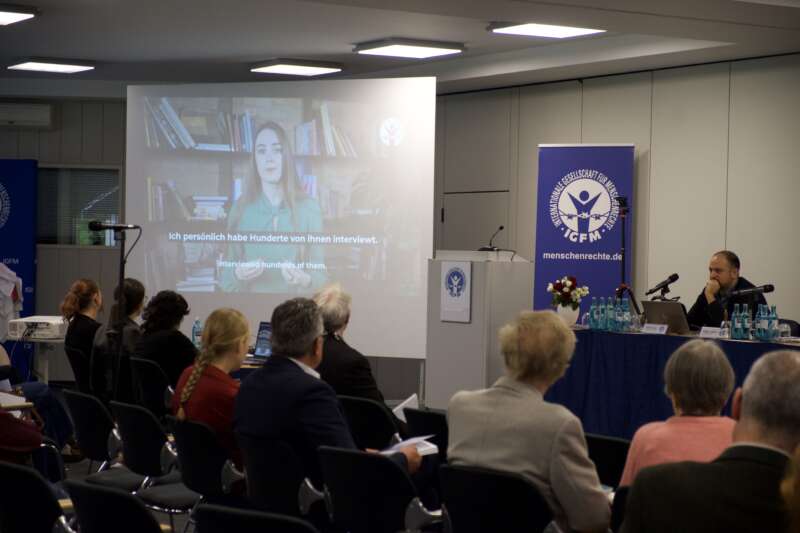
Oleksandra Matviichuk at the 2026 Annual Assembly / Photo: Sajedeh Jalali (ISHR)
I personally interviewed hundreds of them. They told me how they were beaten, raped, locked in wooden boxes, how their fingers were cut off, their nails twisted outward and pierced. One woman told me how her eye was gouged out with a spoon. Given these details, it is clear to me that some of these people have no chance of staying alive until the end of the peace negotiations.
When politicians discuss occupied territories, they talk about them as if they were empty land. But I am sorry. These territories are not empty. Millions of Ukrainians are living under Russian rule in the grey zones. They have no means to defend their rights, their freedom, their property, their lives, their children or their loved ones.
And Russian occupation is not simply a change from one state flag to another. Russian occupation means enforced disappearance, torture, rape, denial of identity, forced adoption of one’s own children, filtration camps and mass graves. That is what Russian occupation means. We must return the human dimension to the political process. Without the human dimension, we will never find a path to sustainable peace.
The most important lesson we have learned from all these tragedies is this: the people have power. We are used to thinking in categories of great powers, states and intergovernmental organisations. But ordinary people have a far greater influence than they can even imagine. Quite ordinary people can achieve extraordinary things and change history.
Our future is not only uncertain. It is also not predetermined. And hope is not a guarantee that everything will turn out well. Hope contains the confidence that all our efforts are of great importance.
Thank you, dear colleagues.
Leave A Comment