



Kevin Lick

Kevin Lick, the youngest prisoner in Russia to be convicted of “high treason”, speaks about the dangers of political indifference and state repression, which he experienced firsthand. Despite psychological torture and imprisonment, he now uses his freedom to draw attention to the fate of the more than 1,500 political prisoners who remain behind bars and to fight against collective forgetting.
Bonn, 11 April 2026. Speech at the Annual Assembly:
Thank you very much for the invitation.
It is not something to be taken for granted that someone as young as I am — a pupil, a secondary school student without an academic title — is invited to such an event.
Before I begin, I must admit that I do not even know where to start. I could speak for hours. And although I am here because of my young age, I am not an isolated case in Russia. Many young people have been convicted and imprisoned.
For me, this responsibility does not lie with myself, but with the people who are still imprisoned in Russia. According to Memorial, there are currently officially more than 1,500 political prisoners, in addition to many who are not recognised as such. There are more than 1,900 cases of high treason, more than 10,000 abducted Ukrainian civilians and more than 25,000 abducted children.
That is why I would like to begin with a question: Why are we so forgetful?
I experienced this forgetfulness myself. I moved to Russia when I was twelve and at that time I barely spoke Russian. My mother and I agreed to speak only Russian. I maintained my German through academic competitions.
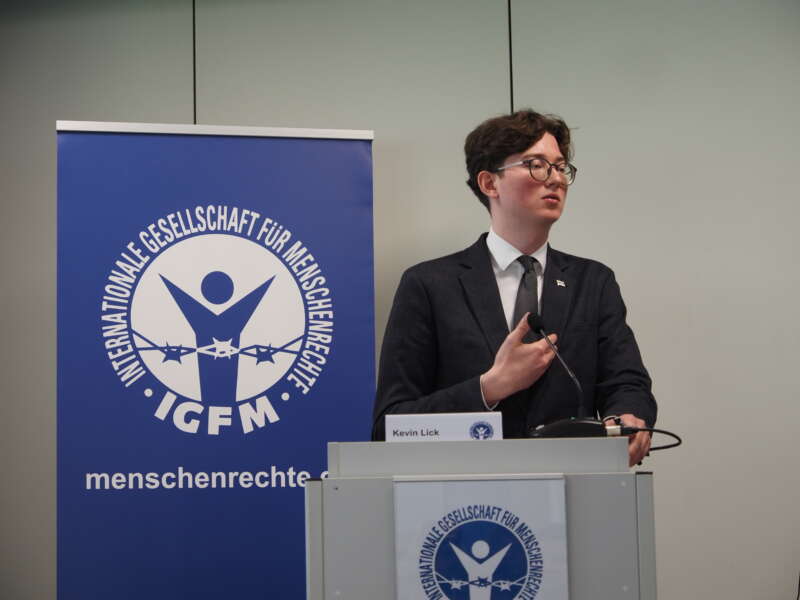
Kevin Lick. Photo: Artem Kryvulia (ISHR)
At school, I was insulted as a “fascist” because of my background and my accent. That led me to engage more deeply with history.
I still see this forgetfulness today.
I am catching up on my Abitur and I see how little many of my classmates are interested in world events. Recently, one classmate showed the Russian flag and anthem in a presentation.
After the beginning of the war in 2022, we had to stand every Monday at the flag ceremony for the national anthem. The same happened every day at 6 a.m. in the labour camp.
Forgetfulness is dangerous. Many current developments have historical parallels, even if they are not identical.
My own story began with a seemingly small incident: at school, I had replaced the portrait of Putin with one of Alexei Navalny. Shortly afterwards, my mother was called to the school. The deputy headteacher asked me what I had against corruption and whether I would not act just like Putin myself.
Later, I found out that she had denounced me to the FSB.
I lived with my mother in a prefabricated apartment block. From our windows, I could see a military park. At the end of 2021, I took photographs of it out of interest, as a kind of documentation. These photographs contained no state secrets, which was later also confirmed.
Nevertheless, I was sentenced to four years in prison for high treason.
After my arrest, we were taken to the FSB. There, an investigator told me that he knew everything about me, including the portrait incident. That showed me how closely the system monitors people. In Russia, there are many unofficial FSB informants, often recruited under pressure.
Kevin Lick’s full speech on video
After the beginning of the war, propaganda was massively intensified. Schools received centrally directed presentations claiming that Ukraine was not an independent people. Critical questions were not answered.
The problem is a deeply rooted apoliticism: many people are not interested in politics because they have no influence over it. At the same time, there is massive pressure, for example during elections.
Even at school, my arrest was met with almost no reaction. Fear and indifference played a major role. But there were also individual gestures of support, for example from a classmate whose mother got schoolbooks for me.
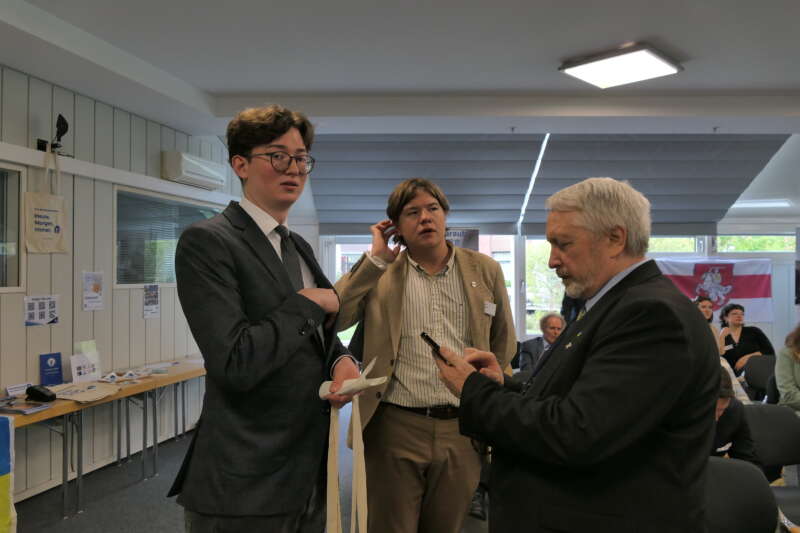
Kevin Lick, Artem Kryvulia (ISHR), Michael Leh (ISHR). Photo: Sajedeh Jalali (ISHR)
Prison conditions:
For the first two months, I was held in solitary confinement — a form of white torture. Afterwards, I was deliberately exposed to provocations: other prisoners were placed in my cell in order to trigger conflicts.
After my 18th birthday, I was transferred to an adult prison. There, I became a victim of so-called “presskhata” methods: cellmates acting on behalf of the authorities who used violence.
For more than a week, I was beaten at night, tied up and threatened. It always revolved around one single question: who knew about the photographs?
It remained at the level of threats of the most severe violence, but the psychological strain was enormous.
Later, I was transferred again. In total, I travelled around 2,000 kilometres, often in stages by train over a period of weeks.
In different prisons, I met many people: Ukrainian civilians, people persecuted for their religion and political prisoners, including a Crimean Tatar serving a 25-year sentence.
School and future:
After a prisoner exchange, I arrived in Ankara and one month later I went back to school to continue my Abitur. Education was and remains central to me.
During my imprisonment, I had 20 books with me — they were taken away from me in the camp.
Today, I am trying to continue my educational path and look ahead.
Leave A Comment