




Media literacy seminar in Arevshat community
On October 19, the International Human Rights Society NGO held a regular media literacy seminar in the Arevshat community of Shirak region, with the participation of about 45 young people from Arevshat and neighboring villages. The meeting was organized within the framework of the regional educational component of the “Monitoring Disinformation Flows” program.
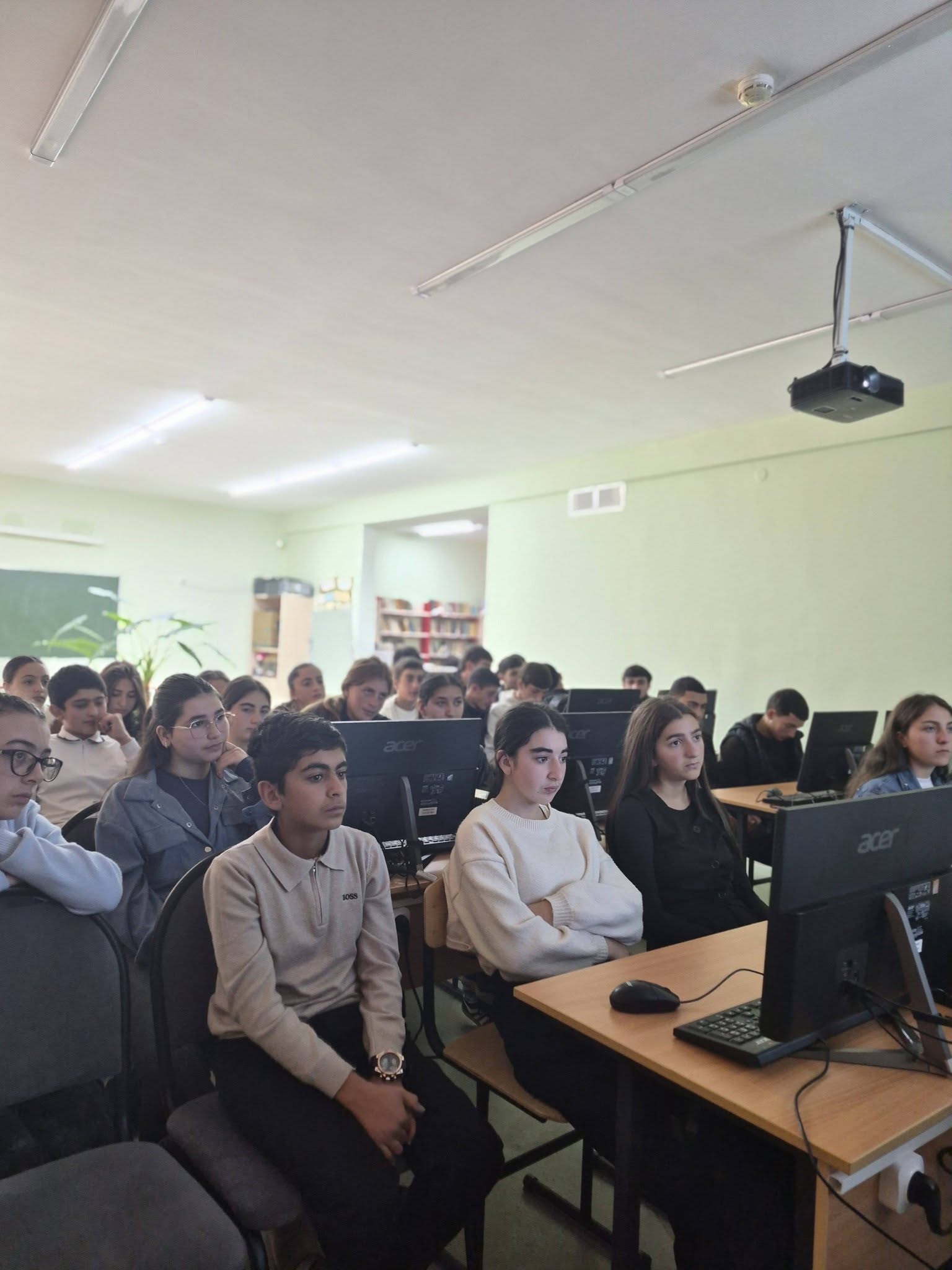


The goal of the seminar was to help young people navigate the modern information environment more confidently, recognize misleading content, and become familiar with available tools for verifying information. The meeting also emphasized the importance of personal responsibility for disseminating information: each user can contribute to both the circulation of reliable information and the dissemination of unverified claims.
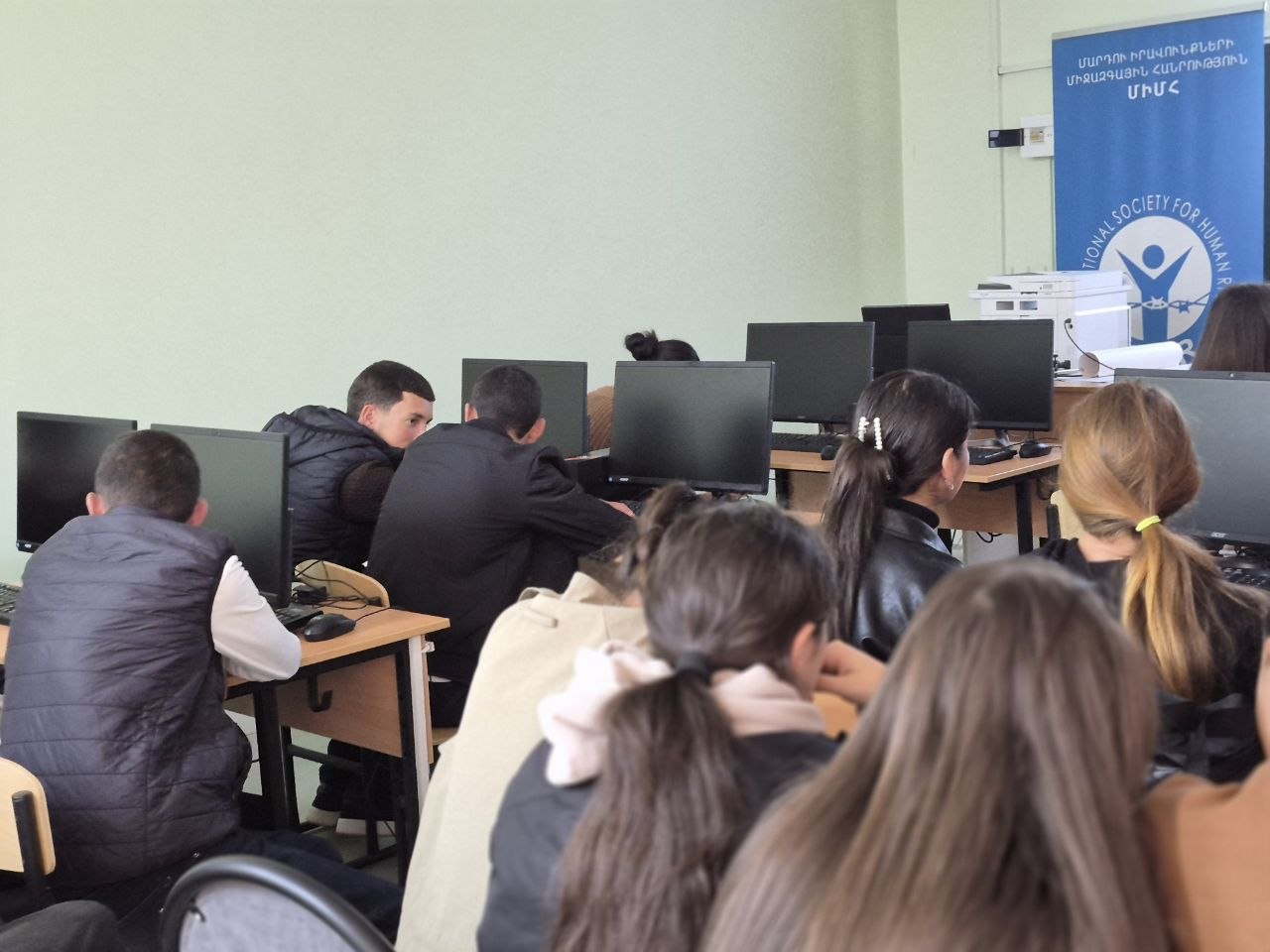
Perception of the information environment and protection against manipulation
The first part of the seminar was led by Bela Shikaryan, President of the International Society for Human Rights. She presented approaches to protecting against information manipulation, types of false and misleading information, the characteristics of the media environment, and issues related to everyday information behavior.
The focus of the discussion was the idea that when evaluating information, it is necessary to pay attention not only to the content, but also to its source, the purpose of publication, and the manner of presentation. Even a real photo, an accurate quote, or a single fact can be misleading if presented without the necessary context.
It was also noted that false information is not always easy to recognize. It may have a convincing design, an emotional headline, or be accompanied by numerous likes and shares. However, being popular is not proof of reliability, and a trustworthy appearance is no substitute for verifiable sources.
Participants’ attention was drawn to questions such as: who published the information, how is it substantiated, is it possible to find the original source, and what important details may be missing from the presented story?
Interactive discussion with examples accessible to young people
The seminar was held in an interactive format, giving participants the opportunity to ask questions, express their opinions, and engage in discussions. The young people actively participated, considering the presented examples from the perspective of their everyday information experience.
The content was structured around accessible and apolitical topics. This approach helped to focus on information evaluation skills, avoiding debates around political positions.
During the discussions, it was important to distinguish between fact, opinion, and conjecture. Particular attention was also paid to the influence of emotions: materials that arouse fear, anger, or strong interest often prompt a quick reaction and sharing without fully reading or verifying the content.
The logic of the seminar was to encourage participants to ask their own questions, rather than providing ready-made answers. Healthy skepticism towards information means seeking justification and verifying claims, while not going to the extreme of saying that no source can be trusted at all.
Practical fact-checking tools
The key part of the program, “Practical Tools for Fact-Checking,” was led by project coordinator and subject matter expert Ani Sukiasyan. She presented how to verify suspicious information using available online tools and simple search steps.
The practical part focused on checking photos, searching for sources of publications, and collating information from different sources. The use of Google Lens was introduced to perform an image search and find other publications of the same or similar photos. Such a search can help determine whether the image has previously been used in the context of a different event, place, or time period.
Available tools for fact-checking included TinEye to search for other uses of an image, Google Maps and, where available, Street View to compare location details, and search engines to find the original sources of claims and quotes. It is also important to use official websites and open data sources, depending on the nature of the information being checked.
It was emphasized that no tool on its own provides the answer to all questions. For example, the absence of an image search result does not yet prove the authenticity of a photo. Effective use of the tools requires comparison of results, examination of context, and careful conclusions.
This approach helps young people understand that fact-checking is also available to the average user: it starts with a simple question, an attempt to find the source, and a willingness to check the information in several directions.
From the recipient of information to the responsible disseminator
One of the important emphases of the seminar was responsibility for one’s own information behavior. When sharing a post on social networks, the user becomes a participant in its circulation, and information received from a friend or acquaintance may seem more reliable precisely because of the personal connection.
Therefore, before sharing the information, it is important to read the entire article, check the publication date, compare the title and content, and make sure that the attached photo or video relates to the event being reported.
Responsible information behavior also includes a willingness to admit and correct mistakes. If the information disseminated is later unconfirmed or turns out to be misleading, it is necessary to inform the people to whom it was transmitted.
Collaboration for access to media literacy in the regions
The meeting organized in Arevshat brought together young people from villages, creating an opportunity to learn together and discuss the information environment. Such meetings are important for making media literacy education accessible in rural areas and strengthening young people’s abilities to make informed decisions.
Through regional educational meetings of the “Monitoring Disinformation Flows” program, we continue to encourage critical thinking about information, fact-checking skills, and responsible communication.
Ani Sukiasyan
The material was prepared within the framework of the Disinformation Flows Monitoring Project.

#CivilSocietyCooperation #ishrarmenia #ishrfactcheck
The project is implemented with the financial support of the Federal Foreign Office of the Federal Republic of Germany.