





To mark the 100th birthday of the founder of the IGFM, Ivan Ivanovich Agrusov, the IGFM is publishing a short biography in memory of the humble doer who dedicated his life to the service of human rights.
The humble maker
Ivan Ivanovich Agrusov
Ivan Ivanovich Agrusov †, the founder and long-standing chairman of the International Society for Human Rights (ISHR), was a humble man who never put himself at the centre of attention, but always in the service of human rights. He was prepared to stand up for the cause he believed in with his life. There are not many people like him who have always stood by their convictions, even in extreme situations. As a 17-year-old, he was recruited by the German Wehrmacht as a forced labourer in the ‘Death’ construction battalion near his home town of Petschory on the Estonian-Russian border, where he was responsible for adapting the railway tracks. After the Germans withdrew, he was later deployed as a forced labourer in a cement factory in the Bavarian municipality of Sengenthal (near Neumarkt), where he lived to see the end of the Second World War. He quickly found work there as a foreman in a school building that served as a camp for Soviet wounded soldiers. When the Americans suddenly relocated these inmates to a Soviet military camp in Prague, they did not hesitate for long and Agrusov fell into the hands of the Soviets.
‘The Americans unloaded us, said ‘Bye Bye’ and drove off. They gave us a ‘wave, wave’, wished us all the best and simply drove off without thinking anything of it. I’ll never forget that.’
The first reunion with representatives of the homeland took place in Prague. A colonel with polished boots, Agrusov recalled, immediately explained to the non-military new arrivals what they could expect. Namely, not a cosy flat. Rather, they were regarded as traitors to the fatherland and as such could expect to be sent to the gulag at best. Then they all had to undress, their hair was shorn and their details were taken, standing naked in a row. Agrusov managed to escape from the Soviet camp in Prague by handing over his suitcase with all his belongings to a Czechoslovakian guard. From there, he sneaked through the woods in the dark to one of the first refugee camps run by the then United Nations Relief and Rehabilitation Administration (UNRRA) for forced labourers from the East near Pilsen. This is how he managed to ‘escape’ back to Germany, so to speak, and it was here that Agrusow developed the idea of founding a human rights association as a result of a formative encounter during the train journey. It was a Jewish gulag prisoner travelling to Israel whose stories led Agrusov to a drastic realisation: Whenever there had been attention for his fate from abroad, the former prisoner said, this had led to an improvement in his treatment in the camp.
The effect was felt immediately, for example through the receipt of a full food ration. Agrusov was well aware of the suffering of this and the countless other victims of Stalin in the gulag system. And it is only through the lens of this suffering, this pain and the deep compassion in response to it, that the man Agrusov and his lifelong commitment can be properly understood. He never saw his beloved mother and his closest family again for the rest of his life. How much he loved his homeland became apparent during the course of his life in forced exile abroad. In the German arrival camps for forced labourers from the East, the largest and for a long time most important Russian exile organisation NTS recruited new members and supporters in the fight against the Stalin regime. The young Agrusov joined the organisation. After training as a radio and television technician in Arolsen near Kassel, he worked for a long time in the educational radio broadcasting of news to the East. This was a very adventurous endeavour at the beginning, and while he and a small team were climbing a tree in a wood to position an antenna there, this strange spectacle was stopped by a British military unit in Göttingen. All of them were arrested as suspected Soviet spies. After a week’s detention and examination by the British, they were all released. In the meantime, Agrusov had befriended a British policeman and adopted his dog. Over time, however, Agrusov felt that the methods and philosophy of the NTS were outdated by reality and terminated his membership. With the emergence of the Conference on Security and Co-operation in Europe, he approached well-known international lawyers and jurists working on human rights in the East-West conflict and asked them whether they would be interested in founding a human rights association.

Always ready with a warm smile, Ivan Agrusov at the IGFM Annual Conference 2006
‘I thought the best people for this were lawyers, because they know the laws and how to formulate them when laws and rights are violated. But that turned out to be a fallacy. People were able to formulate things appropriately, but they couldn’t stand up for rights.’ So in 1972, on his own private initiative and without professional support, he decided to found what was then the Society for Human Rights6. He collected the number of signatures required to found an association from his circle of acquaintances. The first step was thus taken: the founding of an association. The little word ‘for’ in the association’s name was always of the utmost importance to Agrusow. His work has always been about campaigning for human rights, which goes beyond the fight against human rights violations. Standing up for human rights is a completely different and incomparably more difficult basic approach. This is because it makes it necessary to do something positive, to do more than just name the ‘bad guys’.
Working for human rights means doing something for the victims of evil or malice. This basic orientation ran like a red thread through Agrusow’s commitment. Pure protest and criticism alone fell on deaf ears with Agrusow, he didn’t have the time for that. However, if criticism came from someone who could also present a realistic and better alternative plan, he would deal with it. The next step was to find staff for the newly founded Society for Human Rights, as it was not possible to set up a professional and effective human rights organisation alone. Agrusow had a clear idea of what potential employees needed to bring to the table: in his experience (with the lawyers, for example), training and professional qualifications were less important. It was much more important that people were willing to donate their time to the cause of human rights without focussing primarily on remuneration. Attitude and heart were more important to Agrusow than formal qualifications and theoretical knowledge. However, in the period of incipient peaceful coexistence – and especially in a divided Germany – numerous people quickly found themselves who matched this profile and joined the Society for Human Rights. For the work of the IGFM, it was not only mutual respect among the staff that was important to Agrusow.
Respect for everyone who approached the IGFM was also of the utmost importance to him. No enquiry was allowed to go unanswered. Everyone who had ever contributed in any way or supported the association financially was to receive an answer from the organisation. This included, for example, always informing the sponsors exactly what had been achieved with their support and demonstrating that their help really made a difference. According to Agrusow, an important part of the job description in the IGFM was that of a ‘professional beggar’ – direct and sincere contact with people who were willing to support the work ideally and financially was crucial. There were no lengthy and thorough training programmes for the joint work for the early campaigners. All of them suddenly found themselves in the thick of the action and were thrown in at the deep end. Now it was a case of ‘learning by doing’ in order to organise everything together that constituted a genuine civil rights movement: Demonstrations, signature collections and high-profile handovers of lists, information stands, hunger strikes, festive chains on fences, preparation of reports, documentation and other publications, organisation of round tables and other event formats, press conferences, cooperation with other non-governmental organisations and the relevant state organisations, fundraising, preparation and categorisation of cases, case management and humanitarian and social support for victims and relatives.
And the association itself also had its hands full: Working groups were established, supported and developed, members were recruited, supported and networked with each other, annual general meetings were prepared and organised. Agrusow always personally ensured that none of this became a wild mess. Although he was the boss, he was not the only one who developed all the projects and only passed them ‘down’ for implementation. At the IGFM, anyone who wanted to get involved in one of the many fields of activity was warmly welcomed and warmly received: Whether it was someone who sent aid shipments to Romania or someone who set up an exhibition on children’s rights; someone who knew about bookkeeping or someone who did scientific work and produced documentation; someone who was a specialist in information and communication technology or someone who knew their way around the high political stage and ensured that opinions were exchanged there.
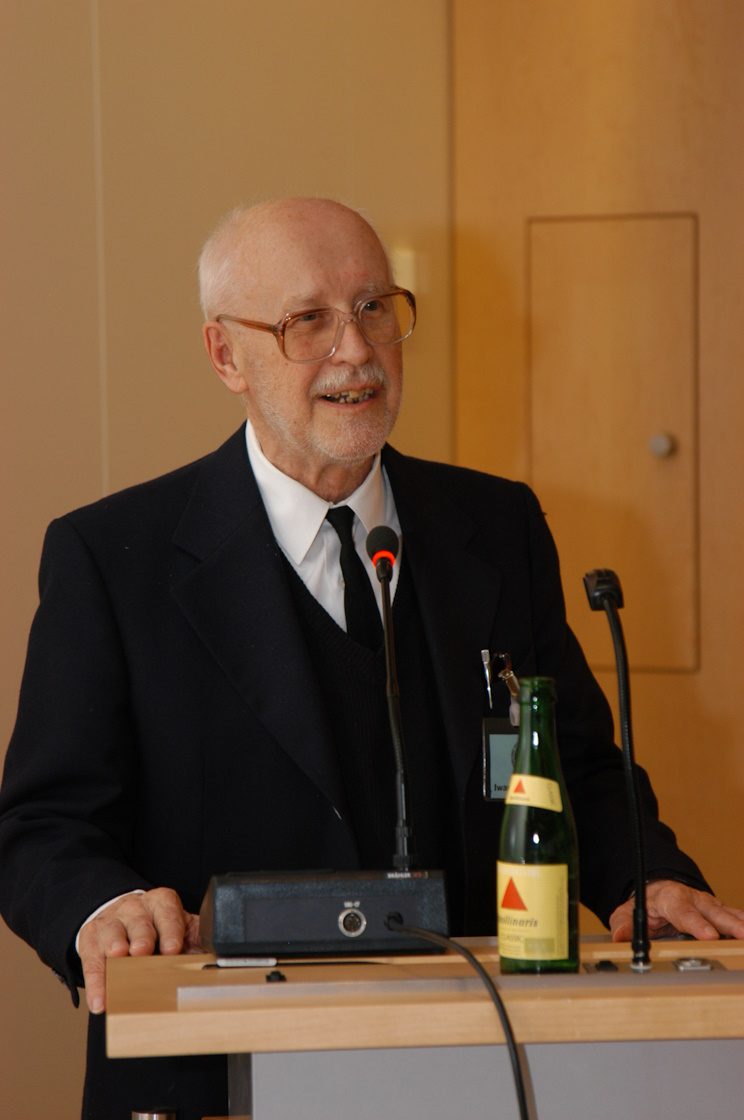
Iwan Agrusow am Rednerpult während der IGFM-Jahrestagung 2004
It was always important that a contribution was made to achieving the common goal. If this was the case, everyone who was committed to human rights could become part of the IGFM family. Over time, extensive expertise was built up within the IGFM and the core staff learnt how to develop, budget, finance and implement promising projects and make them effective in the long term. All of the fields of work that emerged back then still exist today. And the spirit has remained the same: Even today, everyone is welcome to join the IGFM who wants to get involved in human rights and is willing to spend time helping victims of human rights violations without primarily focussing on their own income.
The culture of passionate work for the common cause established by Agrusov endured beyond his death. It was his example and his principles that made the International Society for Human Rights what it is today. The special mixture of humility and active goal-orientation was one of the most interesting personality traits of Ivan Agrusov. His humility was not the kind that simply resigned itself to fate in a God-given universe. Rather, throughout his life he had seen himself as an active and formative part of events in the world in the positive sense of a God-given mission in life. And the older he got, the more Agrusow orientated himself towards the Bible and finally became a deeply religious person in his old age. It was important for him to get involved wherever he could. Even before the IGFM was founded, he had been fascinated by Mahatma Gandhi. The way in which Gandhi humbly campaigned for India’s independence with the few resources at his disposal was exemplary for him. Likewise Mother Theresa, who dedicated her life to the street children in India, or Nelson Mandela, who spent a lifetime fighting to end the apartheid regime in South Africa. They all followed their inner purpose.
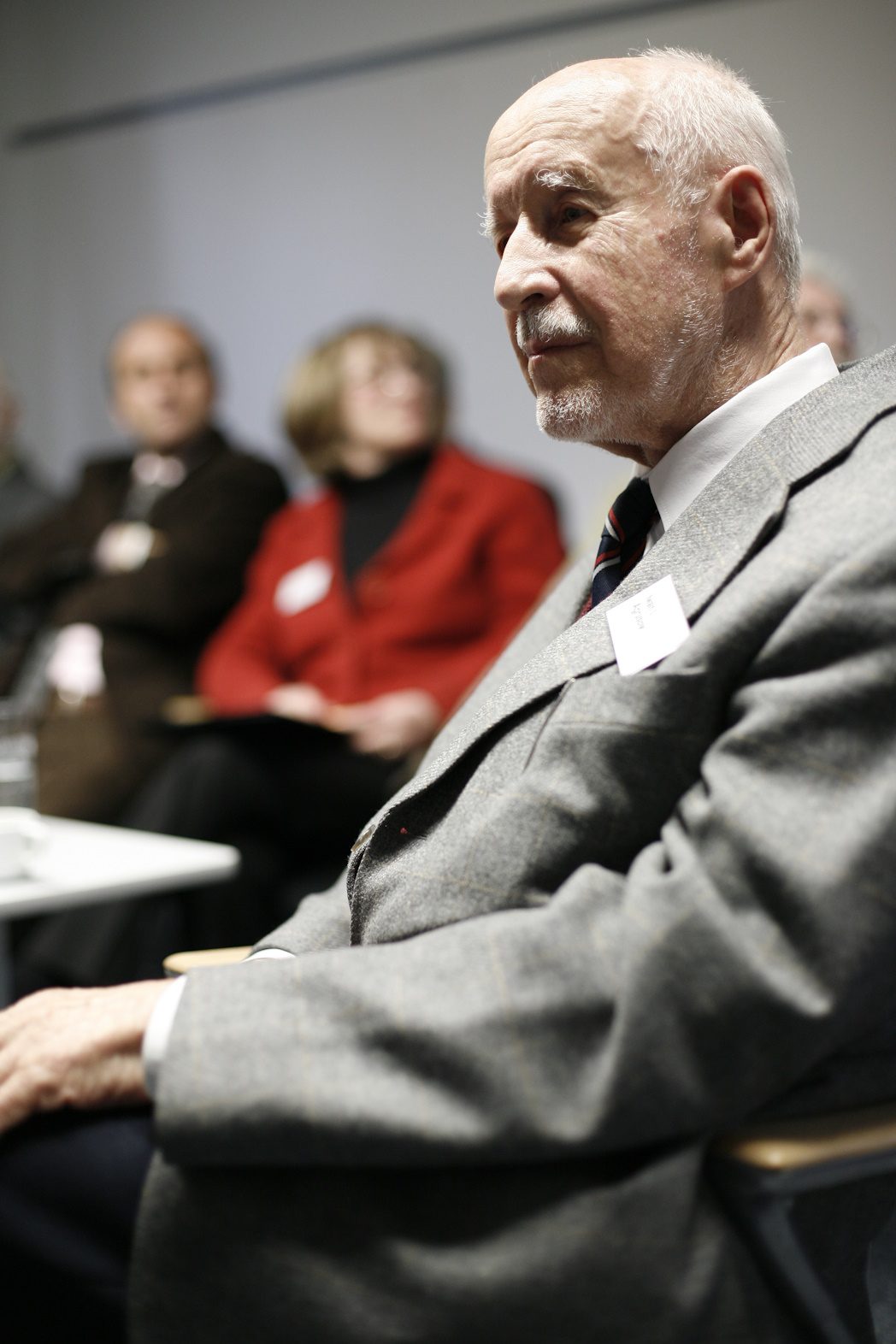


Agrusov’s mission was to campaign for human rights in his home country. He saw himself as a mediator, giving the victims of the Stalin dictatorship a voice in the West. Agrusov radiated this special charisma, but this alone does not make a successful human rights activist. Other qualities are required, which Ivan Agrusov also embodied like no other: he was goal-orientated, intelligent, full of ideas and creative. In everything he did, he was very rarely a private person. Working for human rights was his life. He never had a working day as our society knows it today. He was smart in two respects: he was not only literally clever in his thoughts and actions. He also embodied the success principles of modern project management – long before today’s terms were developed. He always had a clear big goal in mind and was creative in defining sub-goals. Everything he did had to be specific, measurable, attractive, realistic and time-bound – in other words, ‘SMART’ – at all times. For his work, he utilised the entire range of action and communication possibilities of the civil rights movement. Always with the aim of making the voices of the victims heard in the West and helping the victims behind the Iron Curtain.
Due to his commitment against the Stalin regime and later in favour of human rights, he was literally hunted by the KGB and Stasi for many years. No one else like him and the IGFM were so persecuted by these two secret services at the time. All kinds of destructive rumours were deliberately spread and political intrigues were spun. There were several attempts on his life. These smear campaigns were adopted unchecked by the left at the time, and Agrusov was smeared as a fascist, anti-Semite, highly paid CIA or Secret Service agent. One might think that this was very painful for a sensitive man like him. But Agrusow simply put up with it, he was always goal-orientated and focused. He always had enough work that he could not and would not leave undone. There was no room in his work schedule to constantly defend and justify himself against the barrage of slander and attacks. In retrospect, it was vital for the continued existence of the IGFM that Agrusow did not allow himself to be swayed. For him, clean, honest and objective work always took priority and always continued. In the end, he took many of the difficult and challenging things in his stride with a good dose of humour. In his small, sparse room in the retirement home in Frankfurt-Hausen, where he spent the last years of his life, he liked to joke that he was still here looking for the CIA millions that he had always been accused of.
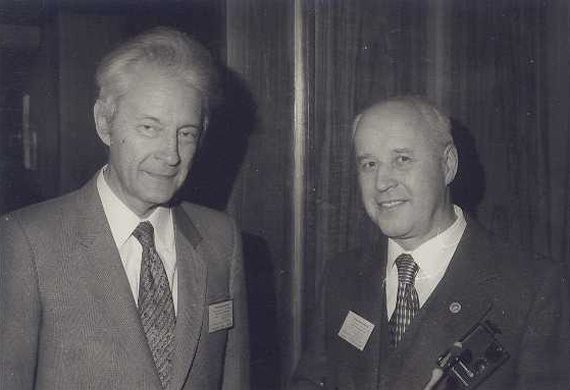
Ivan Agrusov together with the political scientist Prof. Mikhail Voslensky
Many people have tried to read a lot into the person of Ivan Agrusov and his work. He himself was always very surprised by this. Because he was never the philosophical mastermind, the great anti-communist or the political strategist that others thought they saw in him. He was a humanist and a ‘doer’, a man of action. His world was the world of practical actions, in which he chained himself to fences with like-minded people or went on hunger strike for Russian dissidents. High-minded people who boasted that they were standing up for human rights were always a contradiction in terms for him. He couldn’t stand that sort of thing.
Human dignity and respectful interaction with one another, even with criminals, were of great importance to him. He always endeavoured to give a factual and honest account of human rights violations without emotional outbursts against the offenders, for whose just punishment the courts were responsible. Agrusov only partially sympathised with the large left-wing youth movement of the time. He did not deny that its supporters basically wanted something good and wanted to change the world with good intentions. He would have agreed that young people with a good heart should even do this. Nevertheless, he could not understand why there was so much agitation and so much dirt and lack of objectivity in this campaign. And this when the facts were clear. It is easy to understand that his attitude at this point was strongly influenced by his own experience of slander and attacks on his person.
When successes for human rights materialised, these were of course joyful moments in Ivan Agrusov’s life. But encounters with dissidents from his homeland were also moments of happiness for him. And it was particularly inspiring when perestroika and glasnost finally opened up hopeful prospects in his old homeland. In 1991, when Agrusov was 67 years old, a long list of ‘KGB enemies of the first category’ appeared in alphabetical order on the front page of a major Russian newspaper under the headline ‘Welcome, gentlemen anti-communists’, together with an explicit invitation to travel to Russia and be warmly welcomed there. His name was at the top. That made him cry. He did not hesitate for long and immediately seized the opportunity to return to his homeland after 50 years of forced exile. He will never forget this moment either, according to Agrusow in his memoirs. Together with his wife Franziska, he travelled twice along the Volga and visited his home town of Pechory on the Estonian border several more times. Here he was even able to meet the son of his older brother Ilya. He recounted these special experiences with shining eyes.
Although he had close ties to Russia throughout his life, he could not resist recognising the facts – compiled by the equally unforgettable IGFM staff member Wanda Wahnsiedler – about the first new Russian violations of international law and war crimes after 1991. And so, with Wanda Wahnsiedler, the IGFM became a major and internationally recognised reporter of human rights violations in the two Chechen wars. Despite all the terrible events, Agrusov believed that the fundamentally positive development in his home country was irreversible for a long time to come. However, a democratic future was only possible on the basis of a broad-based and thorough investigation and coming to terms with the Stalinist past. Against this background, he would not have been able to cope emotionally with the Russian war of aggression against Ukraine, almost exactly ten years after his death. He personally witnessed the founding of the Russian and Ukrainian sections of the International Society for Human Rights. He took part in their founding meetings, witnessed the founding of further sections and working groups in all countries of the former Soviet Union and was extremely happy about it.
Being able to invite the IGFM family in the East to join the international network for the promotion of human rights was a great, belated joy for him. Nevertheless, he would never have dreamed of retiring. He never ran out of work. Even when he was no longer able to come to the office in his old age, he still developed projects together with the Russian Orthodox Church in Frankfurt to help tuberculosis patients in Russian prisons. Despite all his busyness, Agrusov loved his wife Franziska and his family very much throughout his life. The relatively early death of his wife was a heavy blow for him, from which he never really recovered. At the end of his life, he regretted only one thing: not having given his family the time they deserved. It hurt him greatly that he no longer had an intact relationship with his two sons and their families in later life. His realisation in old age was that family should not be neglected. It was the most important thing that remained in life.
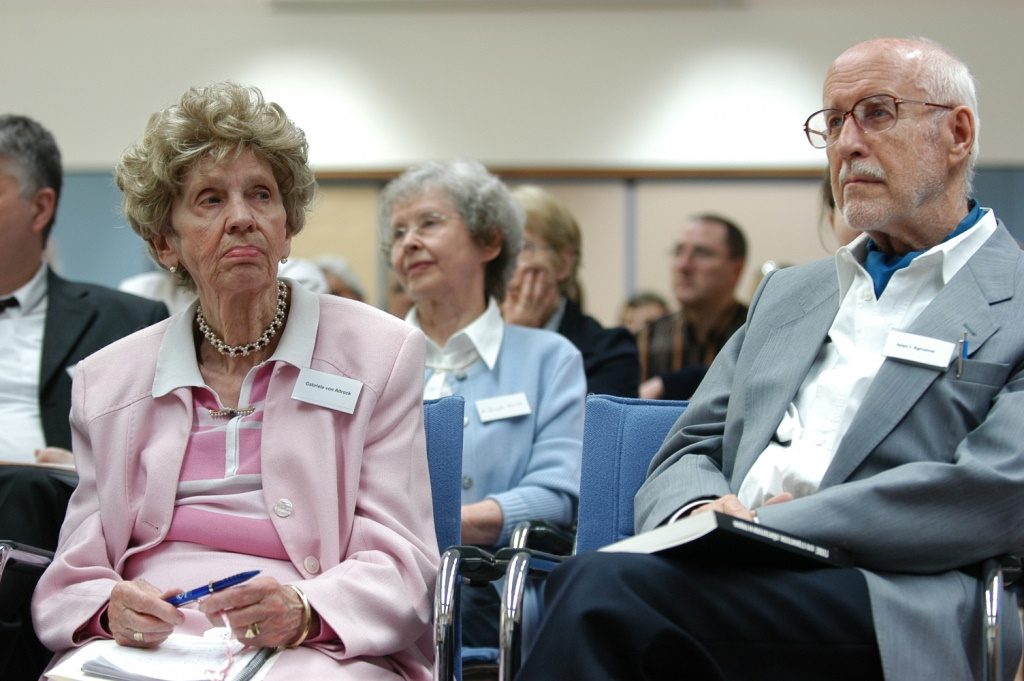
Agrusov’s mission was to campaign for human rights in his home country. He saw himself as a mediator, giving the victims of the Stalin dictatorship a voice in the West.
Ivan Agrusov was not the kind of person who would have actively sought out volunteers and employees to recruit them for human rights work. He didn’t have time for that and didn’t see it as his job. Nor did he have to, because there were always people who wanted to do something for human rights who came to him on their own initiative. It was his charisma that attracted and fascinated people. He always conveyed a sense of reassurance that what they wanted to do to help was the right thing to do.
Where necessary, he provided assistance and practical instructions. He did everything that would be considered good project management today. He always paid attention to detail, whether it was choosing the right words in letters to German donors (even though German was not his mother tongue) or compiling documentation for the CSCE or the UN. He loved, lived and breathed commitment to human rights in all its many forms. A certain amount of self-motivation and initiative was required to get to know Ivan Agrusov. But once you were in his presence, he impressed people, inspired them and made a significant positive impact.
Text: Carmen Krusch-Grün and Matthias Böhning
In grateful memory.
The Executive Board of the IGFM
Frankfurt am Main, 2 October 2024
Leave A Comment