




ANATOMY OF MISINFORMATION
Media Literacy and Information Resilience Educational Series
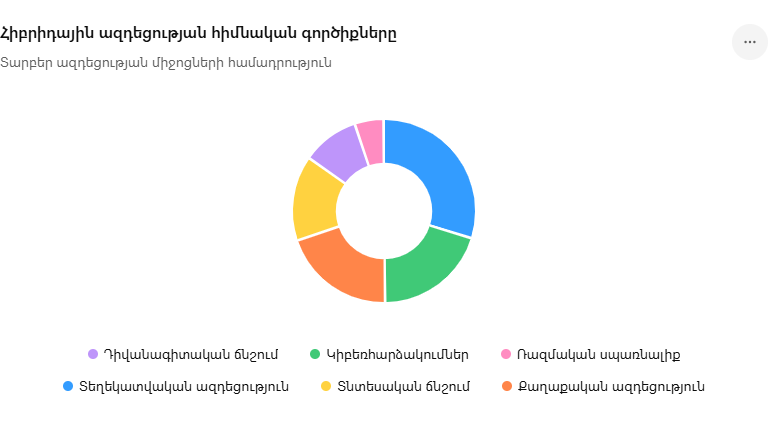
 Disinformation is not a homogeneous phenomenon: it has different forms, purposes, and dissemination mechanisms. To understand how it operates in the information environment, it is important to distinguish its main types and understand their characteristics.
In general, three main approaches can be distinguished in the modern information environment: misinformation, disinformation, and a wide range of harmful information (malinformation). Although these terms are often used together, there are significant differences between them that are important for analysis and countermeasures.
Misinformation
Misinformation is the spread of incorrect or unverified information without the intention of causing harm. That is, the spreader is often convinced that they are conveying correct information.
This type is particularly prevalent on social media, where people often share material without checking the source or accuracy of the content. For example, misinformation about medical advice, natural disasters, or political events can spread quickly simply through reposting.
The danger of misinformation is that even without malicious intent, it can create public confusion, misperceptions, and negatively influence decisions.
False information (Disinformation)
Disinformation is a deliberate and deliberate act. Here, information is created or altered with the specific intent of misleading the public, influencing opinions, or inducing certain behavior.
This type is often used for political, social, or geopolitical purposes. It can include fake articles, manipulative videos, fake quotes, or completely fabricated events.
What is unique about fake news is its systematic nature: it is often not spread randomly, but is part of a broader strategy, where different sources, accounts, or platforms work together to spread the same message.
Malinformation
Harmful information is when factual information is used to cause harm. Here, the content may be accurate, but is presented in a way that violates privacy, damages reputations, or causes public tension.
For example, leaking personal data, spreading statements taken out of context, or publishing private information can be considered manifestations of harmful information.
This type is particularly dangerous because it is often based on real facts, which makes it difficult to refute or neutralize.
The chart shows that misinformation is usually spread without the intention of causing harm, while disinformation is created and spread purposefully to influence public opinion or behavior.
Hybrid and systemic information campaigns
In the modern information environment, coordinated information campaigns that combine all of the above types also have a special place. They can include both incorrect and false and harmful information for a single purpose.
Such campaigns are often characterized by high organization, multi-platform dissemination, and attempts at long-term influence. Their goal is not only to disseminate specific information, but also to undermine public trust in the media, state institutions, or expert communities.
The complexity of boundaries between species
It is important to note that in the real information environment, these types are not always clearly separated. Often, misinformation can turn into disinformation if it is deliberately used in a targeted manner. Similarly, real data can become harmful if taken out of its original context.
For this reason, when evaluating information, not only the content is important, but also the source, purpose of dissemination, and context.
Hybrid threats and information interference
Hybrid threats are considered one of the most complex and dangerous phenomena in the modern information and security environment. They are multi-layered in nature and include several tools of influence simultaneously, aiming to weaken or undermine the stability of states, institutions, and societies.
According to the European Centre of Excellence on Countering Hybrid Threats (Hybrid CoE), hybrid threats are malicious actions that are planned and carried out intentionally with malicious intent. They are aimed at influencing target systems – states, state structures or societal institutions – using a variety of, often combined, means.
These means may include information manipulation, the spread of disinformation and false information, cyberattacks, economic pressure or influence, covert political maneuvers, diplomatic coercion, as well as the use of military force or the threat of it. Thus, hybrid threats are not limited to the information field alone, but operate simultaneously in several areas, creating a comprehensive system of influence.
The peculiarity of hybrid threats is that they are often carried out in the “middle zone” — that is, in ways that do not reach the level of open war, but have a long-term and profound impact. They allow for influence without a formal declaration of military conflict.
The impact of hybrid threats is particularly strong in democratic systems where freedom of speech and the open flow of information are core values. This openness, on the one hand, ensures democratic development, but on the other hand, it can also be used as a vulnerability for manipulative information campaigns.
How is misinformation born?
Goal
↓
Narrative creation
(fear, anger, polarization)
↓
Fake or manipulative content
↓
Bots and fake accounts
↓
Telegram channels
↓
Social networks
(Facebook, X, TikTok, YouTube)
↓
Influencers and opinion leaders
↓
Media
↓
Public opinion
↓
Behavior change
The goal of disinformation is not to inform people, but to influence their thinking, perceptions, and behavior.
MDM model
INFORMATION DISORDERS
┌─
↓
┌─�
│ DISINFORMATION │
│ False information │
│ Deliberate deception │
└─────────────────────�
↓
┌─
Why do people believe misinformation?
MISINFORMATION
↓
┌─
Fear Anger Uncertainty
│ │ │
└─�──────────────┘
↓
Rapid spread
↓
Public polarization
FIMI operation structure
External actor
↓
False narrative
↓
AI content
Deepfake
Fake photo
↓
Bots
Fake accounts
↓
Coordinated distribution
↓
Social impact
The cycle of misinformation on social media
Publishing
↓
Shares
↓
Comments
↓
Algorithm activation
↓
Wide distribution
↓
More shares
↓
Viral spread
International examples
In recent decades, numerous cases of hybrid influence have been recorded in various regions. For example, the multi-level information and cyber campaigns against Ukraine, which preceded the large-scale military operations of 2022, are often considered an example of a hybrid strategy. These campaigns included the spread of disinformation, cyberattacks on state systems, elements of economic pressure, and attempts at political influence.
Similar information and influence operations have been recorded in other countries, including European countries and the United States, especially during electoral processes. In these cases, the main goals were to reduce public trust, deepen political polarization, and create suspicion towards institutional systems.
Hybrid environment and the information field of Armenia
In small and informationally open societies like Armenia, the risks of hybrid and informational influences are often more sensitive. The highly integrated social media environment, rapid dissemination of information, and high interest in regional political developments create conditions where information manipulations can spread quickly and influence public debates.
The Armenian information field is characterized by information flows from both internal and external sources, which can sometimes be manipulative or polarizing. Such influences can manifest themselves in various ways: false or semi-accurate information spread on social networks, polarizing discussions on political topics, or speculation on sensitive public issues.
- Mechanisms of disinformation spread on social networks
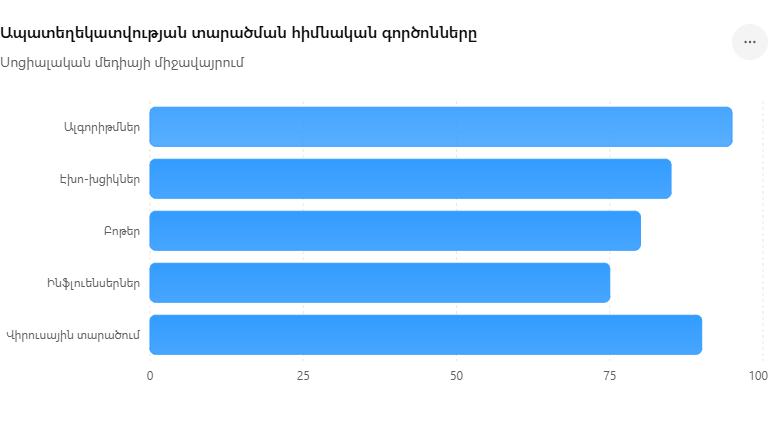
In the modern information environment, social networks have become one of the fastest and most effective platforms for disinformation dissemination. They allow information to reach thousands and even millions of users in just a few minutes.
However, this speed and accessibility also create vulnerabilities: information is often spread without verification, out of context, or in a manipulative manner. The spread of disinformation on social networks is driven by a number of interconnected mechanisms that together form a complex system of influence.
Algorithmic distribution and the «attention economy»
Publication
↓
Shares
↓
Comments
↓
Algorithm activation
↓
Widespread
↓
More shares
↓
Viral spread
One of the main features of social networks is the use of algorithms that determine what content is shown to users. These algorithms are mainly based on engagement: the more «likes», comments or shares» the content has, the wider its distribution.
This system creates what is often called an “attention economy”: attention becomes the primary resource, and the most sensational, emotional, or controversial content receives the greatest distribution.
This is why misinformation often succeeds: it is framed in a way that evokes a strong emotional response—surprise, fear, anger, or shock. These emotions encourage sharing, which in turn accelerates its spread.
For example:
If unverified information is spread on a social network that claims that “a big change is coming that will affect everyone’s personal lives,” users often share it without verifying it, simply out of concern or curiosity. In this way, the information can go viral, even if it is incorrect.
Bots, automated accounts, and coordinated networks
Another important mechanism for the spread of disinformation is the use of automated or semi-automated accounts, known as bots. These accounts can be created in large numbers and used to mass-promote the same message.
Bots are also often used to create «artificial activity» in discussions by leaving comments, sharing posts, or liking certain content. This can create the impression that an opinion has broad public support, even if it does not.
For example:
When several hundred similar comments appear on a certain topic in a short period of time, the user may get the impression that this opinion is «generally accepted,» which affects their perceptions.
Echo chambers and information isolation
Social networks often form so-called «echo chambers», where users mainly see information that aligns with their beliefs.
Algorithms, in an attempt to keep users on the platform longer, offer similar content. As a result, people gradually start interacting only with sources that share the same views and encounter less opposing opinions.
This phenomenon deepens polarization and facilitates the spread of misinformation, as the user is less exposed to critical or counter-intuitive information.
For example:
If a user often views content with a certain political orientation, the system begins to suggest similar pages and videos, gradually forming a one-sided information environment.
Micro-influencers and the trust factor
The psychological component of trust is also an important factor in the spread of disinformation. People often trust specific individuals, such as bloggers, influencers, or community authorities, more than anonymous news sources.
So-called «micro-influencers» (users with a small but active audience) often have high credibility among their followers, which can also be used to spread manipulative information.
For example:
If a popular blogger spreads unverified information about a social or health topic, their followers are more likely to accept it as a reliable source without further verification.
Sharing, reproduction, and loss of context
Information on social networks is often disseminated not from the original source, but second- or third-hand, as a result of sharing and reproduction.
In this process, context loss often occurs. Text or video may be shortened, re-edited, or presented in a new context, which changes its meaning.
For example:
A specific statement that initially referred to a limited situation can be spread on social media as a general rule or universal political position.
Speed vs. Verification
One of the main features of social networks is speed. Information spreads in seconds, while verifying it requires time, comparison of sources, and analysis.
This imbalance creates conditions where false or unverified information often «manages to win» over accurate information simply by spreading faster.
Conclusion
The spread of misinformation on social media is the result of a combination of technological, psychological, and social factors. Algorithms, user behavior, trust mechanisms, and the rapid circulation of information combine to create an environment where misinformation can spread quickly and have a wide impact.
In these circumstances, media literacy, source verification, and critical thinking become key tools for maintaining information security.
Examples of the spread of disinformation in the Armenian information environment
In the information field of Armenia, as in many other countries, social networks and online media often become the main source of rapid dissemination of information. In this environment, there are sometimes cases where information is disseminated without sufficient verification, taken out of context, or presented with different interpretations.
In particular, during important political and social events, there is often a significant activation of information flows on social networks. In such situations, various users, pages, or groups can quickly spread statements, videos, or images that have not yet received official or media confirmation.
For example, during election processes, political statements, or the publication of government decisions, hastily formulated comments and claims often appear on social networks, which may later turn out to be not entirely accurate or presented out of context.
Similar phenomena are also observed when disseminating information on regional security, border developments, or international political events. In these cases, materials from different sources are often circulated, sometimes without clear verification, which can lead to information confusion or contradictory perceptions.
It is important to emphasize that such situations are not necessarily the result of deliberate misinformation. They are often caused by the rapid circulation of information, the desire of users to quickly share seemingly important news, as well as the influence of social media algorithms.
At the same time, the Armenian information environment also has a diversity of news sources, which makes it possible to compare different positions and sources. However, in the face of a large volume of information, it is important for users to develop the habit of verification, especially when it comes to sensitive topics.
In this context, multi-faceted verification of information, through comparison of different sources, as well as identification of the original source, becomes particularly important. This allows us to reduce the influence of misconceptions and unverified information on the formation of public opinion.
ISHR Armenia Team
The material was prepared within the framework of the Disinformation Flows Monitoring Program.

Source: ishrarmenia.am


Оставить комментарий