





On 24 February 2024, 19-year-old student and anti-war activist Daria Kozyreva was arrested in Saint Petersburg.
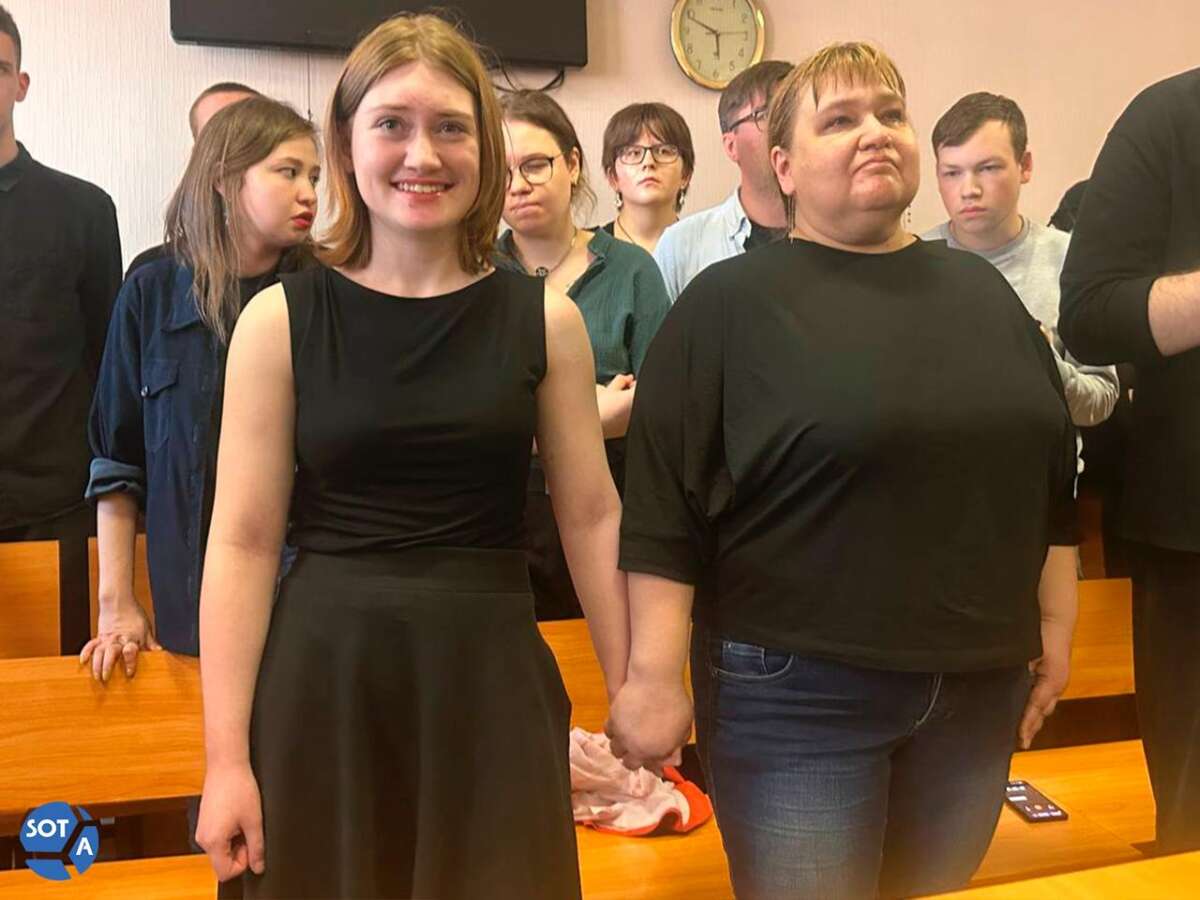
Daria holds her mother’s hand while the judge reads the judgement. Photo: Sota Vision
On 24 February 2024, 19-year-old student and anti-war activist Daria Kozyreva was arrested in Saint Petersburg. The charge: she had placed a printout of the poem “Testament” by Taras Shevchenko on his memorial. The quoted lines read:
“Bury me, then get up,
Break the chains,
And with the enemy’s evil blood
Sprinkle the freedom!”
Because of this peaceful action, she was accused of “repeatedly discrediting the Russian armed forces”. In May 2025, after months of pre-trial detention and court hearings, Daria was sentenced to two years and eight months in prison.
A young voice of resistance

Daria during her closing remarks. Photo by SOTAvison
Daria’s involvement did not begin with this case. In 2022, when she was just 17 years old, she was prosecuted for writing the words: “Murderers, you bombed him. Judas.”
In January 2024, she was expelled from the University of St. Petersburg for critical posts about censorship laws on social networks. Daria stood firm in the courtroom.
She called the proceedings “absurd” and compared them to the persecution of Taras Shevchenko by the tsarist regime.
Despite pressure and intimidation, she refused to recant her convictions or show remorse. Her speeches in court became political manifestos – full of emotion, history and resistance.
Your last word in court
Below we publish Daria Kosyrewa’s last word before the court. It is not just a personal statement – it is a historical analysis, a moral indictment and a passionate plea for the sovereignty of Ukraine. Although she was interrupted several times by the judge, Daria continued to speak, quoting Shevchenko and Mazepa and reflecting on centuries of imperial oppression.
Daria (recites a poem from Schewtschenko in Ukrainian):
Laugh, cruel enemy!
But not too much, because everything passes –
Only fame does not pass;
It does not fade, but will tell,
What happened in the world.
Judge (interrupts): In Russian please, the procedure is in Russian. Can you speak Russian? If I understand correctly, is this a poem?
Daria: Yes.
Judge: Then in Russian, please. Because the proceedings are conducted in Russian.
Daria (continues in Russian): Whose truth, whose lies, whose children, are we? Our thoughts, our song will not die, will not pass away. Here are the people, our glory. Glory to Ukraine!
If Taras Hryhorowytsch would have come to our time by chance- here you would expect me to say that he would have been very surprised. No, he wouldn’t have been surprised at all. This picture would have looked very familiar to him. Moscow is pushing again. Of course, the war did not start in 2022. And not even in 2014, when you look at it narrowly, although 2014 was a starting point. The same Russians who are responsible for every drop of blood spilt started it in 2014. But in a broader sense, this war has been raging for centuries.
An astonishing feature of Russian history: no matter which regime is in power, it is as if a religion forbids this regime to simply leave Ukraine alone. Tsars and communists were no different in this respect. No matter what clothes they wore, the same Moscow onslaught was always hiding beneath them. You would think that after so many centuries they would have realised it. Let it go – just let it go!
Yes, Moscow has often won, many times. But it has never won a final victory. And it never will. The Ukrainian people will not allow it. They have had enough. But the occupiers simply don’t understand that. They are not particularly clever, otherwise they would have understood it long ago. No one has given them the right to decide on Ukraine’s past or future. They don’t realize that Ukrainians don’t need a big brother – and certainly not a ‘triune Russian national body’. Ukraine is a free country, a free nation.
And it alone will decide its fate. If someone spreads the narrative of the occupier, the Ukrainian people will hate him. And we should not talk about Ukrainian nationalists here. You have brought it on yourselves. If someone invades Ukraine – they will be fought. And perhaps even painfully. I sincerely hope that the Russians will finally realize these basic truths. Ukraine is, I repeat, a free nation. It alone will decide which path it takes. It alone will decide who it calls friend or foe. It alone will decide how it deals with its history. And even more so – in which language it speaks.
I say all this as if it were self-evident. But unfortunately, it is not self-evident. The only thing that is clear is that Putin does not realize that Ukraine is a sovereign nation. Many things have no place in his head anyway. Human rights, democratic principles – things like that. But even many people who are actually against Putin’s regime don’t always understand it. They don’t understand that Ukraine, which has paid in blood for its sovereignty, will decide for itself how it wants to live. I want to hope that this attitude will change over time – with the return of democracy. I want to believe in a future in which Russia renounces all imperialism – both the bloodthirsty and the insidious kind that hides in people’s minds.
God grant it, simply God grant it. A few Pechenegs and Polovtsians – how could it be without them. I by no means claim to be giving a historical lecture here. What follows is more of an emotional commentary on historical events. A detailed report would be inappropriate in the format of this hearing. Those present would be bored to death.
Bohdan Khmelnytsky was of course a great hetman. But even great men can make great mistakes. He probably had no idea what tragic consequences the Rada of Pereyaslav would have. He had only hoped for a military alliance against Poland. He would never have dreamed that this alliance would see Ukraine gradually lose all of its Freedom in this alliance.
Judge (interrupts): The investigators ask you to stay closer to the subject of the proceeding. I have the right to interrupt you if you stray too far from the case. I have the right to ask you to stick to the subject of our criminal proceeding — and not to events that happened hundreds of years ago. Do you understand?
Daria (continues): Yes, I was just about to quote a poem from Taras Schewtschenko. Unfortunately, not fully – I can’t remember the translation by heart. But in this trial, the question was also raised as to whether Taras was a nationalist.
Therefore, in my opinion, it is very appropriate.
‘Ruled… Oh, Bohdan, incomprehensible son. Look now at your mother, your Ukraine. What she sang to sleep – of her heavy fate. What she cried to sleep – sought suffering. Oh Bohdan, Bohdanchyk. If she had known – she would have smothered you in the cradle, put you to sleep under her heart.’
Daria (on her spontaneous translation): My God, how awful. Well, it’s just what’s required.
Daria (continuing): If Taras hadn’t been a nationalist – why would he have hated Bohdan so much? There are much harsher expressions in his work. But it is this poem, somewhere in a dark corner, that I really like. The next hetman, Ivan Vyhovsky, tried to correct Bohdan’s mistake. His brilliant victory at Konotop, where he crushed the Muscovite army, is well known in Ukraine. Unfortunately, he was later defeated. As did Petro Doroshenko afterwards. The work of Ivan Masepa also had a great influence. In Russia, every iron tells you what a traitor he was. From the point of view of the Petrine Empire supporters, that may be true. But for the Ukrainians, he was a true patriot who fought for his country’s independence in alliance with the Swedes.
‘Die for your faith, fight for freedom! Eternal be the glory – for thanks to the sabre we have rights.’ – So wrote Masepa himself.
Judge (interrupting): For the second time: we draw your attention to this – the proceedings are in Russian. If you want to say something, please say it in Russian.
Daria (continues): ‘…Thanks to the sabre we have rights’ – so wrote Masepa himself. In the history of the war with Hetman Masepa, of course, the favourite hobby of all colonisers was not missing – the massacre. During the capture of Baturyn, the hetman’s capital, the town was plundered and burnt to the ground. All those who could not flee in time were massacred.
Neither women nor children were spared. These events went down in history as the ‘Baturyn tragedy’. Taras Shevchenko described them vividly in his poem The Great Cellar. Masepa’s endeavours were not crowned with success. Unfortunately. All the more tragic when you consider that Peter then completely abolished the autonomy of the Hetmanate. Although – admittedly – not completely.
The rest was done later by Catherine II. I already mentioned in my defence speech how inappropriate it would be to speak of chains in connection with Ukraine today. The Ukrainians will never allow themselves to be put in chains again. And even now they have not allowed it. In Taras’ time, however, these chains were a brutal reality. That is why there are no militant calls in his works to beat the Muscovites. Not the time, not the hope. His patriotic work is a lament. A lament for the bitter fate of Ukraine. About the forgotten glory of the Cossacks. About the mistakes and defeats that cost Ukraine its freedom. He believed, of course, that the glory would return one day. That the spirits of the great hetmans of the centuries would rise again. That Ukraine would throw off its enemy chains. When exactly this would happen, he could not know. He could not have known that a Ukrainian People’s Republic would emerge on the map in barely fifty years. That those very Ukrainian farmers, once without rights and mute, would finally raise the national flag, take up arms and march against the Bolsheviks and the White Army under the command of Ataman Petlyura.
Unfortunately, the Bolsheviks won. And not only to the suffering of the Ukrainians. Many other peoples as well. And Ukraine fell into the hands of a cruel executioner – for another 70 years.
Judge (interrupts): We have to interrupt you again. Please return to the subject. This is about a specific offence, not a history lesson.
Daria (continues): Now to the present. Today, the chains have long since fallen. No one will ever put them back on Ukraine. The people have shed blood for their freedom for centuries. They will never give it up again. The Ukrainians remember. They remember well how their ancestors once fought. And I just want to ask one question:
Does the eastern neighbour also remember? Fortunately, there are no more communists. And certainly not tsars. But the imperial traditions – they seem to have remained. As I said, Putin obviously doesn’t realise what Ukrainian sovereignty means. He would probably prefer it to be a submissive, mute province of Little Russia. One that has no will of its own. That obeys his every word. That speaks in a foreign language – and slowly forgets its own. A mistake was made somewhere. Putin simply couldn’t believe that Little Russia was over. That the Ukrainians would not let their homeland become one again.
Putin tried, with all his might. He annexed Crimea in 2014.
He started the war in Donbass for the same reasons.
In 2022, he obviously thought it was time to bring the whole thing to an end. A good plan. Blitzkrieg. Kiev in three days.
No wonder three years wasn’t enough for him. Even three decades would not be enough. The enemy was quickly driven out of the Kiev area. Later from the Kharkiv area. From Kherson via the Dnipro. Not only did the occupiers not reach the capital – they did not even fully control the ‘special territories’ in the Donbass.
Part of Ukrainian territory is still occupied. And will probably remain so for a long time. It’s sad to admit – but that’s the way it is.
But Moscow could not conquer Ukraine. The heroic Ukrainian people rose up to protect their homeland. And defended their homeland with many, many sacrifices. The national flag flies over Kiev. And will do so forever. Even when they were beaten back from the capital in early 2022, the occupiers were empty-handed.
Of course, I dream of Ukraine taking back every inch of its land. Even the Donbass. Including Crimea.
I believe that one day my dream will become reality.
One day, history will judge everything fairly.
But Ukraine has already won.
It has already won.
That was all.

Daria shortly before her closing words. Photo: SOTAvision
Leave A Comment