



During the June 2026 elections to the National Assembly of the Republic of Armenia, numerous false and manipulative information regarding the work of polling stations and the organization of voting was spread on social networks, especially Telegram channels.
The myths of the Kveakhtsi: how they convinced us that our vote was visible and the polling stations were controllable
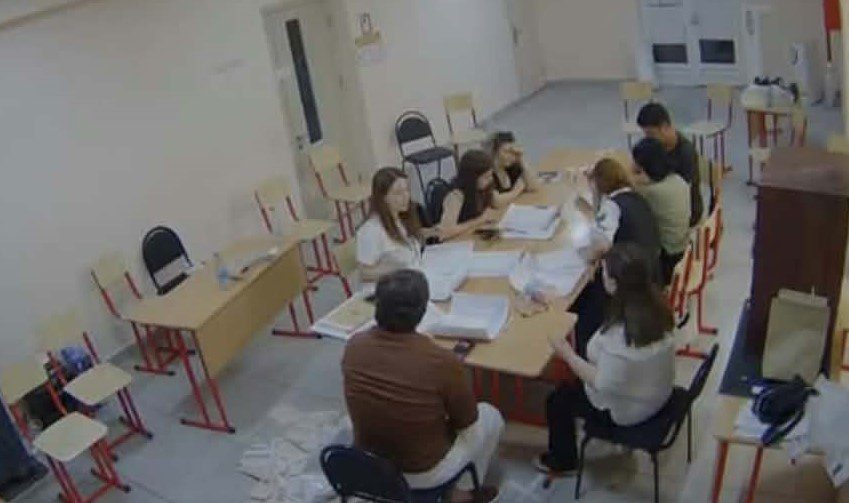 Some of these messages tried to convince people that it was possible to monitor a citizen’s choice at polling stations, see who they voted for, or even change the result of the vote through technical means.
However, such claims were often based not on the actual mechanisms of the electoral process, but on fear and distrust.
In this article, we present several common claims and explain how a citizen’s vote is actually protected at the polling station.
Myth 1: “Hundreds of people are brought to polling stations in buses to vote for others”
The fake.
On election day, videos and photos were shared on Telegram channels and social media, with accompanying posts claiming that the authorities were transporting hundreds of buses of “foreigners” or residents of other cities to specific polling stations in Yerevan to vote for others.
Some publications tried to present the same footage as evidence of election fraud, regardless of when and where it was filmed.
Reality.
The existence of such a video does not in itself prove the fact of fraudulent voting at a polling station. During the fact-checking, some of such footage was found to be old or related to other situations, including the transfer of employees.
Additionally, voter identification in Armenia is carried out at the polling station using electronic devices. This is intended to exclude cases where one person attempts to vote more than once or on behalf of another person.
In other words, simply moving people from one place to another does not mean that they can vote for others.
Myth 2: “The same voter list can be scanned multiple times with the device”
The fake .
There was also a claim circulating on social networks that the same voter list could be scanned multiple times using an electronic identification device, thus artificially increasing the number of voters.
Reality.
The electronic identification system is designed for one-time voter identification and monitoring of the voting process. Electronic data is compared with voter registration and electoral documents.
Therefore, the claim about “running the list several times with the machine” does not mean that it is possible to vote twice for the same people.
Myth 3: “Secret devices are installed in the voting booth that can see who you voted for”
The fake.
Before the elections, a fake platform called Haymitq.am, as reported by JAMnews, spread information that secret devices would allegedly be installed in polling booths at polling stations, which could see citizens’ votes in real time and change the election result through the “Curtain” program.
Reality.
This claim contradicts the voting mechanism used in Armenia.
The citizen makes his choice with a paper ballot in a voting booth. The voting booth is designed to ensure the secrecy of the election, and at the time of voting, the citizen’s choice is not recorded in the electronic system.
It is also important to distinguish between two processes: voting and vote counting.
The voter’s choice during voting is secret. The voter’s vote is counted at the polling station, according to the procedure established by the commission, and the results are recorded in the relevant protocol.
Thus, the claim that “in the voting booth, they see who the citizen has voted for with a camera or a secret device” does not correspond to the actual organization of the vote.
Myth 4 : “The cameras are turned off during the count to allow for vote-rigging.”
The fake.
Allegations were also spread on social networks that the cameras installed at polling stations, which provide live broadcasts to the Central Election Commission website, would be intentionally turned off during the vote count in order to commit fraud.
Reality.
During the 2026 elections, more than 1,800 polling stations were provided with live broadcast, covering about 99 percent of voters. In the event of technical problems, they can also be recorded and verified by observers, proxies, and other participants present at the polling station.
Thus, an isolated technical failure cannot automatically be presented as evidence that electoral fraud occurred at a given precinct.
Moreover, the possible disconnection of the camera and the falsification of the vote count are not the same thing.
And who controls the polling station?
The process at the polling station is not carried out under the control of one person or one structure.
Parties and alliances that have a faction in the National Assembly, as well as the relevant electoral district commission, have the right to appoint members of the precinct electoral commission, in proportion to the law.
In addition to the commission members, the electoral process may be followed by observers and proxies, and in cases provided for by law, also by journalists.
This multi-layered oversight is important because at different stages of the electoral process it is possible to record problems, raise concerns about violations, and demand their verification.
What really protects our vote?
The secrecy of a voter’s vote and the controllability of the electoral process are ensured not by one “miraculous” technology, but by a combination of several mechanisms.
Electronic identification allows you to verify the identity of the voter and prevent double or impersonation attempts.
Paper voting ensures that a citizen makes their choice secretly, in a voting booth, without having it recorded electronically.
Counting votes at the polling station provides an opportunity to monitor the process and results in the presence of commission members, observers, and proxies.
Video recording and live streaming create additional transparency, allowing for monitoring of the work of polling stations.
And, finally, the multilateral composition of electoral commissions, the presence of observers and proxies create a mechanism of mutual control.
Why are such fakes dangerous?
The most dangerous form of election disinformation is not always propaganda in favor of a specific candidate or party.
Sometimes the goal is much broader: to convince people that their vote means nothing, that the election is controlled by some “secret system,” or that it is impossible to protect a citizen’s choice at the polling station.
Such stories can spread very quickly, especially when accompanied by videos, technical terms, or half-baked “evidence.”
Therefore, during every election, it is important to ask not only “who benefits from this information”, but also “how does the mechanism being talked about actually work?”
Every claim spread about the Kveakhtsi must be verified with facts, electoral legislation, and the actual technical mechanisms of the electoral process.
The secrecy of the vote is not a myth. It is one of the fundamental principles of the electoral process.
Tatevik Barseghyan
The material was prepared within the framework of the Disinformation Flows Monitoring Project

#CivilSocietyCooperation #ishrarmenia #ishrfactcheck
The project is implemented with the financial support of the Federal Foreign Office of the Federal Republic of Germany.

Leave A Comment