




Berlin, September 2025
“Untouchable and vulnerable”
The preservation of human dignity was the focus of the international congress of the Catholic solidarity campaign “Renovabis” for the people of Eastern Europe. Ukrainian Nobel Peace Prize winner Oleksandra Matviichuk gave a moving speech
BY MICHAEL LEH
Human dignity was the focus of the three-day International Renovabis Congress held in Berlin from September 9 to 11. Ukrainian Nobel Peace Prize winner Oleksandra Matviichuk gave a moving speech via video link from Kiev to the more than 200 congress participants. They had previously been welcomed to the Catholic Academy by Berlin Archbishop Heiner Koch and the managing director of Renovabis, Father Thomas Schwartz.
The participants came from many countries in Central, Eastern, and Southeastern Europe. Founded in 1993, the German Catholic solidarity campaign “Renovabis” for the people of Eastern Europe is active in 29 countries. The name ‘Renovabis’ comes from Psalm 104: “You will renew.” The motto of this year’s Renovabis Pentecost campaign was: “Full of dignity. Empowering people in Eastern Europe.”
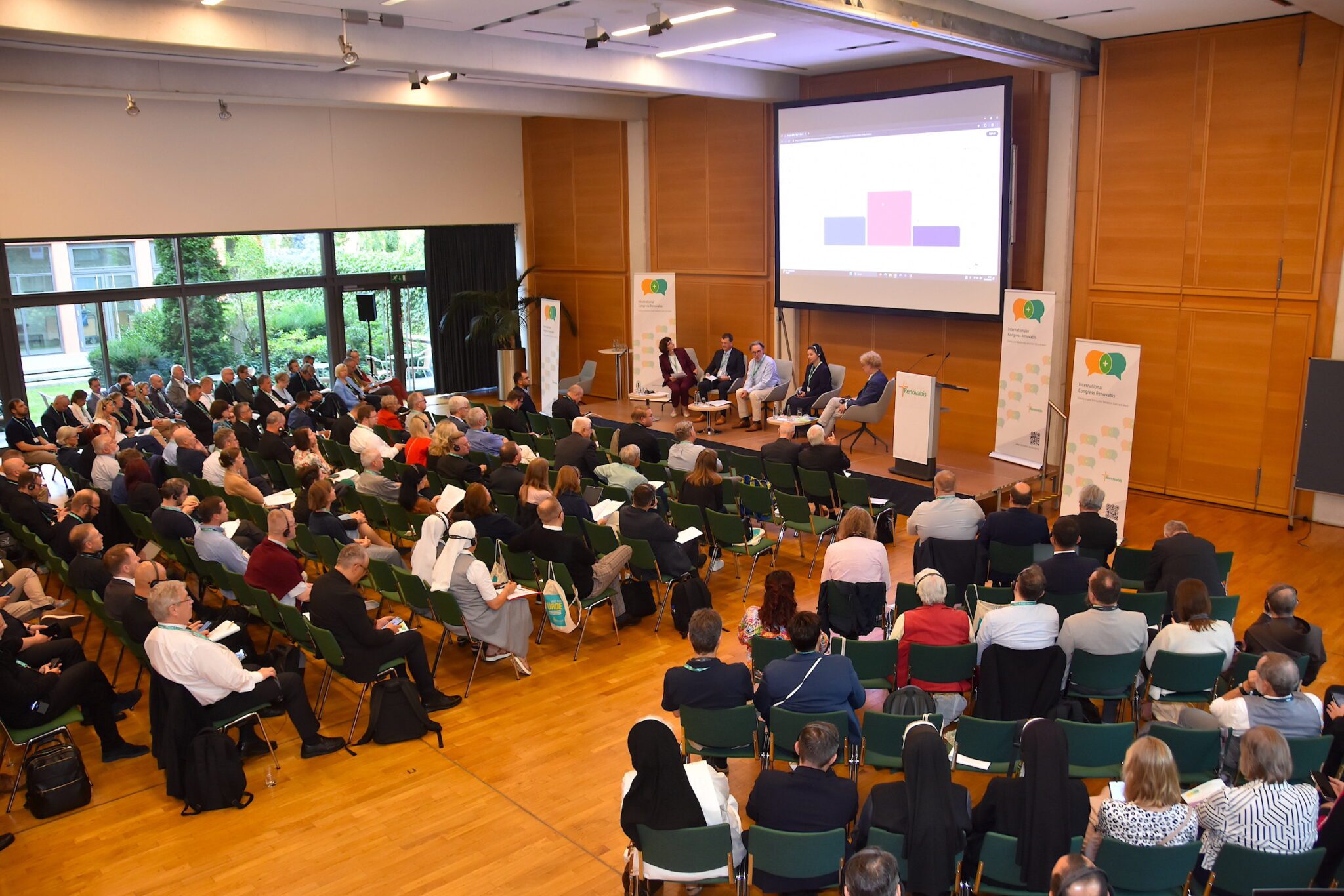
View of the hall at the Catholic Academy in Berlin, photo: Leh
Likeness to God
The congress emphasized the importance of the dignity of every human being as an expression of their likeness (imago Dei) to God. The first sentence of the first article of the German constitution reads: “Human dignity shall be inviolable. To respect and protect it shall be the duty of all state authority.” The heated discussions about whether unborn life is also entitled to indivisible human dignity have recently made it clear how endangered human dignity can be in our society. At the beginning of the congress, Archbishop Koch declared that Christians must “speak out vividly and committedly and stand up for human dignity in all phases of life without exception.”
The congress also formulated a final appeal. It states: “Every human being has dignity from the beginning because he or she is made in the image of God. It does not depend on success or strength.” However, human dignity is threatened by violence, social inequality, and exclusion. “When a person’s value is measured by performance and usefulness, when polarization and dehumanization increase, the common foundation of our society breaks down,” the appeal states. And: “We call on each and every one of us to take personal responsibility for humane coexistence – in everyday life, in the family, in the neighborhood, at work.” The way we treat the weakest among us shows “how human we are.”
Dignity as a matter of life and death
Jesuit Father Vyacheslav Okun, who comes from Ukraine, explained that he always visits a military cemetery in Lviv. He knew some of the fallen soldiers personally. Father Vyacheslav: “At this moment, when Ukraine is facing the greatest test of its independence, the word ‘dignity’ takes on a new and urgent meaning. It is no longer an abstract concept, but a matter of life and death, freedom and oppression, light and darkness.” War shows how fragile the line between humanity and inhumanity is. “We are witnessing,” Father Vyacheslav continued, “how easily a person can become ‘inhuman’ when they lose awareness of the image of God in themselves and in others. At the same time, we also see the opposite: extraordinary acts of solidarity, mutual support, and devoted love—glimmers of divine dignity that no darkness can extinguish.”
Occupation is just war in another form
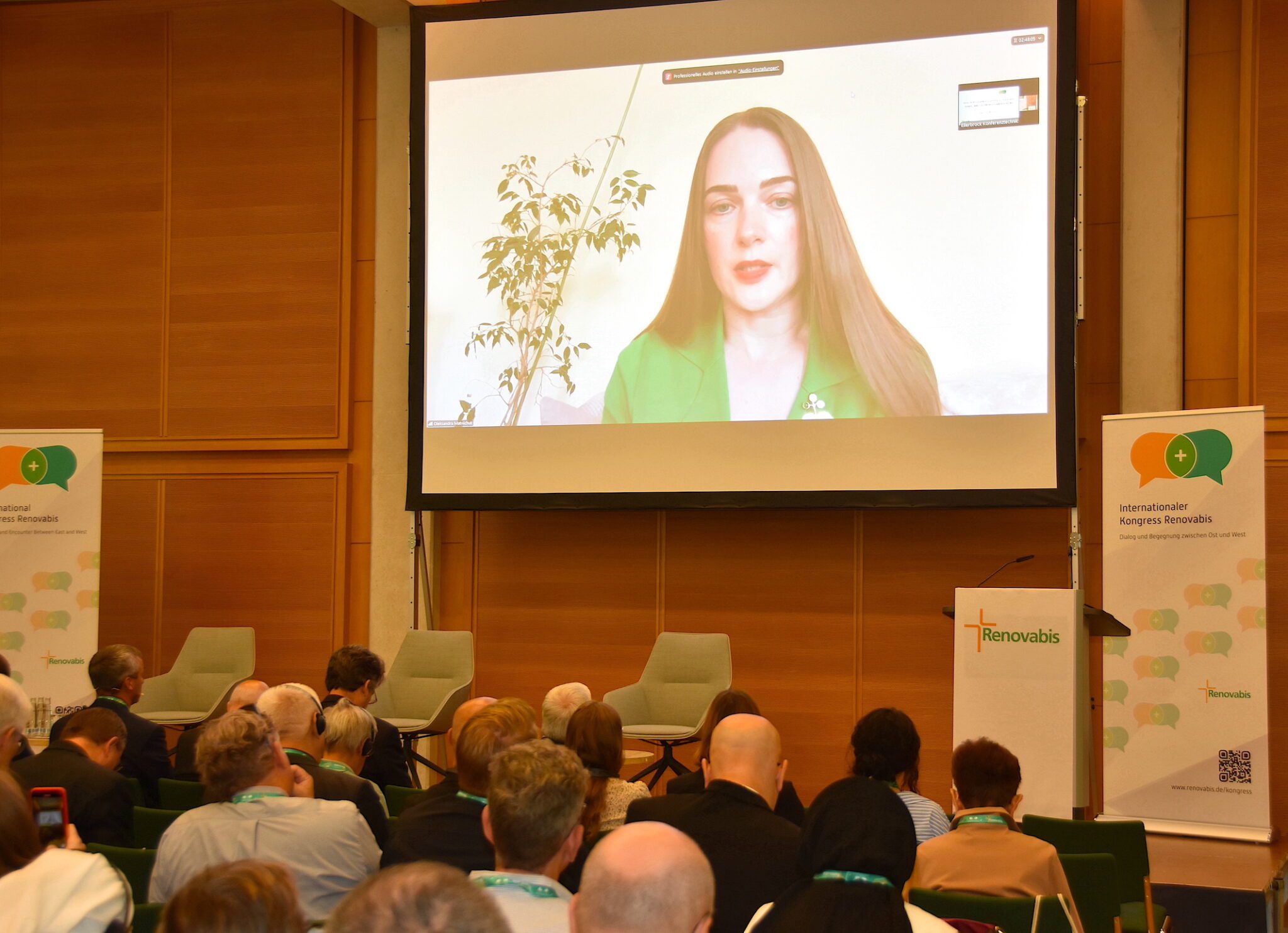
Nobel Peace Prize laureate Oleksandra Matviichuk spoke to the conference participants via video link from Kyiv. Photo: Leh
Oleksandra Matviichuk, a human rights lawyer who was awarded the Nobel Peace Prize in 2022, has documented more than 70,000 Russian war crimes in Ukraine since 2014 with her Center for Civil Liberties and other organizations. In her speech, she described individual atrocities as examples. Putin denies Ukraine’s right to exist and wants to wipe out the Ukrainian nation and culture. Civilian buildings and infrastructure, including hospitals, are being attacked indiscriminately. Matviichuk emphasized: “Some may think that occupation is better than war because it reduces human suffering. But occupation does not reduce human suffering, it only hides it. Living under Russian occupation means deportations, torture, rape, denial of Ukrainian identity, forced adoption of children, filtration camps, and mass graves. It is war, just in a different form.” Any peace built on the suppression of human suffering would be neither just nor sustainable.
Oleksandra Matviichuk, a human rights lawyer who was awarded the Nobel Peace Prize in 2022, has documented more than 70,000 Russian war crimes in Ukraine since 2014 with her Center for Civil Liberties and other organizations. In her speech, she described individual atrocities as examples. Putin denies Ukraine’s right to exist and wants to wipe out the Ukrainian nation and culture. Civilian buildings and infrastructure, including hospitals, are being attacked indiscriminately. Matviichuk emphasized: “Some may think that occupation is better than war because it reduces human suffering. But occupation does not reduce human suffering, it only hides it. Living under Russian occupation means deportations, torture, rape, denial of Ukrainian identity, forced adoption of children, filtration camps, and mass graves. It is war, just in a different form.” Any peace built on the suppression of human suffering would be neither just nor sustainable.
She herself has interviewed hundreds of people who survived Russian captivity: ”They reported being beaten, repeatedly raped, locked in wooden boxes, their knees smashed, their genitals tortured with electric shocks, their fingers cut off, their fingernails pulled out and drilled into. One woman had her eye gouged out with a spoon.“ Matviichuk emphasized: ”Russian soldiers commit these war crimes simply because they can—without being punished.” Putin and other Russian government and military officials must be prosecuted.
Matviichuk underscored the importance of each individual’s commitment in light of her experiences in Ukraine: “Ordinary people can do extraordinary things.” In Ukraine, ordinary people repeatedly risk their lives to save others they have never met before.
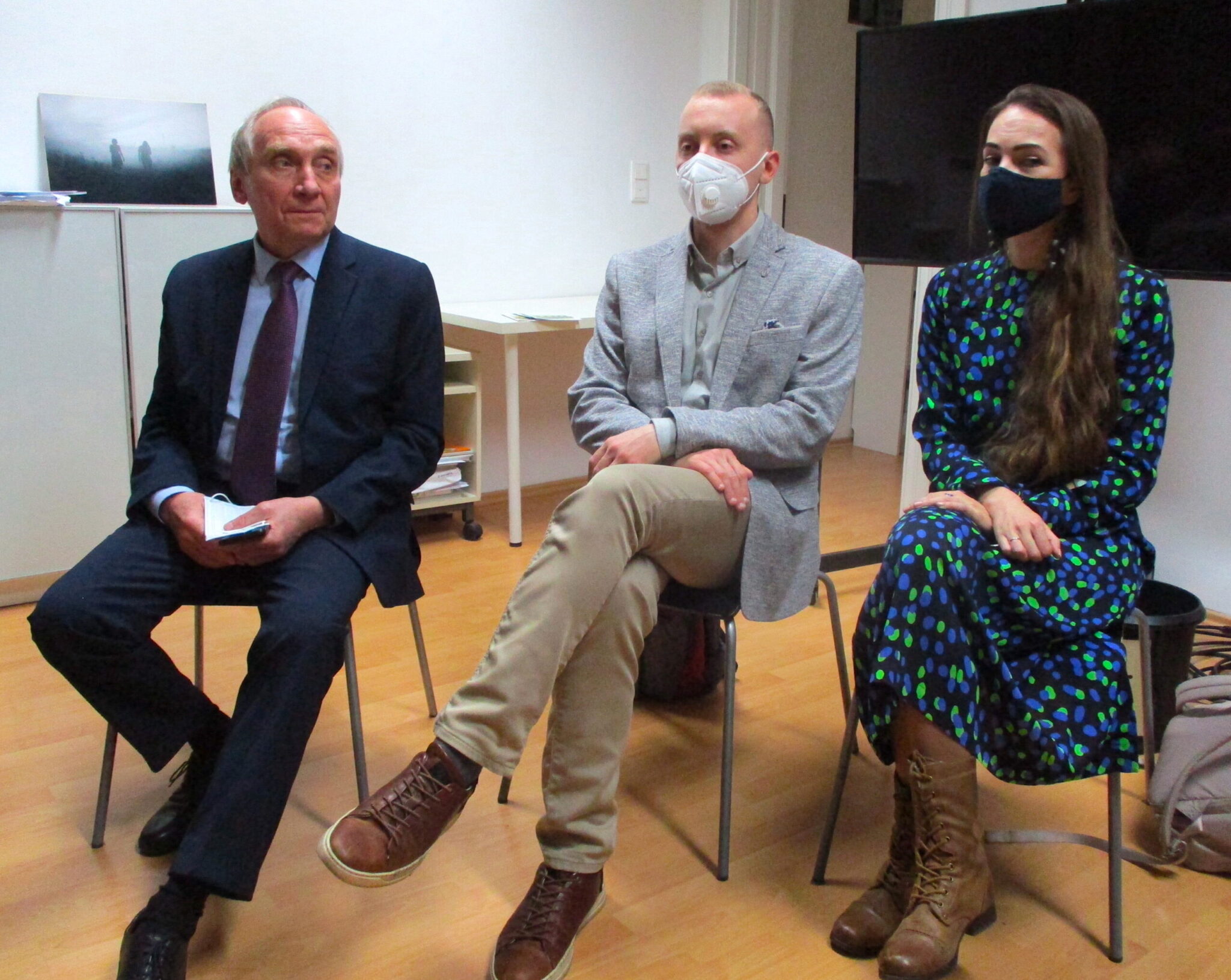
Oleksandra Matviichuk (right) accompanied former political prisoners and torture victims Prof. Ihor Kozlovskiy (left) and journalist Stanislav Aseyew (centre) from Donetsk prison to panel discussions in Berlin in December 2021. Photo: Michael Leh
Lectures for rats in prison cell
The author of this article had already met Oleksandra Matviichuk in Berlin in December 2021, before she had been awarded the Nobel Peace Prize. At that time, she had accompanied philosophy professor Ihor Kozlovsky (who died in 2023 at the age of 69) and Ukrainian journalist Stanislav Aseyev, both of whom were political prisoners in the same prison in Donetsk and had been tortured. Kozlovsky also had a leg broken during the torture. Matviichuk had recorded his statements after 700 days of Russian captivity. As she reported in her speech at the Renovabis Congress, Kozlovsky had also given philosophy lectures to the rats that came up through the sewers in his windowless, filthy cell during his solitary confinement – “so that they could hear the sound of a human voice” (and probably his own as well).
Discussion forums, lectures, excursions
During the congress, there were several panel discussions, lectures, dialogue groups, and excursions—for example, to a Caritas hospice in Berlin Pankow. Topics included “Living in dignity. Dimensions of human dignity and questions surrounding it” (introductory lecture by Ingeborg Gabriel, professor emeritus of social ethics from Vienna), “Challenges and dilemmas based on the question of assisted suicide” (with Professor Andreas Lob-Hüdepohl and Professor Jean-Pierre Wils, among others).
Parliamentary State Secretary Johann Saathoff (SPD) spoke on “Politics has a duty – dignity as a guide for development and cooperation.” In a “Country Focus: Bulgaria,” Diana Dimova reported on border protection and the treatment of refugees. Harutyun Harutyunyan from the University of Yerevan in Armenia spoke about internally displaced persons from Nagorno-Karabakh/Artsakh. Father Norbert Frejek SJ from Chernivtsi explained the traumas of war in Ukraine. Other topics included the practice of pregnancy conflict counseling, violence against women, and assistance for victims of human trafficking.
*
This article by IGFM board member Michael Leh appeared on September 18 2025 in the Catholic weekly newspaper “Die Tagespost.” We are publishing it here with the kind permission of the author.
Leave A Comment