




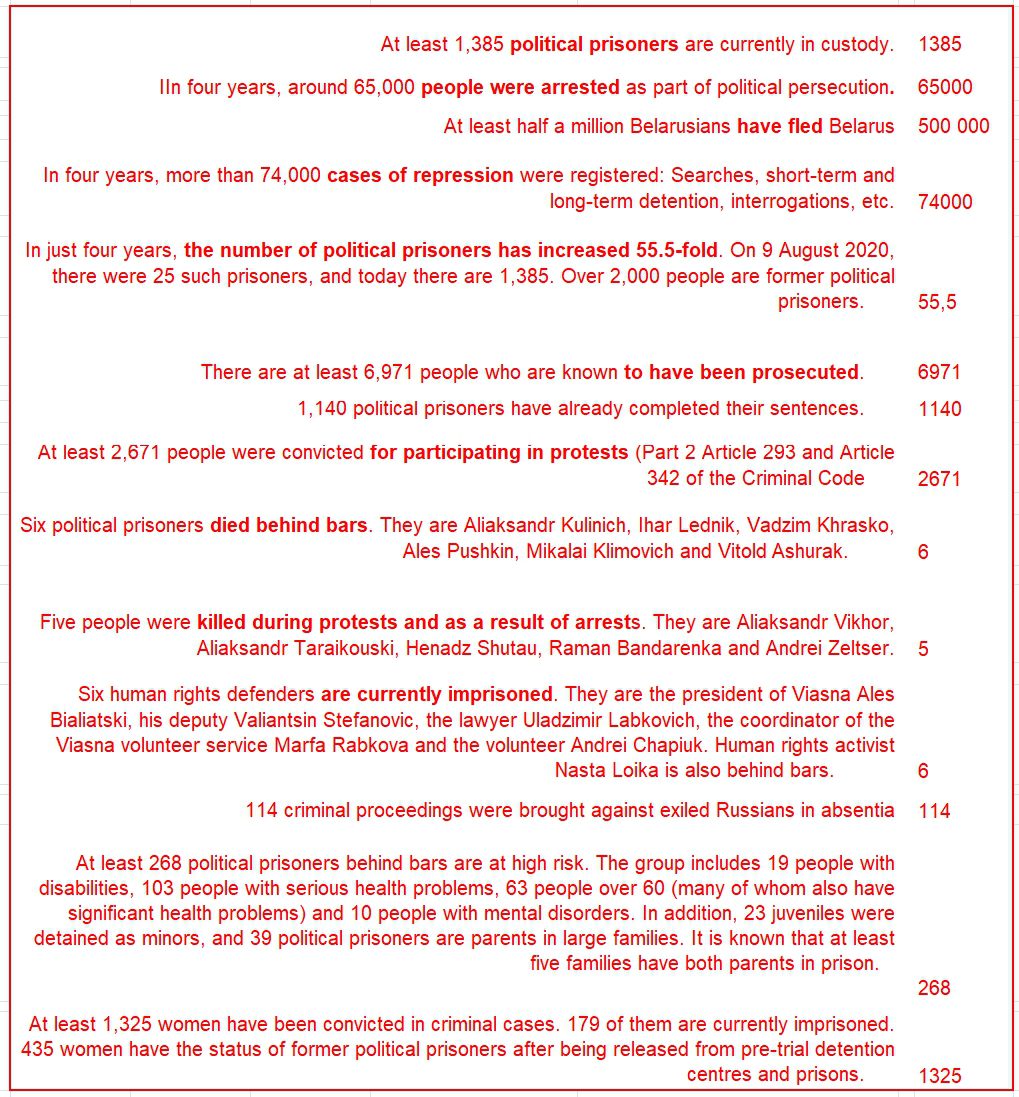
Exactly four years after the uprising of the Belarusian democracy movement in the summer of 2020, the best-known exile organisation ‘Viasna’ presents its infographic ‘4 Years of Mass Repression’. Excerpts from it here at a glance
Looking back: Spring 2020 – 3 presidential candidates eliminated
Courageous and powerful men had indeed put themselves on the list of presidential candidates for the election in August 2020 in accordance with democratic principles. But what does a dictator do with such promising and popular candidates as video blogger Serghei Tikhanovsky, bank manager Viktor Babarika and diplomat Valery Zepkala? In fact, Tikhanovsky was arrested in May, followed by Babarika and his son in June, and Zepkalo managed to flee the country in July.
Wife not taken seriously by Lukashenka as presidential candidate
However, this is not the end, but the beginning of recent Belarusian history. At the last minute, Tikhanovsky’s wife managed to get herself put on the official list of presidential candidates in his place. And the only reason why she was not immediately imprisoned was that nobody in the circles of the dictator Lukashenko actually thought that a housewife and mother could pose a serious threat, and at the same time it gave them the opportunity to show that any citizen can run for president.
Election campaign of the female trio captivates the people
Yet Svetlana Tikhanovskaya, whose husband was now behind bars, turned out to be anything but a mum at the cooker. She bravely and diligently took on the great responsibility of her sudden role as presidential candidate against the ‘last dictator of Europe’ Aleksander Lukashenka. Supported by a team of the new generation who wanted to lead Belarus out of the fossilised post-Soviet dictatorship and into the long overdue democratic reality of the 21st century. Supported by the wife of the fugitive presidential candidate Veronika Zepkalo and the Belarusian musician Maryja Kalesnikawa, who had travelled from Germany to support Babarika’s election campaign team.
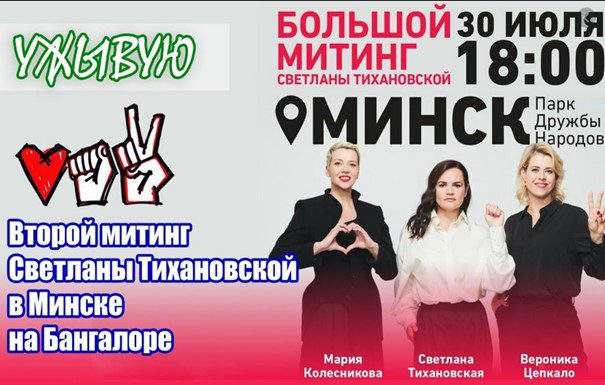
vlnr Maryja Kalesnikawa with a heart, Svetlana Tikhanovskaya with a fist and Veronika Zepkalo with the Victory sign, advertising the major event in the capital Minsk on 30 July 2020.
In their nationwide election campaign, this trio achieved something that had never been seen before on this scale in Belarus – they brought real hope for change. Belarusians understood how brave these women were, what they were risking with their performances. They could identify with these authentic women from the people, and they saw at the election events with tens of thousands of visitors how enormous their numbers were throughout the country.
As has been the case for 26 years, the election result remains 80 per cent in favour of the dictator
But what does an electoral commission that has calculated an average of 80.31 per cent for Lukashenka in six presidential elections over the past 26 years do on the evening of 9 August 2020? Quite simply, 80 per cent of the votes remained in favour of the president.
Overwhelming, peaceful mass demonstrations as family walks
This result could not be true in view of the masses that this women’s team had moved, everyone understood that much. And so people immediately took to the streets and protested or demonstrated. These were extraordinary mass demonstrations that stood out for their modern, decidedly peaceful and civilised form. Hundreds of thousands of Belarusians were dressed in the colours of the Belarusian democracy movement, mostly in white, holding red roses in their hands, countless families with prams and grandpa and grandma in tow. They raised endless white and red flags above their heads. The daily aerial images of the demonstrations in the international media were so overwhelming that there was real hope for a historic change of system in Belarus.
Brutal suppression with Putin’s help
But what does a dictator do with such mass demonstrations? Lukashenka was dependent on massive help and although he wanted to rule his country all by himself, as a subordinate supplicant he had to ask the responsible higher-ranking dictator for support. With a billion-euro injection from Putin and Lukashenka’s promise that they would all be hunted down, the somewhat rusty Stalinist secret service was quickly brought back up to full speed.
People were pulled out of the demonstrations by special rolling squads, cries for help tore the air, the red of the roses was covered by the blood of violence. The detention centres were flooded with tens of thousands of completely blameless citizens who were now completely defenceless in the face of massive police violence. Tens of thousands more fled abroad to escape this violence.
Devastating status quo after four years
Today, exactly four years on, the best-known Belarusian organisation Viasna, which is backed by the internationally recognised leader of the Belarusian democracy movement Svetlana Tikhanovskaya, is publishing a chilling ‘Infofragraphic: 4 years of mass oppression’ from exile in Lithuania.
Behind these figures lies immeasurable suffering, national trauma and ongoing dictatorial terror.
Considering that Belarus has less than 10 million inhabitants, that about half a million have fled the country since then and that almost 75,000 cases of repressive police operations have been registered, about one in 15 Belarusian citizens is personally persecuted.
ISHR affected at first hand
The IGFM was and is also personally affected. Due to its own founding history, the links to Eastern Europe are the longest and the IGFM has independent sections in almost all countries of the former Soviet Union. The last decade before the violent suppression of the democracy movement in Belarus was characterised by regular meetings of all these sections, joint plans for the future and unforgettable youth exchange events.
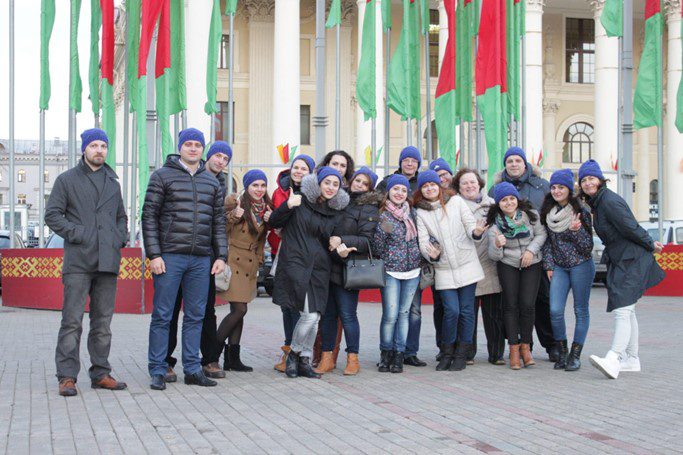
ISHR Youth Exchange of the Eastern Partnership, Minsk/Belarus, 2015
Young people from all Eastern Partnership countries on a boat trip on the Dnipr in Kyiv, a bus tour in Minsk or discovering the German metropolis of Frankfurt. What impressed her most was a typical question at the end of the events: ‘I think it’s really great how freely and informally people talk to each other here, I’ve never experienced anything like that before, it’s not possible here,’ said the Belarusian participant.
In this respect, we were there from the very beginning of the -major- police violence in Belarus and received a flood of information over many months that we could hardly cope with. Belarus was the focus of the Western media, Eastern European organisations and the EU; there were countless campaigns, events and documentaries. The many Belarusian exile organisations, whether large or small, were powerful and full of hope.
The ISHR alone reported continuously and in four languages on the fate of political prisoners, torture, the gradual closure of the independent media and much more. It sought out and informed politicians who were committed to sponsoring the prisoners, it constantly promoted writing letters to political prisoners and created its own stamp campaign with portraits of the prisoners designed by artists for this purpose. In autumn 2021, she organised a rally at the Römer in Frankfurt and lined the square in the colours of the Belarusian democracy movement. The honorary chairwoman of the IGFM, Katrin Bornmüller, and her Wittlich working group continue to support the Belarusian exiles in Lithuania with countless aid shipments.

ISHR stamp campaign with artistic pictures of the Belarusian political prisoners Svetlana Kupreeva and Sergei Petrukhin – both now released from prison


Autumn 2021, large ISHR rally together with Martina Feldmayer MdL and Kulturverein Belarus/KuB. Speakers included M. Gahler, MEP, many members of the Bundestag, Frankfurt Mayor Eskandari-Grünberg and Eastern Europe expert Manfred Sapper from the German Association for Eastern European Studies (DGO)
Bare numbers that cannot depict the suffering
If we look at the bare numbers of the Viasna infographic today, we see the number 5 among the people who were murdered during the arrests during the demonstrations. The first person to be killed with a firearm was Gennady Shutov from Brest, a rather apolitical happy father of five children. At that time, we were still able to visit the family through our local contacts, talk to them, give them comfort and support them in their legal defence.
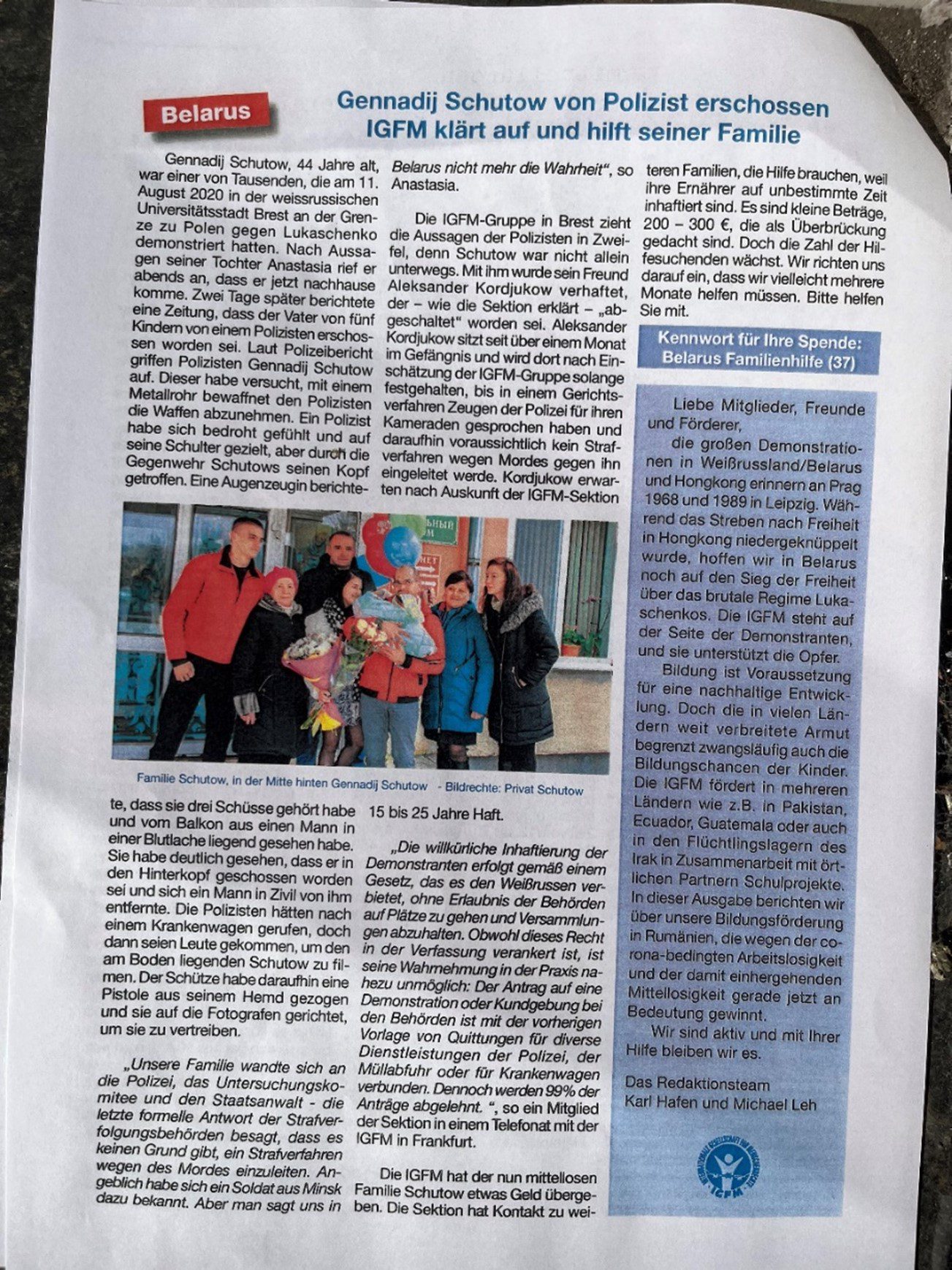
First death by firearm, In: ISHR Newsletter ‘For Human Rights’, Oct. 2020
We reported on this case in great detail, as well as on the fact that the perpetrator, a member of the military who was suddenly sent into action with a weapon, was never convicted. And about the fact that Shutov’s friend, Alexander Kurdyukov, was sentenced to 10 years in prison in February 2021 for allegedly threatening this soldier. The family of the murdered man gave us very personal insights into their family album: the eldest daughter had just got married – the proud father dancing with the bride; the first grandchild had been born – pictures of a happy extended family welcoming their new arrival with colourful balloons. Other pictures – Gennadij with a big fish on a fishing rod or as a free man on a motorbike.
And let’s take a look at the number 1140, political prisoners who have already served their sentences today. The IGFM was affected here in November 2021, when one of our young colleagues was taken away from his parents’ flat by a five-man mobile squad.
With ‘good luck’, he had received ‘only two years’ and is now back in freedom, or rather in the ‘big prison’ that Belarus has now become. His release was followed by close surveillance, monitoring and many other deep cuts in his life. As in Soviet times, professional careers are over, bank accounts are monitored and much more.

Prof. Dr Yuri Bubnov, February 2022, Belarus
But older IGFM friends are also among the number 1385, the current political prisoners. For example, 68-year-old sociology professor Yuri Bubnov, who was arrested at his workplace at the university in February 2022. He was also given ‘only two years’ for analysing the events of summer 2020 and concluding that the democracy movement was also united in its dissatisfaction with the president.
Torture for life
The prison sentences for well-known leaders of the Belarusian democracy movement, which start at 10 years, were quite different. For example, in March 2023 for the Nobel Peace Prize winner and founder of Viasna, Ales Bialiatski. The well-known flautist Maryja Kalesnikawa, who had travelled from her workplace in Stuttgart to join Babarika’s election campaign team and played a key role in supporting Tikhanovskaya after his arrest, was sentenced to 11 years. Tikhanovskaya’s husband, Sergei Tikhanovsky, who is now 46, received 19.5 years!
Incommunicado detention – complete isolation from the outside world
All of them and many others have been in ‘incommunicado’ detention for a year. They have been tortured for over a year by being denied any contact with the outside world, no letters, no phone calls, the lawyers themselves are behind bars or in exile. Many have to sleep on the bare floor and are incarcerated for months in solitary confinement.
Belarusian democracy movement goes through hell
How does one endure this in prison and how is it bearable for loved ones outside the prison walls? And this since Belarus has been so forgotten in the Western world, not least because of the war in Ukraine? Thinking about this brings us closer to the current emotional state of the Belarusian democracy movement: it is going through hell.
The Belarusian opposition leader Svetlana Tikhanovskaya provides very personal insights into this emotional world from her exile in Vilnius in her interview with the Secretary General of the IGFM/ISHR (International Society for Human Rights) for his current book ‘Defending Human Rights’, which sensitively presents seven life stories of human rights defenders.
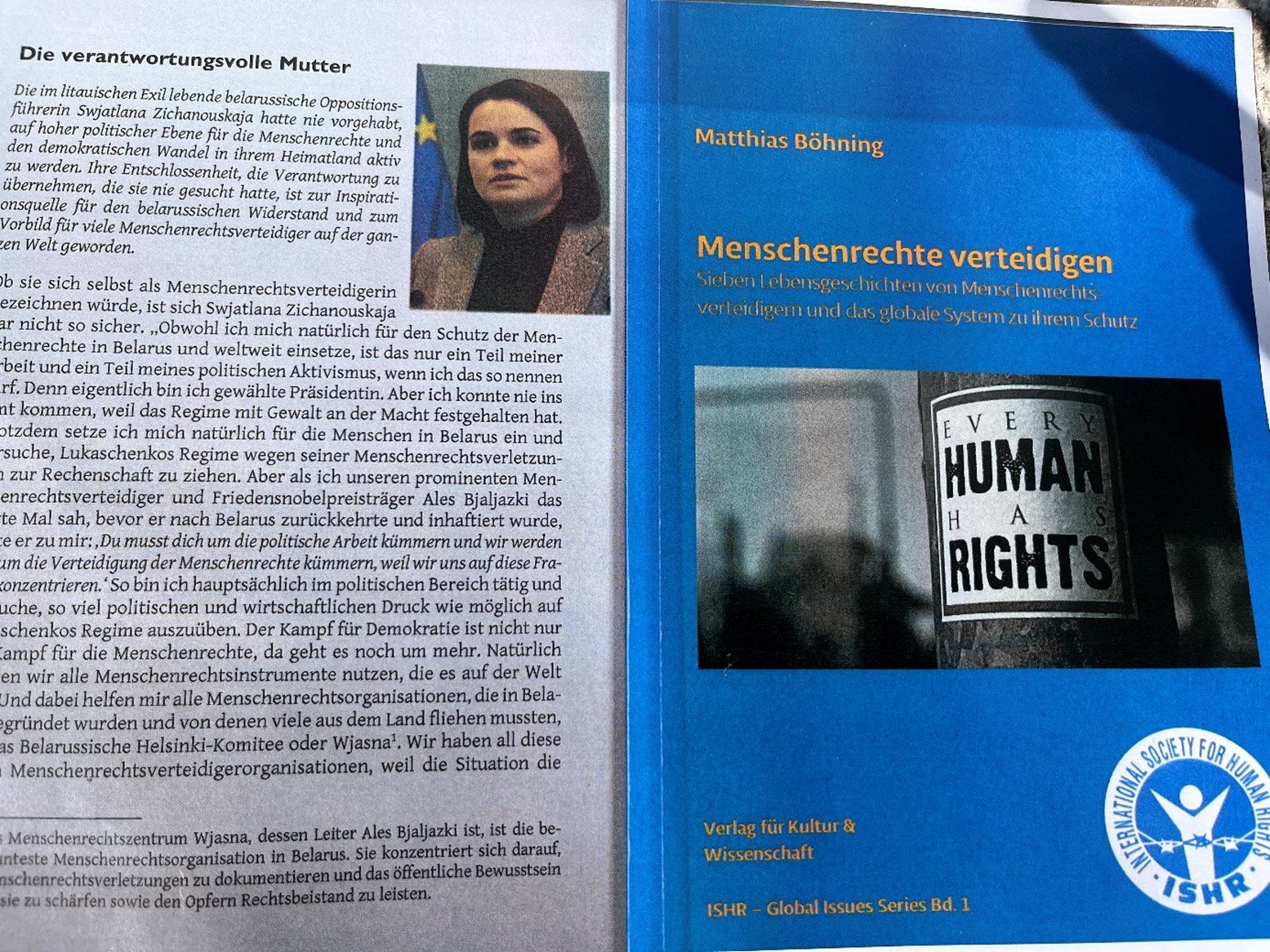
Interview with the Belarusian opposition leader Svetlana Tikhanovskaya in ‘Defending human rights’ by Matthias Böhning, 2024
Increasing pressure as Western European attention wanes
As a result of the Russian war of aggression against Ukraine and the crimes committed by the Russian military against the Ukrainian population and the resulting flight of millions of people, the ISHR was compelled to share its previous energetic support for the victims of the democracy movement in Belarus in favour of our Ukrainian colleagues active in refugee aid. We are keeping a close eye on developments in Belarus and helping where and how we can.
And even this inconceivable, barbaric war of aggression against the largest country in Europe with a population of over 60 million has now lost some of its attention and sympathy on our own continent. Western Europeans are overwhelmed by the increasing global catastrophes and even many directly affected Ukrainians and Belarusians have fled from the trauma into a kind of carpe diem mode.
Meanwhile, and here is another recent figure from the Viasna team, there are 55.5 times as many political prisoners in Belarus today as there were in 2020.
Brave, responsible figures for the Belarusian people
It is clear that all these bare figures cannot reflect the unspeakable pain that lies behind them. But there is another elementary power in the precise collection of data. It shows the victims that their fate is being recorded, that they will not be helpless and defenceless forever and that the perpetrators can be held accountable, because there is no statute of limitations for such serious crimes against universal human rights.
Responsible support from the international community of values is urgently needed
In this respect, the exiled ‘president’ and her Viasna team have been assuming government responsibility for their people in a highly professional and admirable manner on a daily basis for the past four years. It would be desirable for the international community of values to fulfil its responsibility towards the Belarusian democracy movement to the same extent, regardless of all the world catastrophes. After four years, it could urgently use a boost of motivation!
Leave A Comment