




24 February 2026 — the next anniversary of the start of Russia’s full-scale invasion of Ukraine.
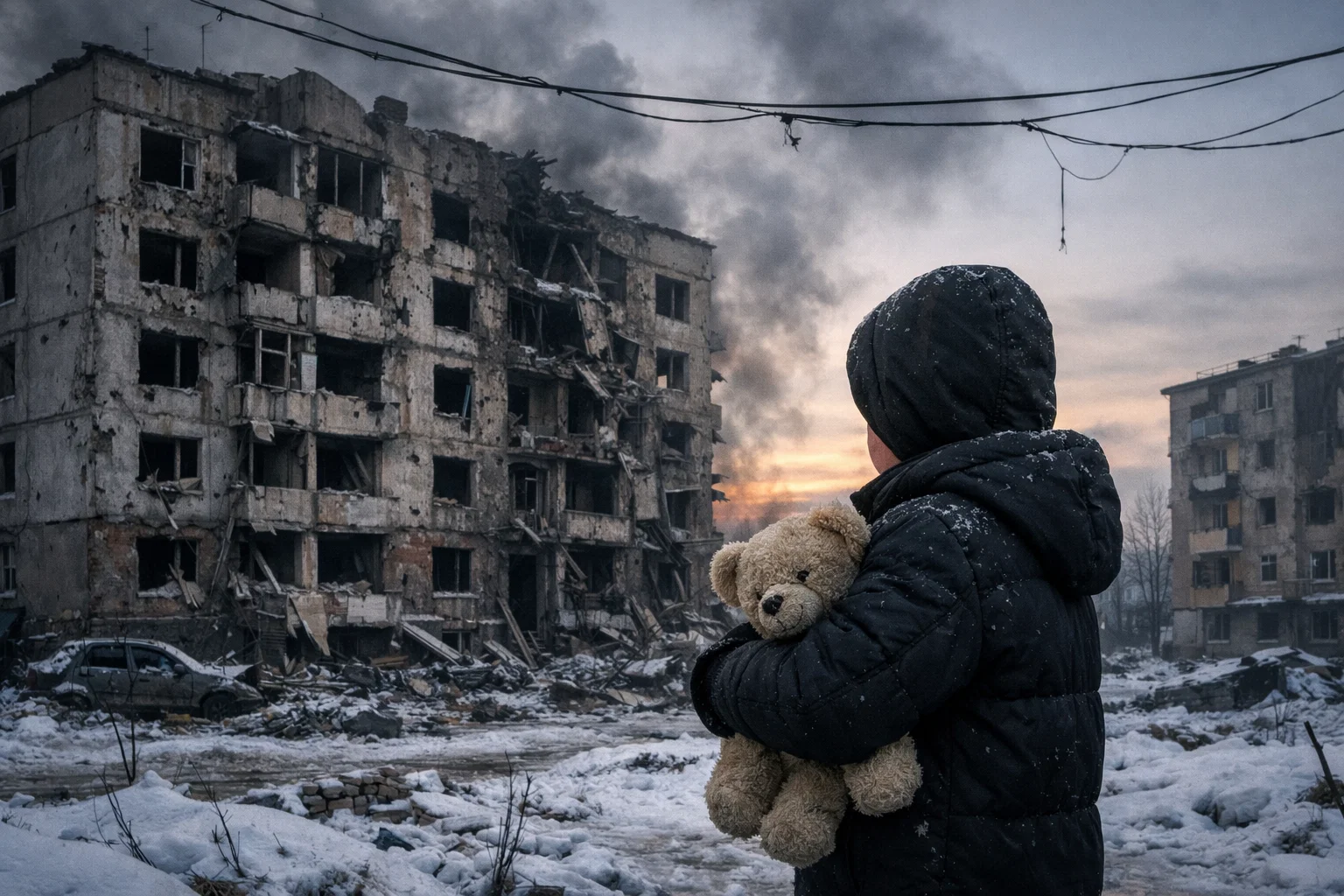
The illustration was created with the help of AI.
Over the course of four years, the war has not only changed the architecture of European security, but has also become one of the most documented humanitarian disasters of the 21st century. Its main outcome has been tens of thousands of civilian casualties, millions of displaced persons and systematic, often demonstrative violations of international humanitarian law.
The scale of civilian casualties
According to United Nations missions, the actual number of civilian casualties significantly exceeds the confirmed cases. Shelling of residential areas, strikes on energy infrastructure, hospitals, schools and water supply facilities have become part of everyday reality for Ukrainian cities.
The events in Bucha and the siege of Mariupol, where mass killings, the destruction of a theatre sheltering civilians and the blocking of humanitarian corridors were recorded, have become particularly tragic symbols of this war. International investigators have classified many of these incidents as possible war crimes.
Extrajudicial executions, torture and enforced disappearances
Human rights organisations, including the International Society for Human Rights (ISHR), have documented throughout the four years:
- extrajudicial executions;
- cases of torture and ill-treatment of prisoners;
- enforced disappearances;
- filtration camps and arbitrary detentions in the occupied territoriesх.
Testimonies from former prisoners indicate systematic violence: beatings, use of electric shocks, threats of sexual violence. International humanitarian law expressly prohibits such actions regardless of the status of the conflict.

The illustration was created with the help of AI.
Deportations and children’s rights
The international community has paid particular attention to cases of forced displacement of Ukrainian children to Russia. These actions have become the subject of an investigation by the International Criminal Court, which has issued arrest warrants on suspicion of illegal deportation of minors, including against Russian President Vladimir Putin.
Forcibly changing custody, nationality, and the conditions of raising children in wartime may be classified as a war crime and, under certain circumstances, as a crime against humanity.
Attacks on energy infrastructure
Systematic attacks on energy facilities during the winter months led to widespread cuts in heating, water and electricity supplies. Millions of citizens were threatened with a humanitarian disaster in sub-zero temperatures. International law prohibits attacks on facilities that are essential for the survival of the civilian population.
Freedom of speech and persecution of dissent
In the occupied territories, there have been reports of persecution of journalists, activists, local government officials and religious communities. The closure of independent media outlets, kidnappings and pressure on peaceful activists indicate an attempt to suppress any public criticism.
At the same time, the war has intensified repression within Russia itself: anti-war statements, social media posts and participation in peaceful protests have become grounds for administrative and criminal prosecution. Thus, the conflict has affected the human rights situation on both sides of the front line, although the scale of destruction and violence in Ukraine is incomparably greater.
Impunity as the main challenge
After four years of war, the key issue remains not only documenting crimes, but also bringing those responsible to justice. The work of international investigation teams, national prosecutors and human rights defenders continues, but the lack of immediate justice reinforces the sense of impunity.
The history of international conflicts shows that lasting peace is impossible without justice. Documenting crimes, supporting victims and protecting witnesses is not only a legal procedure, but also a moral obligation of the international community.
The result of four years
Four years of war means:
- millions of refugees and internally displaced persons;
- destroyed cities and infrastructure;
- a generation of children who grew up to the sound of sirens;
- a deep wound that will be felt for decades.
On the anniversary of the start of the full-scale invasion, the main question remains the same: will the international human rights protection system be able to prove its effectiveness not on paper, but in real mechanisms of accountability and restoration of justice?
Leave A Comment