




Crimea. Peninsula of fear
Russia continues to persecute Crimean Tatars – Appaz Kurtamet is the youngest Crimean Tatar political prisoner and is being held in Siberia
BY MICHAEL LEH
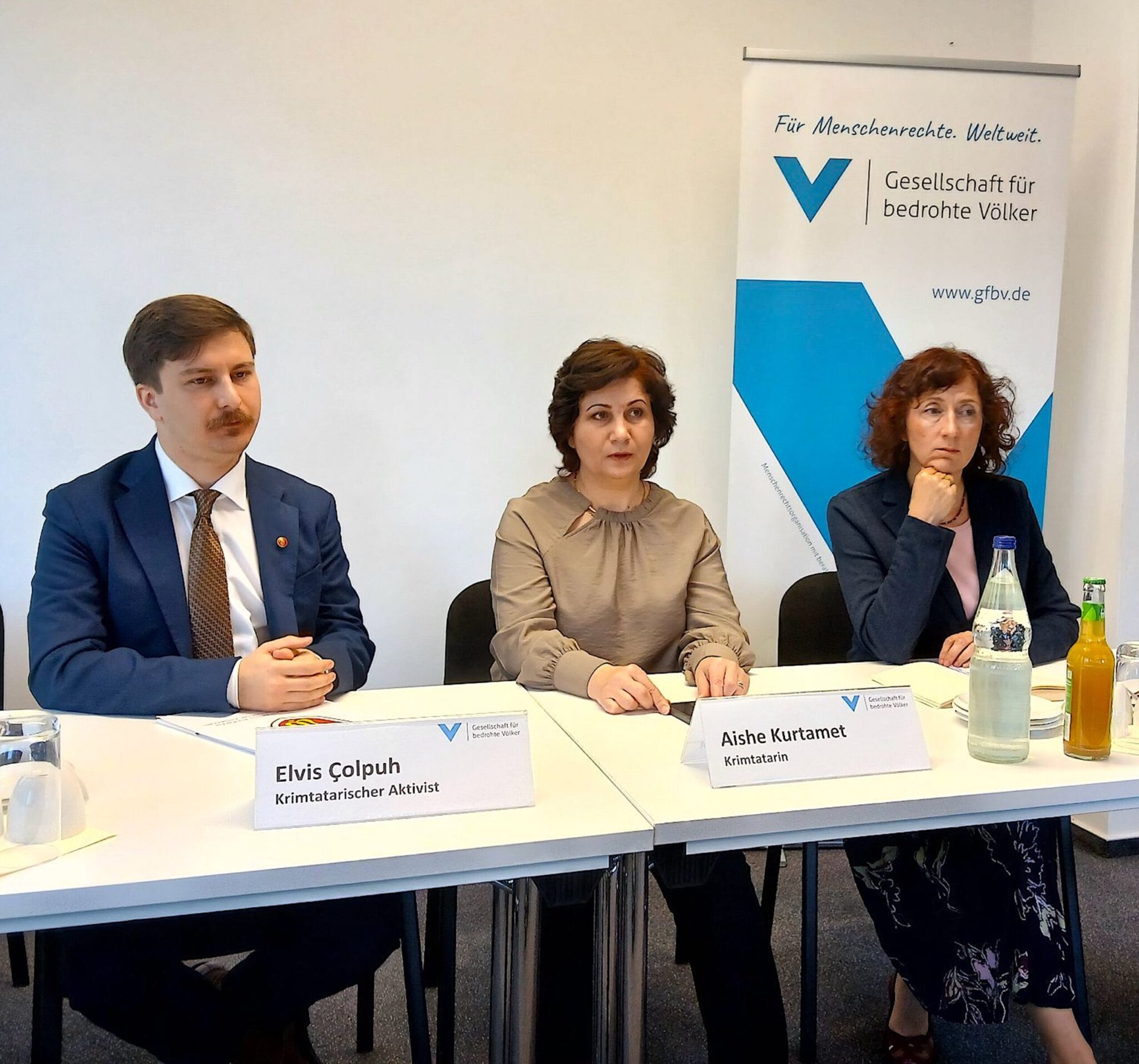
At the press conference of the Society for Threatened Peoples in Berlin (from left): Elvis Colpuh, Aishe Kurtamet, and Sarah Reinke. – Photo: Michael Leh
The Society for Threatened Peoples (STP) has reported in Berlin on the ongoing persecution of Crimean Tatars on the Crimean peninsula, which has been annexed by Russia. A STP documentary is entitled “Peninsula of Fear.” Sarah Reinke, the Society’s Ukraine and Crimea expert, pointed out that in June 2024, the European Court of Human Rights (ECHR) also declared in a landmark decision (Ukraine v. Russia, re Crimea) that Crimean Tatars in particular are subjected to numerous human rights violations. They are the target of intimidation tactics, pressure, physical attacks, threats, searches, arrests, and punishments.
Crimean Tatars are being taken to prisons in Siberia
According to the STP, as of September 2025, 220 people from Crimea are being unlawfully detained for ethnic, religious, and political reasons. More than half of the political prisoners are Crimean Tatars. They are often deported to areas of Russia far away from Crimea. Prison sentences of up to 20 years and solitary confinement are imposed. At least 30 women from Crimea are also in Russian prisons. In recent months, there have also been several reports of arbitrary disappearances of Crimean Tatars. Crimean Tatar identity, language, and culture are systematically suppressed. Crimean Tatars are also harassed and persecuted as Muslims.
Torture and long prison sentences
Aishe Kurtamet, the mother of the youngest Crimean Tatar political prisoner, Appaz Kurtamet, and Crimean Tatar Elvis Colpuh were present at the STP press conference in Berlin. Colpuh, 29, is a doctor, musician, and dir
ector of the Crimean Tatar cultural institute “Kerem” in Nuremberg, which he founded. As Ms. Kurtamet explained, her son and his father Khalil were abducted by the Russian secret service FSB in July 2022 in the southern Ukrainian city of Kherson. “At first, I had no idea where the two of them were,” she said. It was only after three months that she learned that Appaz, now 22, had initially been taken to a remand prison in Crimea. The 58-year-old father was sentenced to eight years in prison and the son to seven years. Both were tortured. The son is now in a prison in the Pskov district of Siberia.
“I am proud of my son”
“According to the verdict, Appaz was accused of supporting his friends who are fighting in the Ukrainian army. The accusations are fabricated; both are completely innocent. Appaz has friends in the Ukrainian army, but that is not a crime. The Russian occupiers are solely to blame for everything.” According to the Ukrainian human rights organization KHPG, Appaz Kurtamet sent the equivalent of twelve euros to a friend who was defending Ukraine in a volunteer battalion called “Crimea.”
Aische Kurtamet said in Berlin: “Appaz is a Ukrainian patriot. Before his arrest, the FSB had tried to recruit him. They told him it would be better for him to work for them, otherwise he would face ten to fifteen years in prison.“ Many people in his circle had suffered the same fate, being pressured during recruitment attempts and threatened with torture. Many had then changed sides. ”I am proud of my son for resisting, even though he is still so young. He basically said he would rather go to prison than work for the FSB. He preserved his dignity and was very brave for his young age,” explained Ms. Kurtamet.
The status of Appaz and Khalil Kurtamet as prisoners of conscience has not yet been confirmed by the International Red Cross, she added. “This makes it very difficult to include them in a prisoner exchange, for example. I ask that many people lobby the International Red Cross to have this status recognized so that the International Red Cross can negotiate with the Russian Red Cross.”
Russia wants to change the demographics of Crimea
According to Elvis Colpuh, there are still about 350,000 Crimean Tatars living in Crimea. That is about 12 percent of the population. Since 2014, about 50,000 Crimean Tatars have fled to mainland Ukraine. Russia has been heavily colonizing the peninsula since 2014. “They have conducted recruitment campaigns throughout Russia, even as far as Kamchatka,” said Colpuh. Crimean Tatars’ houses are being given to immigrants and higher salaries are being promised. “It’s really about changing the demographics,” explained Sarah Reinke.
Colpuh pointed out the major problem of citizenship. “Crimea Colpuh pointed out the major problem of citizenship. “Crimea has been occupied for twelve years and our young people do not have Ukrainian passports.” This means they cannot leave Crimea—except perhaps to Central Asia or Turkey—and are also being forced into the Russian army: “This is a major catastrophe.”
*
This article by ISHR board member Michael Leh appeared on October 2 2025 in the Catholic weekly newspaper “Die Tagespost.” We are publishing it here with the kind permission of the author.
Leave A Comment