




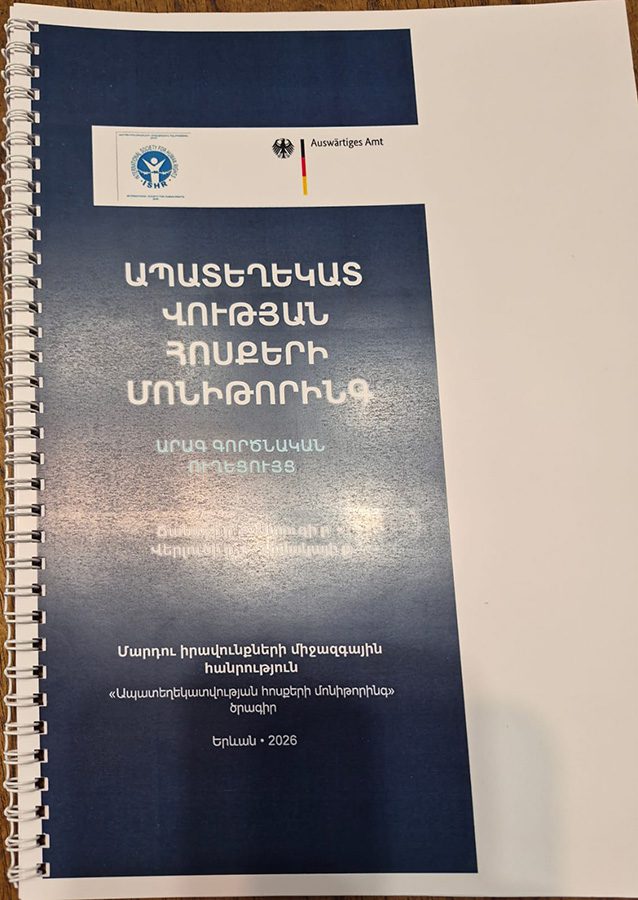
The booklet was prepared within the framework of the “Monitoring Disinformation Flows” project by the Human Rights International (HRI) Armenia organization.
The main goal of the project is to increase the level of media literacy, support journalists and young professionals in more effectively recognizing, analyzing, and countering disinformation flows in the modern information environment.
MONITORING OF DISINFORMATION FLOWS Educational and practical manual for journalists, researchers and civil society representatives
Monitoring disinformation flows
Educational and practical manual
© International Human Rights Community (IHRC) Armenia, 2026
 INTRODUCTION
We live in an era of unprecedented information overload. Every day we receive hundreds of messages, news, videos, and publications from social networks, media outlets, and messengers. In this vast flow of information, it is becoming increasingly difficult to distinguish fact from falsehood, a reliable source from manipulative content.
Disinformation has become one of the most important challenges facing modern societies. It can affect public opinion formation, political processes, elections, healthcare decisions, and even national security.
Armenia’s information environment is also not immune to these challenges. Unverified information, manipulative comments, fake photos and videos, as well as elements of external influence operations are often spread on social networks, messengers, and various media platforms.
The aim of this guide is to help journalists, researchers, civil society representatives and active citizens:
✅ understand the main types of disinformation,
✅ recognize information manipulations,
✅ apply basic fact-checking methods,
✅ navigate safely in the information environment.
1. WHAT IS MISINFORMATION?
Disinformation is false or misleading information that is created and spread intentionally to mislead people, influence public opinion, or achieve certain goals.
The three main forms of disinformation
Disinformation
False or distorted information that is intentionally spread.
| EXAMPLEFake news that aims to cause panic in society. |
Misinformation
Misinformation that is spread without the intention of causing harm.
| EXAMPLEA user shares an old photo, thinking it relates to a current event. |
Malinformation
Real information used to cause harm.
| EXAMPLEPublishing personal information to damage a person’s reputation. | |
| REMEMBERNot all misinformation is disinformation.
An important characteristic of disinformation is the intent to mislead, influence, or cause harm. |
|
2. WHY IS MISINFORMATION DANGEROUS?
Disinformation is not just fake news. It can influence people’s decisions, public sentiment, and even the security of nations.
In the information age, disinformation often becomes a tool of influence through which it is possible to:
✅ shape public opinion,
✅ deepen social divisions,
✅ weaken trust in state and public institutions,
✅ influence political processes,
✅ create panic or uncertainty.
The main consequences of disinformation
Decline in public trust
When people are constantly confronted with contradictory or false information, they begin to distrust not only the media, but also government agencies, experts, and even facts.
Polarization
Misinformation often presents the world in a “black and white” way, dividing people into opposing groups.
Panic and disorientation
During crises, wars, pandemics, or emergencies, misinformation can spread quickly and cause panic.
Impact on democracy
Information manipulation can influence electoral processes, public debates, and political decisions.
Armenia’s experience
In recent years, Armenia’s information environment has repeatedly faced information pressure, fake news, manipulative narratives, and coordinated information campaigns on social networks.
They are especially sensitive.
- security-related topics
- foreign policy issues
- military and border events
social and political crises.
In such situations, verifying information becomes especially important.
3. HYBRID THREATS AND FIMI
In the modern world, states and other actors do not always use only military force to achieve their goals.
So-called hybrid methods are being used more and more often.
What is a hybrid threat?
A hybrid threat is the combined use of different tools to exert influence on another country, society, or institution.
These tools may include:
- disinformation
- information manipulation
- cyberattacks
- economic pressures
- political influence activities
diplomatic coercion.
Often they are applied simultaneously and in an interconnected manner.
What is FIMI?
FIMI (Foreign Information Manipulation and Interference) stands for:
Foreign Information Manipulation and Interference (FIMI)
This is a coordinated activity in which external actors attempt to influence public opinion, political processes, or the information environment of other countries.
How is FIMI implemented?
Often used are:
✔ false or misleading publications,
✔ coordinated social media campaigns,
✔ fake accounts and bots,
✔ manipulative videos,
✔ fake experts,
✔ Content created with artificial intelligence.
Why is this important for Armenia?
Countries with small and open information environments are often more vulnerable to external information influences.
Therefore it is important.
- recognize manipulations
- check sources
- understand narratives
develop media literacy.
| REMEMBERNot all misinformation is a hybrid threat.
The main characteristic of hybrid operations is their coordinated and strategic nature. |
4. THE MOST COMMON TYPES OF DISINFORMATION
Disinformation can take many forms. It is not always completely false; sometimes real facts are presented in a distorted or manipulative context.
Fake News
Completely fabricated or false information presented as real news.
| EXAMPLEA post is circulating on social media that a well-known official has resigned, while there is no such information in official sources. |
Manipulative headlines (Clickbait)
Headlines that aim to grab attention and compel readers to open the article.
| EXAMPLE🚨 “SHOCK: Everyone is talking about this secret decision” |
🚨 “You won’t believe what happened”
Such titles often do not correspond to the content.
False Context
The actual photo or video is presented as evidence of another event.
| EXAMPLEThe photo from 2016 is presented as a picture of today’s event. |
Edited images and videos
Photos or videos are altered to mislead people.
| EXAMPLEonly one part of the video is cut, |
- remove important context
They add fake elements.
Conspiracy theories
Claims that important events are being orchestrated by secret forces.
| REMEMBERConspiracy theories usually:
❌ not based on verifiable evidence, |
❌ They provide very simple explanations,
❌ They reject contrary facts.
Content created with artificial intelligence
Modern AI tools can create:
- texts
- images
- voices
videos.
For this reason, it is important to double-check especially sensational or unusual content.
Quick reminder
If the publication.
☐ is too emotional,
☐ provokes fear or anger,
☐ has no clear source,
☐ requires immediate distribution,
☐ contains sensational claims,
then it requires additional verification.
5. DEEPFAKE AND ARTIFICIAL LOGIC
The development of artificial intelligence has changed the information environment.
Today, it is possible to create images, sounds, and videos that are very difficult to distinguish from the real thing.
What is Deepfake?
A deepfake is a video, photo, or audio created or altered by artificial intelligence that is presented as real.
Why are Deepfakes dangerous?
They can:
- to attribute words to people that they never said
- create false evidence
- to damage reputation
- influence political processes
spread quickly on social networks.
How to recognize a Deepfake
Pay attention.
Facial movements
They may be observed:
- disproportionate expressions
- strange flashes
facial distortions.
To the voice
- unnatural intonation
- sudden changes in voice
mismatch between lips and voice.
To the source
Ask.
Who published it?
Is there a source?
Is it confirmed by other reliable sources?
A quick rule for checking deepfake
If the video:
☐ is too sensational,
☐ appeared in only one source,
☐ has no clear source,
☐ spreads quickly on social networks,
So check first, then trust.
| REMEMBERArtificial intelligence in itself is not a threat.
The problem is its misuse for the purpose of creating disinformation, manipulation, or fake content. |
6. 5 STEPS TO FACT CHECKING
One of the most effective ways to combat disinformation is fact-checking.
Before trusting or sharing any information, try going through the following five steps.
Step 1. Check the source
Ask yourself:
✔ Who published the information?
✔ Is it a well-known and reliable source?
✔ Are the author and publication date indicated?
✔ Is there contact or editorial information?
| REMEMBERIf it is not possible to understand who the source of the information is, one should be cautious. |
Step 2: Find the source
Many publications refer to “media,” “experts,” or “confidential sources.”
Try to find out.
Where was the information first published?
Who is the first author?
Is there an official announcement?
Step 3: Compare with other sources
Check if the same information has been published.
- other media
- government agencies
- international organizations
independent experts.
If only one source reports an important event, additional verification is necessary.
Step 4: Check photos and videos
Misinformation is often spread through old or manipulated images.
Use:
📷 Google Lens
📷 TinEye
📷 Yandex Images
Check if the same photo has not been used before in a different context.
Step 5. Don’t rush to spread.
The main driver of the spread of disinformation is rapid dissemination.
If you are not sure.
⛔ Do not spread
⛔ Do not interpret as fact
⛔ Do not use as a source
Check first, then share.
THE GOLDEN RULE OF FACT CHECKING
If the information seems too sensational, there is a high probability that it needs additional verification.
7. OSINT: KEY TOOLS FOR OPEN SOURCE INTELLIGENCE
OSINT (Open Source Intelligence) is a methodology for collecting and verifying information from open sources.
Modern journalists and researchers widely use OSINT tools.
Google Lens
It helps.
✔ find the source of the photo,
✔ discover other versions of the same image,
✔ find previous uses of a photo.
Google Maps
It is useful.
✔ for location identification,
✔ for studying maps,
✔ To check the location of publications.
Google Earth
Allows:
✔ study satellite images,
✔ compare locations,
✔ perform geolocation.
TinEye
It is a specialized reverse image search tool.
It often helps to find the oldest publication of a photo.
InVID
One of the most popular tools for journalists.
It helps.
✔ split the video into separate frames,
✔ perform a reverse search,
✔ verify the authenticity of the video.
Wayback Machine
Allows you to see previous versions of websites.
It is useful.
✔ deleted publications,
✔ modified announcements,
✔ for exploring old websites.
Quick OSINT checklist
If you see a suspicious post:
☐ Who is the source?
☐ Is there a source?
☐ Has the photo been verified?
☐ Has the video been verified?
☐ Is there independent verification?
☐ Does it fit the context?
| REMEMBEROSINT is not a technology.
OSINT is a way of thinking. |
A good researcher always asks:
“How can I verify this information?”
8. SOCIAL NETWORK ALGORITHMS AND THE SPREAD OF MISINFORMATION
We don’t see all posts on social media in the same order. Algorithms select content that the system believes is most likely to grab our attention.
Why does fake content often spread quickly?
Posts that evoke anger, fear, surprise, or admiration tend to get more engagement. Many comments and shares signal to the platform that the post is “interesting,” and it is shown to new users. The algorithm doesn’t necessarily have to decide whether the claim is true or false.
Information bubble
If we only follow pages that share the same opinion, the platform starts to suggest similar content. This creates an information bubble, where seeing the same claim repeatedly can create the illusion of its truthfulness.
How to reduce the impact
☐ Don’t judge a claim solely by the number of likes and shares.
☐ Compare credible sources presenting different positions.
☐ When you see sensational material, pause and find the source.
☐ Do not share material just because it confirms your opinion.
Remember
Many views are not proof of credibility. Popularity indicates the extent of dissemination, not the accuracy of the information.
9. NARRATIVES AND SYSTEMATIC INFORMATION CAMPAIGNS
A single piece of fake news is usually a single claim, while a narrative is a general story or frame of interpretation that is repeated over a long period of time. A narrative may be based on real facts, but may be presented selectively in order to change the audience’s attitude.
How to recognize a narrative
- The same formulations are repeated on different pages and media outlets,
- a complex event is presented through a single simple culprit or cause,
- Words that evoke fear, hostility, or inevitability are constantly used,
- Opposing facts are silenced or presented as “part of a conspiracy.”
Possible signs of systemic spread
Raise suspicion when multiple accounts post the same text, hashtag, or video in a short period of time, when newly created pages are only active on a single topic, or when the number of responses is disproportionate to the actual discussion. One sign is not enough evidence, but a combination of several signs requires a deeper investigation.
Simple analysis format
- What main idea is repeated?
- Who first spread it?
- What audience and emotion is it aimed at?
- What facts are being taken out of context?
- Who can benefit from that comment?
10. IN-DEPTH CHECK OF PHOTOS AND VIDEOS
A true image can be misleading if it is presented with a story about the wrong place, time, or event. Therefore, it is important to check not only whether the image has been edited, but also whether its context is correct.
Step 1. Save the source material
Record the publication link, author name, date, and accompanying note. If the material is later deleted or changed, this information will help restore the review process.
Step 2: Do a reverse search
Use Google Lens, TinEye, or Yandex Images to search for earlier versions of the same image. Select a few clear frames from the video and search each frame separately.
Step 3: Examine the visible details
☐ road signs and billboards,
☐ architecture of buildings and site features,
☐ weather, shadows and vegetation,
☐ License plates, uniforms, or insignia.
Step 4: Compare with independent data
Compare official reports, maps, weather data, and other media reports. If the time or location cannot be confirmed with certainty, clearly state the uncertainty in your conclusion.
Important principle
The absence of metadata is not proof of fakery; social platforms often remove it. The decision should be based on a combination of several independent pieces of evidence.
11. FAKE ACCOUNTS, BOTS AND FAKE EXPERTS
Fake accounts can pose as ordinary citizens, journalists, or experts. Their goal may be to create credibility, divert discussion, or create the impression of an artificial majority around a claim.
Account evaluation symbols
- The account is new, but the volume of posts is very large,
- almost all posts are about one topic or person,
- biographical data, photo or work experience are not verified,
- the same texts are repeated in other accounts,
- The account mainly attacks people and presents few verifiable facts.
How to check the “expert”
Look for a professional biography on the organization’s official website, in academic journals, or in reliable sources of past work. Check to see if the person is speaking within the scope of their actual profession and provides verifiable sources. A television presence or a large following are not professional qualifications in themselves.
Don’t rush to label.
Being anonymous or posting frequently doesn’t mean an account is a bot. Use multiple criteria, preserve evidence, and distinguish fact from speculation.
Quick question
Does this account provide verifiable information, or does it only try to evoke strong emotion and force a ready-made conclusion?
12. WHAT TO DO AFTER DISCOVERING MISINFORMATION
Detecting false or misleading material is not the end of the investigation. It is important to respond appropriately so that the rebuttal does not increase the visibility of the false claim and does not harm the people about whom the material is being spread.
1. Preserve the evidence
Save the link, screenshot, date of publication, and sharing account information. Do not save or share sensitive personal information unless it is necessary to protect the public interest.
2. Formulate the refutation in a simple structure
✔ first present the established fact,
✔ then briefly state what claim is false or misleading,
✔ explain the verification method and attach the sources,
✔ At the end, underline the correct information again.
3. Choose a proportional response
A false claim with a small spread is sometimes better to simply report to the platform rather than widely repost. If the material could harm people’s health, safety, or the electoral process, a quick and visible fact check is needed.
4. Correct your mistake too.
If you yourself have shared unverified information, do not delete it without explanation. Publish a clear correction, state what has changed, and if possible, notify those who have already seen or shared the material.
Final principle
The goal is not to “win” the argument, but to provide the reader with verifiable facts and restore informational trust.
FINAL QUICK CHECK
When you see a suspicious post, first answer these questions.
| ☐ Who is the source? |
| ☐ Is there a source? |
| ☐ Has the photo been verified? |
| ☐ Has the video been verified? |
| ☐ Is there independent verification? |
| ☐ Does it fit the context? |
| GOLDEN RULECheck first, then share. |
The booklet was prepared within the framework of the Disinformation Flows Monitoring Project.

#CivilSocietyCooperation #ishrarmenia #ishrfactcheck
The project is implemented with the financial support of the Federal Foreign Office of the Federal Republic of Germany.
Leave A Comment