



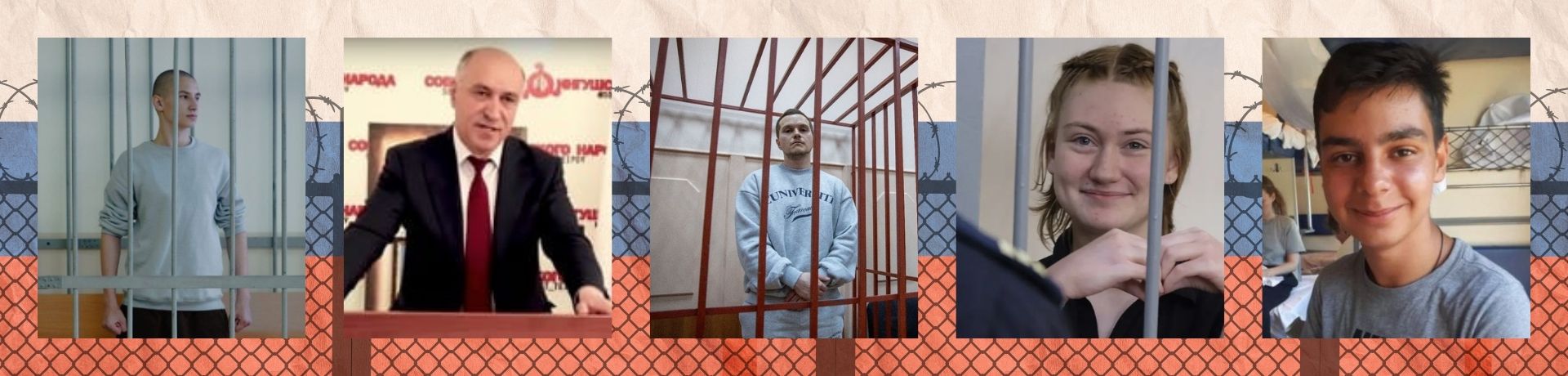
On the occasion of Political Prisoners’ Day in Russia, the International Society for Human Rights (ISHR) condemns the imprisonment and torture of Ukrainian and Russian civilians and calls for the immediate release of all political prisoners.
Day of Political Prisoners in Russia
Thousands tortured and dehumanised
Electric shocks, rape and cruel torture are commonplace
Frankfurt am Main / Moscow, 29 October 2025 – In Russia, critics of the regime and the war are criminalised, tortured and imprisoned for years for distributing leaflets, posting on social media or staging symbolic protests. Thousands of Ukrainian civilians are victims of Russian state terror, tortured and dehumanised. On the occasion of Political Prisoners’ Day in Russia, which is observed on 30 October, the International Society for Human Rights (ISHR) condemns the imprisonment and torture of Ukrainian and Russian civilians and calls for the immediate release of all political prisoners and the cessation of all acts of war.
“In Russian prisons, Ukrainian civilians are tortured with electric shocks, sexually abused, Ukrainian tattoos are burned out and organs are removed from corpses. Critics of the regime in Russia are also subjected to arbitrary treatment and torture. There will be no freedom or peace under Putin, neither for Ukraine nor for critics in Russia. Europe must therefore act with strength and determination, because that is the only language Putin understands,” said Valerio Krüger, spokesperson for the ISHR Executive Board.
Torture and execution of Ukrainian civilians
Tens of thousands of Ukrainian civilians are being held in prisons in the temporarily occupied east of Ukraine and throughout Russia. According to a recent ISHR report, 29 prisons, including the remand centres in Donetsk and Taganrog (a southern Russian port city), have been clearly identified as torture prisons. These detention centres have “well-equipped rooms” for electric shock, waterboarding, gagging and hanging mechanisms. There, body parts are clamped in pincers, fingers are cut off, mock executions are staged and executions are carried out. Very often, prisoners with pro-Ukrainian tattoos are also “branded”. Corpses have been returned without internal organs.
Putin’s logic: anyone who defends his opponents will be eliminated
Just a few days ago, 18-year-old street musician Diana Loginova (stage name: Naoko) was arrested in St. Petersburg and sentenced to 13 days in prison after singing a song calling for Putin’s overthrow. After serving her sentence, she faces further legal proceedings. Former victims of Soviet state terror are also being persecuted. Dissident Aleksander Skobow, about whom the ISHR reported as early as 1986, was sentenced to 16 years in prison for criticising Russia’s war of aggression.

Show trials: When criticism becomes a “crime”
Journalists, human rights defenders and lawyers are also targeted by the Russian repressive apparatus. For example, Aleksei Lipzer, lawyer for the late opposition figure Navalny, was sentenced to five years in prison on 17 January 2025 – officially for “participating in the activities of an extremist community.” The ISHR has documented more than 130 young opponents of the war who have been arrested and imprisoned for merely expressing their opinions or engaging in symbolic acts of protest. These include Daria Kosyreva (20), sentenced to two years and eight months in prison for criticising the war, Egor Balaseikin (16), sentenced to six years in prison for an unexploded Molotov cocktail, and Arseniy Turbin (15), sentenced to five years for distributing leaflets.


Leave A Comment