




The image depicts the founder of Polymarket, Shayne Coplan, as a modern Julius Caesar, symbolizing centralized power over markets where life-and-death outcomes are decided, while faceless bettors represent anonymity and the absence of accountability. Together, they mirror the logic of the Roman arena: authority sets the rules, the crowd delivers the verdict and those whose lives are at stake remain unseen.
Someone Already Bet on Your Life
How Polymarket Turned Human Lives Into a Gambling Instruction Manual
Frankfurt am Main, 04.02.2026 — For years, a familiar joke has circulated among critics of technology and authoritarianism: Black Mirror should be banned — it gives autocrats ideas. The joke no longer lands. Not because it is offensive, but because it is outdated. We do not need dystopian fiction to imagine the future anymore. We are already living inside one of its episodes.
Consider a website where users trade on whether a city will fall, whether a war will end, whether a president will be forced from office. A clean interface, green and red buttons, precise percentages that claim to reflect reality itself. Human suffering flattened into tradable outcomes. Death, displacement and destruction rendered as price signals.
This is not speculative fiction. It is Polymarket.
Polymarket describes itself, without irony, as “Polymarket | The World’s Largest Prediction Market™.” It is a blockchain-based platform where users buy and sell shares in the outcomes of real-world events. If an event happens, the “Yes” shares pay out. If it does not, they expire worthless. The price of each share becomes the implied probability, a number that looks like knowledge.
At first glance, Polymarket resembles a hybrid of a stock exchange and a polling aggregator. Its founders argue that prediction markets are powerful tools for truth-seeking: people, they claim, are more honest when money is on the line. In a world flooded with misinformation, markets promise clarity.
But clarity for whom and at what cost?
From Elections to Airstrikes
Polymarket’s markets span almost every domain of public life. Users trade on election outcomes in the United States and Europe, interest-rate decisions, celebrity scandals, corporate lawsuits and the release dates of pop albums. There are markets on whether artificial intelligence will achieve specific milestones, whether billionaires will make certain public statements, even whether religious prophecies will be fulfilled within set timelines.
More quietly, but far more consequentially, Polymarket has become a place to trade on war.
Not metaphorically. Literally.
Alongside markets about U.S. politics and Silicon Valley, Polymarket hosts active betting on armed conflicts in Ukraine, Gaza, Iran, Somalia, Mexico and other regions marked by violence and instability. These markets ask whether ceasefires will occur, whether cities will be captured, whether military strikes will happen by a certain date.
In effect, they ask users to speculate on human life expectancy at scale.
The platform does not frame these markets as gambling on death. It frames them as forecasts. But the distinction is thin. When a market asks whether a city will fall by the end of the month, it is not predicting weather. It is pricing the probability of mass displacement, civilian casualties and the collapse of daily life for tens or hundreds of thousands of people.
To click “Yes” is not merely to express belief. It is to take a position that pays out if destruction arrives on time.

War reduced to a dashboard. On Polymarket, ceasefires, city captures and political futures appear side by side as tradable tiles. Human lives compressed into percentages, deadlines and “Yes/No” buttons.
Ukraine as the Ultimate Case Study
Nowhere is this logic more exposed than in Polymarket’s Ukraine section.
The Russian invasion of Ukraine has generated dozens of active markets: timelines for ceasefires, prospects for negotiations, leadership scenarios. But the most liquid and persistent markets are territorial. They ask when, not whether, Russian forces will capture specific Ukrainian cities.
Pokrovsk. Myrnohrad. Kupiansk. Sloviansk.
Each market is tied to a date. Each date carries a price. Each price claims to represent collective judgment.
More than $100 million has already been traded on Ukraine-related markets alone.
This is not analysis in the traditional sense. There are no footnotes, no methodological debates, no accountability for error. There is only settlement: Yes or No. Captured or Not Captured. Before or After.
In a war defined by ambiguity, contested front lines, propaganda, delayed confirmation and deliberate deception. This demand for binary resolution creates a dangerous mismatch. War does not resolve cleanly. Markets must.
That tension turns information itself into a pressure point.
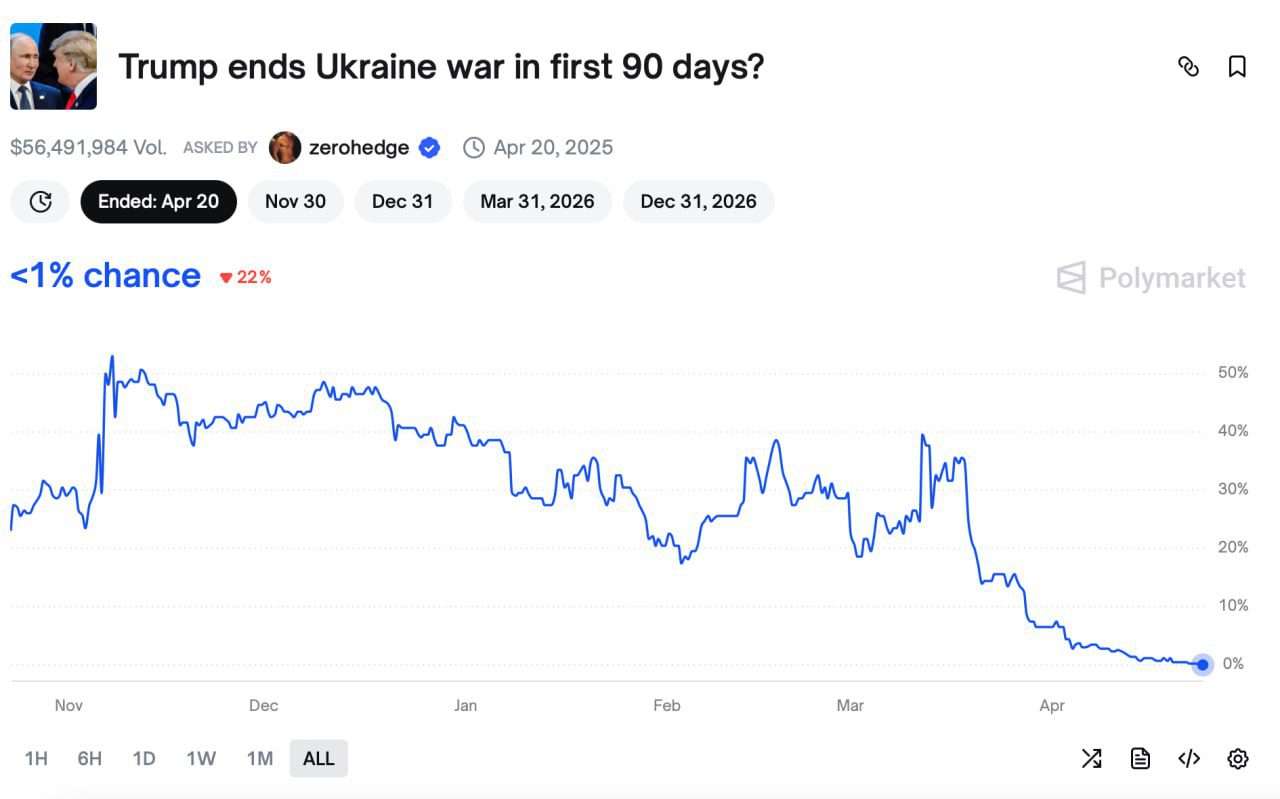

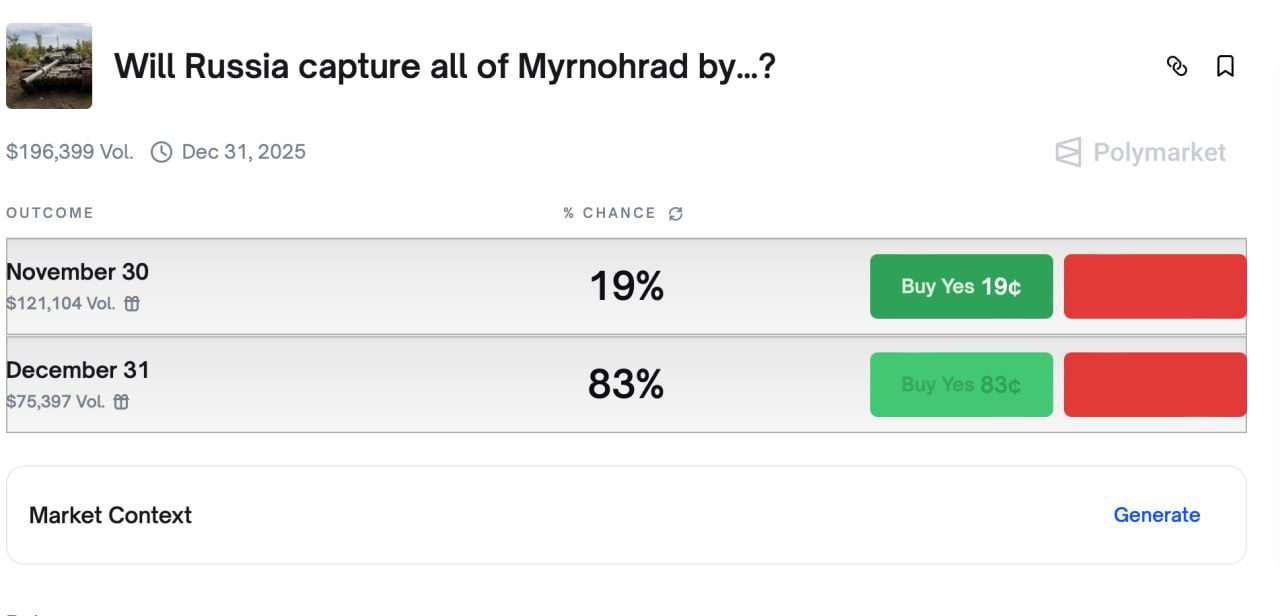
Markets where war becomes a timeline. On Polymarket, the fall of cities, ceasefires and political decisions are traded as probabilities. Complex human realities reduced to charts, deadlines and implied odds.
When Information Becomes Infrastructure
Polymarket does not verify events on the ground. Instead, it settles its markets by deferring to what it calls “authoritative sources”, a loosely defined category that can include official statements, widely cited media reports and, crucially, third-party analytical products.
In the case of Ukraine, one of those sources has been the daily interactive battlefield maps produced by the Institute for the Study of War (ISW), a Washington-based think tank whose assessments are regularly cited by governments, journalists and military analysts. ISW’s maps were never designed to serve as financial arbiters. They are interpretive tools, assembled under conditions of uncertainty, intended to illustrate trends rather than certify facts in real time. But once Polymarket began relying on them to adjudicate bets, those maps acquired a new function. They became infrastructure, a settlement layer for money.
And infrastructure, once tied to payouts, becomes vulnerable.
On November 15, 2025, as Russian forces were advancing on the outskirts of the eastern Ukrainian city of Myrnohrad, Polymarket was hosting an active market asking whether Russia would capture the city by a specific deadline. Users had collectively wagered more than $1.3 million on the outcome.
Shortly before the market was resolved, ISW’s interactive map was edited to show that Russian forces had taken control of a key intersection in Myrnohrad, despite the absence of corroborating evidence from other monitoring projects such as DeepState or Liveuamap. The change was brief, but decisive. As first reported by 404 Media, Polymarket resolved the market in favor of a Russian advance while the altered map was still live. Traders who had placed low-probability bets stood to earn returns of up to 33,000 percent, not because the city had fallen, but because a visual representation briefly said it had.
By the following morning, the map edit had disappeared.
Two days later, ISW issued a public statement acknowledging that an “unauthorized and unapproved edit” had been made to its Ukraine map overnight, emphasizing that the change did not reflect ISW’s official assessment and was removed before the next day’s workflow began. The statement made no reference to Polymarket or online betting. Soon after, ISW quietly removed the name of one of its geospatial researchers from the list of contributors to its daily Ukraine maps. According to reporting by Quincy Institute for Responsible Statecraft’s publication Responsible Statecraft, a source familiar with the matter said the staff member had been dismissed, though ISW did not publicly confirm the reason.
In a subsequent response to inquiries, ISW made its position explicit: it “strongly disapproves” of betting on the war in Ukraine and “strenuously objects” to the use of its maps for such purposes, stating that it does not consent to being used as an adjudication mechanism for prediction markets.
The episode did not prompt Polymarket to reverse payouts.

When a map becomes a verdict. Battlefield assessments designed for analysis and situational awareness are repurposed as settlement tools — lines and colors on a map quietly determining financial outcomes tied to real cities, real people and an unfinished war. Map by ISW
What These Markets Actually Measure
Defenders of prediction markets argue that they merely reflect collective belief, that Polymarket and similar platforms are neutral aggregators of opinion, akin to mirrors that show what people think.
But mirrors shape behavior.
A percentage displayed prominently on a widely shared platform does not stay neutral. It is copied, screenshot and disseminated across social media, where it is often presented without context. Over time, such figures begin to shape expectations, not just reflect them, especially when they are framed as probabilities tied to global events.
In the realm of geopolitical conflict, that influence can be consequential.
Take, for example, widely shared odds on markets tied to military actions. Polymarket currently lists real contracts such as “U.S. strike on Somalia by January 31?” — an active binary market that treats the very possibility of U.S. military intervention in Somalian territory as tradeable outcomes. Similar markets exist for diplomatic and strategic scenarios tied to global hotspots, including Iran and other regions where violence or conflict is forecastable.
Independent reporting has documented how such markets and their implied probabilities, are treated as signals rather than pure speculation. A long-form investigation by The Guardian exposed how anonymous users on Polymarket appear to have made millions by betting on military strikes and diplomatic developments, raising questions about whether these outcomes were “anticipated” or merely reflected by insiders with privileged information.
There are also high-profile disputes over how markets are settled. When Polymarket refused to pay users who wagered on a U.S. invasion of Venezuela after a military operation unfolded, the episode sparked outrage among bettors and raised questions about how the platform defines qualifying events. The Financial Times reported that more than $10.5 million was tied to contracts related to the Venezuela scenario and users contested the platform’s interpretation after payouts were denied.
The data from these markets is attractive to political analysts, consultants and commentators precisely because it offers a simple number, a probability, that seems to answer complex questions in real time. That legibility gives these figures disproportionate influence relative to how they were produced.
Polymarket does not reveal what people think in any broad or representative sense. What it reveals is what incentives produce, a combination of speculation, information access, strategic positioning and market dynamics that can be mistaken for consensus.

A catalogue of possible defeats. Dozens of Ukrainian towns reduced to tiles on a dashboard, each paired with odds and deadlines — war fragmented into markets where capture becomes a percentage and survival a bet.
Beyond Ukraine
Ukraine is the most visible case, but it is not the only one. A review of active and recent markets on Polymarket shows that the platform regularly hosts contracts tied to armed conflict and political violence far beyond Eastern Europe. Users have been able to trade on scenarios related to escalation in Gaza, confrontation involving Iran, instability in Somalia and violence linked to organized crime in Mexico. Some markets ask whether military strikes will occur by a certain date; others focus on ceasefires, interventions or regime-level outcomes.
In each case, the structure is the same. A question is framed around a violent or destabilizing event. A deadline is attached. Shares are issued. The outcome becomes tradable.
The platform presents these contracts as neutral forecasts, a way to aggregate belief about the future. But the subject matter is not abstract. These are not questions about interest rates or box-office receipts. They are questions whose resolution implies civilian casualties, displacement, or the expansion of armed conflict. Each market translates lives at risk into a financial instrument. Each treats human suffering as volatility.
This breadth has not gone unnoticed. Media outlets including Axios and Yahoo News have reported on growing concern among policymakers and analysts that prediction markets increasingly allow users to wager directly on wars and crises, often in legal gray zones with limited oversight. Critics have warned that such markets risk normalizing violence as a speculative asset class. Something to be priced, hedged and traded rather than prevented.
Importantly, this is not an accidental by-product of user behavior. Polymarket does not operate as an open marketplace where anyone can list any contract. While users may propose ideas through community channels, the company itself decides which markets are approved, listed and promoted. In other words, Polymarket exercises editorial control over which aspects of global instability become tradable.
Some questions, notably, never appear.
There is no market asking whether betting on war is ethical. No contract assessing whether profiting from forecasts of violence causes harm. No mechanism for trading on whether this model of prediction should exist at all.
That absence is telling.
Casinos, after all, rarely offer wagers on their own legitimacy

The Black Mirror Problem
In Black Mirror, the horror is rarely technology itself. It is the quiet normalization — the way systems designed for convenience or efficiency slide into cruelty without anyone quite deciding to be cruel.
Polymarket fits this pattern precisely.
No one on the platform needs to celebrate violence. No one needs to wish for cities to fall. All that is required is participation in a system where outcomes tied to human suffering are rendered abstract, priced and traded.
Click by click, tragedy becomes liquidity.
The unsettling question is not whether Polymarket predicts the future accurately.
It is whether a society that accepts this model has already decided what kind of future it deserves.
By Artem Kryvulia
Project Assistant, Eastern Europe Department
International Society for Human Rights (German Section)


Leave A Comment