



ISHR publishes comprehensive documentation on the human rights situation in Russian-occupied territories in Ukraine.
24 September 2025
The president of the largest country in the world, Vladimir Putin, accused of war crimes, said on camera on 20 June 2025.
And what does it look like where Russian soldiers put their feet? When it belongs to “them”? What does it look like in the occupied territories that have been legitimised by sham referendums since September 2022? How large are these territories and how many Ukrainians (hereinafter referred to as Ukrainians) still live there? What happens there? How are the Ukrainians there doing in their homeland under Russian rule?
The ISHR estimates that 3.5 million Ukrainians live in the “old” and “new” occupied territories and is following the fates of over a hundred displaced Ukrainian civilians in its individual casework. Their fates are also a focus of this documentary.
While the Russian war of aggression in Ukraine is in full swing, the largest Russian infrastructure and Russification programme in the newly occupied territories is running at full speed.
A basic principle of totalitarian systems applies here: any resistance is to be nipped in the bud by force. And the greater the resistance, the more brutal the violence. Under the personal responsibility of its leader Vladimir Putin, Russia is pulling out all the stops in the newly occupied territories in terms of the systemic, structural and physical use of force.
The Russian Federation is clearly violating all international legal acts with extraordinary severity. Nevertheless, all these legal acts do not help to get hold of the Russian state apparatus and once again prove to be too fragmented for complex issues and a paper tiger without an executive power. And this despite the fact that Russia’s state, war and human rights crimes are documented in such detail and comprehensively, probably for the first time in history.
In practice, there are hardly any resources in the existing international institutions for prosecuting Russia. For example, Russia, which violates all the rules of the UN Charter, still has veto status in the UN Security Council.
Part of the UN’s jurisdiction is the International Court of Justice in The Hague, which is responsible for interstate conflicts and crimes, but unfortunately has no real instruments for action. Another institution is the European Court of Human Rights in Strasbourg, an organ of the Council of Europe, from which Russia “withdrew” shortly after its war of aggression against Ukraine. And Russia has never ratified the Rome Statute, in which a state recognizes the jurisdiction of the International Criminal Court in The Hague (ICC).
Although the ICC brought charges against President Putin as a war criminal for the deportation of 20,000 Ukrainian children in March 2023 and issued an arrest warrant, this has yet to be implemented.
The Council of Europe’s “special tribunal”, which was agreed with Ukraine in June 2025 and is also to be set up in The Hague, is now intended to offer a way out of this fragmented impunity. However, here too, the exact framework has not yet been defined and planned reforms to extend the jurisdiction of the ICC for the crime of aggression have not yet been decided.
- to give the legal instruments for the prosecution of Russian war crimes a firm framework and thus counteract possible impunity to protect the victims.
- – not to misuse the territories of Ukraine occupied and unilaterally incorporated by Russia as a bargaining chip for peace negotiations.
- – to obtain immediate access for the International Red Cross to all Russian places of detention for captured Ukrainian military personnel and civilians.
- – to support Ukraine with all possible means, especially since support from the USA appears more than questionable.
- – to consider withdrawing the Russian Federation’s veto right in the UN Security Council.
- – to utilise the full amount (not just the interest income) of the Russian funds frozen under the sanctions of around 200 billion euros for Ukrainian reconstruction and the rehabilitation of the victims.
- The ISHR demands the immediate withdrawal of all troops of the Russian Federation and its allies from the territory of Ukraine, as well as the immediate cessation of all military attacks on Ukrainian territory. All acts of war must also cease immediately.
- – The ISHR demands the immediate release of all abducted Ukrainian civilians and the end of arbitrary repression against Ukrainian minorities, such as the Crimean Tatars, and immediate access for the International Red Cross to all Russian places of detention for captured Ukrainian military personnel and civilians.
- – Call on the Russian Federation to recognise the right to self-determination and freedom of a free and sovereign Ukrainian state. This right also applies to the Baltic states of Estonia, Latvia and Lithuania as well as the Republic of Moldova.
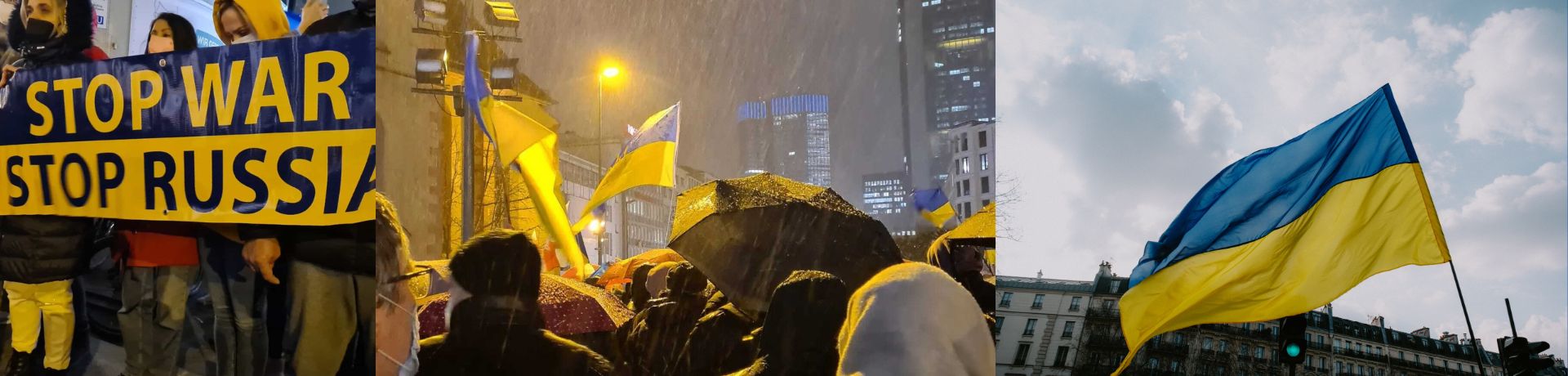
Russia is committing the most serious crimes against millions of people in Ukraine. The Ukrainian territory is being Russified by force and a system of terror is being established. Millions of people continue to face the most severe systematic oppression, torture and death.
According to the ISHR, an expansion of the war or military action by Russia for the purpose of annexing further territories, including those of the EU, is not unlikely. Only a resolute and strong Europe can prevent this, the ISHR concludes.
Leave A Comment