



4 Years of Russia’s Unprovoked War of Aggression Against Ukraine
The EU must confront the “end of the values-based world order” far more decisively on its own continent.
Everyone understands that the EU’s Zeitenwende cannot be carried out as swiftly or sharply as the decision-making of a one-man rule in a single country. But the fact that, after four years, in the largest country in Europe, the Russian army continues to murder, terrorize, and torture day after day is a damning indictment of the EU. More than that: according to the latest UN report, last year was the “deadliest” for civilians since the war began.
While bad news cascades through the global information sphere, the term “human rights” seems to be swallowed, only to resurface as the “end of the values-based world order.” The EU must not drift toward the end of that order and must oppose it far more resolutely, especially on its own continent.

On knee-deep snow-covered Ukrainian cemeteries, seas of flags marking hundreds of thousands of war dead shatter in the biting wind (AI-generated image)
On 24 February 2022, Putin catapulted modern 21st-century Europe overnight into a new world order with a single blow.
Forty-four million Ukrainians were bombed awake from their sleep, a quarter of the total population was forced to flee, triggering the largest refugee crisis since the Second World War. It was a war of aggression that, wherever Russian soldiers set foot on Ukrainian soil, was marked from the very first day by war crimes and atrocities.
Twenty percent of the country’s territory, an area larger than Hungary, with around eight million inhabitants before the war, is not only occupied by Russia but has been incorporated and forcibly Russified under rigid terror. The overwhelming majority of the population fled from its so-called “liberator” at the very beginning of Russia’s full-scale invasion. Twenty thousand Ukrainian children were abducted by the Russian army and are being subjected to enforced indoctrination as Russian patriots. Sixteen thousand Ukrainian civilians were abducted as well. The United Nations has clearly documented the systematic torture of abductees and prisoners of war, on a scale that even the long-serving UN Special Rapporteur on Torture had never witnessed before. Russia not only refuses to provide any information about the abducted civilians and prisoners of war, but also denies all access to detention camps, not even allowing the International Committee of the Red Cross to enter.
That this catastrophic human rights situation in the Russian-occupied territories is so little known to the public in EU countries is itself a damning indictment of the European Union.
For four years now, Ukraine has been relentlessly bombarded, day after day, and above all night after night. In the coldest winter since the start of Russia’s full-scale invasion, Russian bombs are once again aimed primarily at Ukrainian infrastructure. For months, apartments have been so bitterly cold that pipes freeze; people have to trudge for kilometres through snow and ice to find a place to warm up and to give their children a hot meal. Night after night it means: out of bed in the freezing cold and into the shelters with shivering children. Traumatised, filled with fear, deprived of sleep and rest, most of the time without heating and electricity, often even without running water. On knee-deep snow-covered Ukrainian cemeteries, seas of flags marking hundreds of thousands of war dead shatter in the biting wind.
Anyone who claims to be a friend of Ukraine today and does not lose their mind over this has no mind left.
Anyone in Ukraine today who is not completely broken is dead.
A Four-Year Review of the International Society for Human Rights (ISHR)’s Work in Ukraine

As late as 23 February 2022, one day before the war began, a full-scale attack on Ukraine still seemed unthinkable to most of us:
“An invasion of Ukraine, a country the size of France with 44 million people, who will certainly not line the streets waving fluttering Russian flags, would unleash images upon the world that no one could even imagine and could put the cheat behind bars as a war criminal for the rest of his days…”
— from our ISHR report at the time, “The Devil Is Loose in the East.”
Largest Refugee Crisis Since the Second World War
Putin’s full-scale assault triggered, overnight, what has been described as the “largest refugee movement since the Second World War,” involving around 14 million people.
In the heart of Europe, 44 million people were bombed awake in the early hours of the morning and confronted with the unimaginable reality of war in the 21st century.
ISHR/KHPG Project: Voices of the War
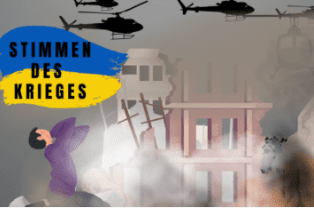
Voices of the War That Must Never Be Forgotten
Mechanical actions set in: searching for loved ones, searching for news and instructions, searching for safe places. Packing the most essential belongings. Saying goodbye to everything familiar. Fleeing into the unknown. How Ukrainians experienced that day was translated continuously into German by ISHR for more than a year in “Voices of the War.” Because this rupture in Europe’s human history of the 21st century must never be forgotten.
The project was initiated by the Kharkiv Human Rights Protection Group (KHPG) under the leadership of Jevhen Zakharov, a founding member of IGFM. In June 2024, IGFM’s partner organization was awarded the Lev Kopelev Prize.
Russian War Atrocities from the Very Beginning
The previously unthinkable images of horror confronted us from the very first days of Russia’s full-scale assault on Ukraine. This was also emphasized in the speech delivered by former German Federal President Joachim Gauck at our 50th Annual General Assembly on 9 April 2022:
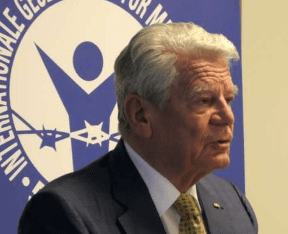
Former German Federal President Joachim Gauck at the ISHR Annual General Assembly 2022
“Since 24 February 2022, Russia has been waging a murderous war of aggression against a peaceful, democratic state on the border of the European Union. For more than six weeks now, Ukrainian cities have been bombed and in some cases reduced to rubble. From the very first day, Putin’s terror has been directed indiscriminately against women and children, soldiers and civilians—who are killed, wounded, driven from their homes, and abducted. And if there was still a final spark of hope that this war between ‘brotherly peoples’ would not once again lead to horrific crimes, that spark was extinguished last weekend, when images from Bucha and many other places north of Kyiv reached us. Once again, we are frozen in horror at the sight of executed women and men, body after body lying along the roadside, entire families wiped out and buried.” …
Bodies also littered the streets of the Ukrainian Black Sea metropolis of Mariupol, a city that before the war was home to nearly a tenth of Ukraine’s population. “The Hell of Mariupol” was documented by journalist Michael Leh, a board member of the International Society for Human Rights (ISHR), in an interview with paramedic Kateryna Sukhomlynova. More than a dozen mobile Russian crematoria were unable to keep up with destroying the evidence of their war crimes. The entire city was reduced to rubble.
Humanitarian Emergency Aid by ISHR for Over Half a Million Children, Elderly People, and the Sick

ISHR Emergency Aid Begins in Rural Communities After the Retreat of Russian Troops from the Kyiv Region
It was a truly extraordinary phenomenon how Ukrainians, wherever they could, wherever they were not overrun by the Russian army, came together in solidarity and stabilized one another in this catastrophic situation. They immediately stepped in wherever help was possible.
The ISHR Ukraine team, which at the time was in the midst of a nationwide project supporting EU accession, was scattered in all directions that very night. At their places of refuge, they went to neighbors, bringing food and water to those in need. Within two weeks, with the help of our German donors, they were able to distribute the first emergency aid packages on a larger scale. In the first two months, donations totaling more than €200,000 were used to build a reliable distribution network for IDP’s and people living near the front lines.
Hundreds of refugees in Poland, Lithuania, and Moldova were also supplied with emergency aid packages by our local sections, at the borders and within the host countries. For two years, we published weekly updates on humanitarian assistance and the fates of those in need, images and stories that have been etched into our memory.
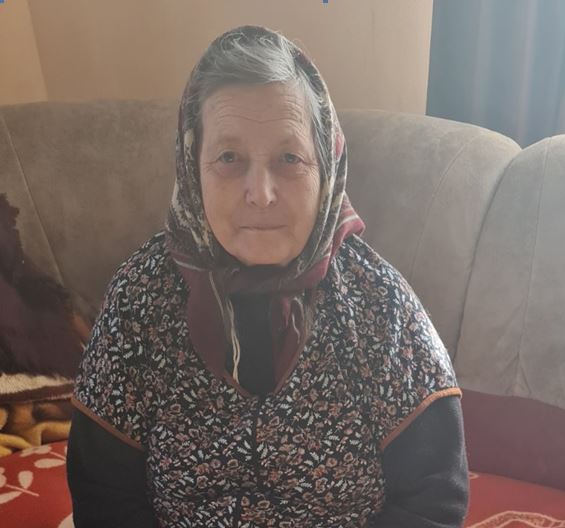
ISHR Aid. Countless Unforgettable Human Stories
Hundreds of war refugees in Poland, Lithuania, and Moldova were also supplied with emergency aid packages by our local sections—both at the borders and within the host countries. For two years, we published weekly updates on humanitarian assistance and on the personal fates of those in need—countless images and stories that have become etched into our memory.
While EU Europe debated helmets, the Zeitenwende, sanctions packages, and the risk of the war expanding, Ukrainian society confronted the new reality of war with remarkable strength and solidarity:
“Working… doing something for society, is the only thing that helps us keep from losing our minds right now,”
— as the ISHR team in the war zone put it.

ISHR’s Ukraine Aid as a UN Partner, Led by Anton Aleksejew, Surpasses the One-Million Mark in the First Year of the War
That ISHR was able, just three months later, on 1 June, to launch a large-scale aid project as a new partner of the UN’s humanitarian assistance program (UHF) is the result of the tireless, relentless efforts and extraordinary dedication of all team members.
By March 2023, using UN funds amounting to USD 1.3 million alone, we were able to reach half a million particularly vulnerable people with emergency aid packages.
And despite the significant decline in donations for Ukraine, we are able, thanks to your support and the exceptional commitment of our volunteers, to continue providing humanitarian assistance on an ongoing basis.
Ambulances, medical supplies, hygiene items, food and children’s toys are procured locally by our Kyiv office.

J. Leisenberg (on the left), with the support of ISHR friends in Cottbus, has personally delivered aid worth around €1 million directly into the war zone since the beginning of the war. Shown here during a brief visit to the ISHR Kyiv office in October 2025.
Particular recognition is due to the tireless members and friends in Cottbus, who to this day continue to deliver urgently needed supplies, especially medical aid, directly into the war zone.
Food packages are also collected and packed at the Frankfurt office by an ever-energetic 85-year-old volunteer. With the support of the disaster relief service of the Federation of Free Evangelical Churches, these supplies are transported to their warehouse and from there to Ukraine.
The most active ISHR working group in Wittlich sends a large aid convoy every month to the three warehouses of the ISHR section in Lithuania. From there, the assistance benefits Ukrainian war refugees, with part of the aid forwarded onward to Ukraine.
Detailed information about ISHR’s humanitarian work can be found in our monthly bulletin “For Human Rights.”
This also highlights another distinctive feature of ISHR: with us, you can closely track how your donation is used, or you can get involved yourself and lend a hand.


20,000 Ukrainian children deported to Russia for forced Russification

20,000 Ukrainian children deported by Russia must not become bargaining chips in negotiations
Among the earliest Russian crimes against humanity, one distinct category must be highlighted in particular. From the chaos of the fighting, especially in the territories of eastern Ukraine that are now temporarily occupied by Russia, Ukrainian children were deported to Russia. This is the very war crime for which Russian President Vladimir Putin was personally charged on 17 March 2023 by the International Criminal Court on the basis of well-founded suspicion; an arrest warrant has been outstanding ever since. To this day, Russia provides no information about the whereabouts of these approximately 20,000 children.
The issuance of new Russian passports and the rigid, forced Russification of these children further complicate efforts to locate them. Last year, in March 2025, all funding was cut for a program at Yale University that had used state-of-the-art satellite technology to identify the locations of these children and process the related data.
16,000 abducted Ukrainian civilians
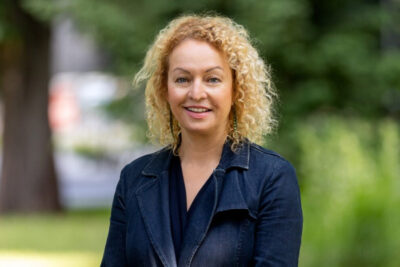
Martina Feldmayer, Member of the Hessian State Parliament (The Greens), assumes ISHR’s first sponsorship for an abducted Ukrainian civilian
At our Frankfurt office, another major focus of Russian war crimes in Ukraine soon emerged: abducted civilians. The sister of 30-year-old Kostiantyn Litvinov, a technical engineer with a PhD, approached us seeking help. Her brother, a civilian who was not serving in the military, had been detained by Russian soldiers at the very start of the war, and since then there had been no information about his fate.
With his case, ISHR for the first time included an abducted civilian in its sponsorship program for political prisoners. The member of the Hessian state parliament Martina Feldmayer took on his sponsorship and persistently appealed for his release, including through letters to the Russian government and the Russian Human Rights Commissioner.
When Kostyantyn, after almost two years in Russian captivity, was finally released in early January 2024 as one of the very few civilians in a prisoner exchange (which normally applies only to soldiers), the joy was indescribable.

Civilians abducted by Russia are generally not included in prisoner exchanges
Only afterward did the catastrophic scale of this phenomenon become fully apparent to ISHR. News of our success spread like wildfire among those affected—whose relatives had also been abducted by the Russian army, and we received a flood of heartbreaking testimonies from family members. We translated more than one hundred of these accounts into German under the title “Abducted Ukrainian Civilians.”
They stand for the fates of approximately 16,000 civilians abducted by the Russian army, about whom Russia provides little to no information. Even according to official UN statements, these people are held under inhumane conditions and subjected to systematic torture. All investigations conducted by ISHR confirm this.
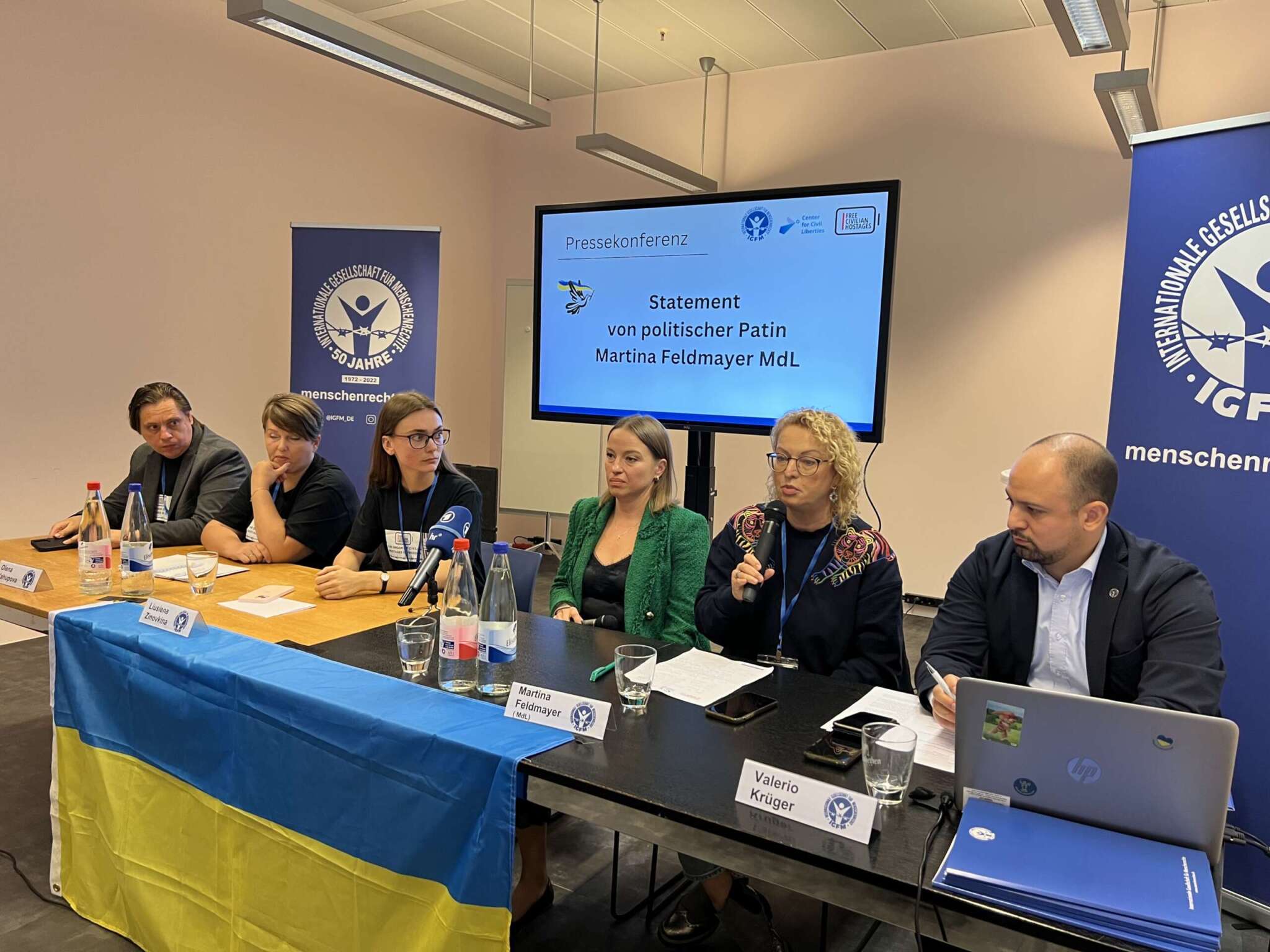
ISHR press conference together with “Civilians in Captivity” generated broad media coverage
How little known this Russian war crime is beyond Ukraine’s borders became clear at an ISHR press conference that we held in early September 2024 in Frankfurt together with the Ukrainian organization Civilians in Captivity (ГО «Цивільні в полоні»). The news about the large number of abducted civilians was taken up by numerous major media outlets and thus reached tens of millions of people in Germany.
Even among experts on Ukraine, many were unaware of the scale of this issue. Our pitch on the topic (2025), together with Liusiena Zinkovina, the young wife of the abducted civilian Kostyantyn Zinovkin, at the annual Ukraine mega-event of the Konrad Adenauer Foundation, “Cafe Kyiv,” in Berlin, met with great interest. Her personal testimony also deeply moved all participants at the ISHR Annual General Assembly 2025. The Member of the European Parliament and ISHR member Michael Gahler immediately agreed to take on an ISHR sponsorship. Shortly thereafter, he addressed Putin directly in his speech before the European Parliament:

Michael Gahler, MEP, addresses Vladimir Putin directly in the European Parliament
“Even less attention is paid to civilians who are arbitrarily arrested in the Russian-occupied zone of Ukraine. The reality is best illustrated by a single example. I refer here to the fate of Konstantin Zinowkin from Melitopol, who was arrested on 12 May 2023 under the pretext of violating the curfew. On 4 June 2023, the family was informed that he had allegedly confessed to planning to blow up a man. On 29 October 2023, he was paraded on Russian state television. Several court hearings took place this spring in Rostov. Because he is innocent, he, like thousands of others, must be released.
Release these people, Mr. Putin!”
ISHR Actively Standing by the Victims

ISHR writing workshop at the Frankfurt office together with Libereco – Partnership for Human Rights
But ISHR would not be ISHR if it limited its work to engagement at the “highest political level.” ISHR is always also a point of contact and a humanitarian supporter for the victims of dictatorial violence.
For example, together with the renowned NGO Libereco – Partnership for Human Rights, we organize writing workshops for postcard campaigns addressed to abducted Ukrainian civilians whose place of detention is known. Some of these postcards do in fact reach the prisoners, and give them a light in the darkness.

ISHR project for internally displaced persons, supported by the German Federal Foreign Office
In 2024, we were also able to bring a light in the darkness into the lives of internally displaced women in Ukraine.
Together with our section in Ukraine and with the support of the German Federal Foreign Office, we implemented a training project for women media professionals. One participant was subsequently accepted into our PR internship program at the ISHR Frankfurt office.

ISHR as a panel speaker at the UCC mass rally
The entire team at the ISHR German office actively and consistently takes part in anti-war demonstrations and public events. This included the impressive large-scale rally organized by the Ukrainian Coordination Center (UCC) on the occasion of the third year of the war at the Römer in Frankfurt, where we were able to address the crowd as speakers and offer encouragement and solidarity to thousands of Ukrainian refugees.
ISHR as a Credible and Authoritative Source of Information
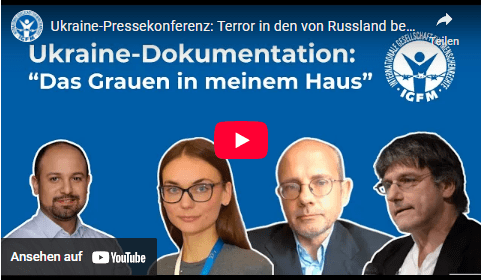
ISHR launch press conference with Eastern Europe experts M. Sapper and A. Umland
Another core pillar of our work is the investigation of human rights violations, as well as the production and dissemination of well-founded documentation. With the publication of our trilingual documentation on the human rights situation in the “black box” of the Russian-occupied territories in Ukraine, we made a significant contribution in September 2025 to exposing the countless systematic war crimes of the Russian terror regime.
At the launch press conference, we were supported, among others, by Manfred Sapper, Editor-in-Chief of Osteuropa, as well as Ukraine expert Andreas Umland.

ISHR documentation: “The Horror in My Home – The Russian-Occupied Territories in Ukraine”
The documentation was also a key focus at our stand at the five-day Frankfurt Book Fair the following month, which attracted well over 200,000 visitors.
“…in the Russian-occupied territories, where there is no continuous Russian bombardment, a clear picture emerges of a fascistoid dictatorship that reveals the genocidal Ukraine policy of the Russian Federation.”
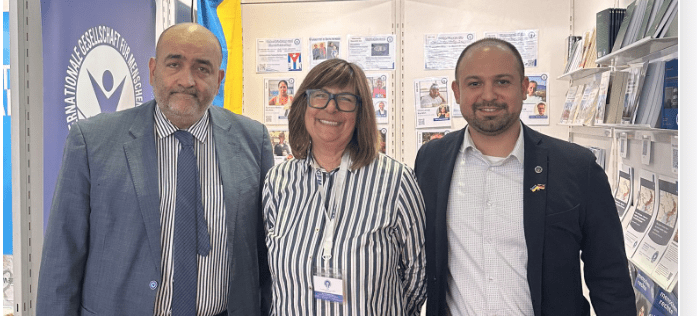
Omid Nouripour, Vice President of the Bundestag (Alliance 90/The Greens), visits the ISHR stand at the book fair.
Omid Nouripour, Vice President of the German Bundestag and a long-standing participant in ISHR’s sponsorship program for political prisoners, took time for a personal visit to the ISHR stand and declared his willingness to assume a new sponsorship for an abducted Ukrainian civilian.

Dmytro Lubinets (from the right), Ukraine’s Human Rights Ombudsman, and Anton Aleksejew (from the left), Head of the ISHR Ukraine Section, sign a joint memorandum
By contrast, in Ukraine it is possible to do what would be unthinkable in Russia: our team can participate on a large scale in strengthening the rule of law, and thus in supporting Ukraine’s future accession to the EU. With the support of the German Federal Ministry for Economic Cooperation and Development (BMZ), we launched a Fair Trial Monitoring project at the High Anti-Corruption Court in November 2025.
Fair Trial Monitoring means observing court proceedings for compliance with rule-of-law principles in line with EU legal standards. The project involves three major Kyiv universities and 250 law students. In total, 120 court proceedings at the High Anti-Corruption Court are being monitored and professionally evaluated.
This professional work by our Ukrainian expert team quickly gained recognition from Ukraine’s Human Rights Commissioner, Dmytro Lubinets, who in December 2024 signed a memorandum with ISHR Ukraine on training regional staff in Fair Trial Monitoring.
Lubinets, who has been in office since the summer of 2022, is also responsible for negotiations with Russia regarding Ukrainian prisoners of war and abducted civilians. As a highly effective behind-the-scenes negotiator, he has earned broad respect. In Ukraine, he is known as “the man who brings Ukrainians home.”
Upcoming ISHR Annual General Assembly on 11 April 2026

Left: Roderich Kiesewetter, MP, visiting President Volodymyr Zelenskyy as part of a delegation with (today’s) Federal Chancellor Friedrich Merz, May 2022.
Against this backdrop, a central focus of ISHR’s work since the outbreak of the war has been Ukraine—a focus also reflected in the themes of our last four Annual General Assemblies. We are therefore pleased to welcome, on 11 April 2026, a German guest speaker on Ukraine: Roderich Kiesewetter, Member of the German Bundestag and ISHR member.
The experienced foreign and security policy expert serves as chair of the Foreign Affairs Committee of the German Bundestag and as spokesperson of the Advisory Board of the Federal Academy for Security Policy. As early as May 2022, he traveled to Ukraine as part of a delegation together with today’s Federal Chancellor Friedrich Merz. Since the beginning of the war, Roderich Kiesewetter, MP (CDU/CSU), has stood out among German foreign policy figures for his clear and consistent support for Ukraine.

Leave A Comment