




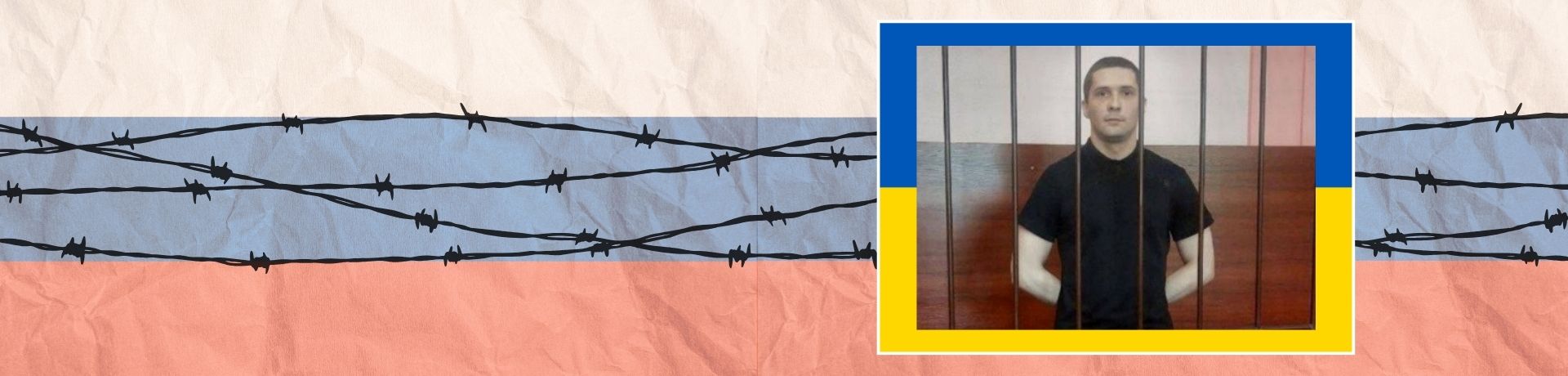
The young Ukrainian soldier was charged in Russia with, amongst other things, alleged terrorist activities. Because of these criminal charges, we regard him as a political prisoner in Russia rather than a prisoner of war, unlike other detained Ukrainian soldiers. Dmytro was unlawfully sentenced to 29 years and 4 months in a high-security prison.
Dmytro released: Nearly 30 years in prison in connection with the fighting in Mariupol
Dmytro KucheryavyDate of birth: 10 April 2001 Arrested: 18 May 2022 Detained at: IK-10 Correctional Facility of the Federal Penitentiary Service of Russia for the Saratov Region Charges: including “participation in a terrorist organisation” and “undergoing training for the purpose of carrying out terrorist activities” Sentence: 29 years and 4 months’ imprisonment. Free from 23 October 2026!
Dmytro Kutscherjawij is a Ukrainian citizen and soldier. He was captured by Russian forces in May 2022 after his regiment surrendered during fighting. Criminal proceedings were brought against Dmytro on various charges, and he was sentenced to a total of 29 years and four months’ imprisonment in a high-security prison.
Arrest
At the time of his arrest, Dmytro was in Mariupol, in the occupied Donetsk region. There, on 18 May 2022, during the fighting at the Azovstal steelworks, more than 300 people left the factory premises, laid down their weapons and surrendered to the Russian armed forces.
Among them were ten Ukrainian soldiers from one regiment: Artem Vyshnyak, Ivan Noshechkin and the soldiers under their command: Serhii Samokhval, Serhii Haikovytsh, Semen Severyn, Dmytro Klusenko, Yevhen Lavrenko, Denys Fedirko, Yegor Yakovenko and Dmytro Kucheryaviy.
Charges, trial and verdict
Unlawful criminal proceedings were brought against the soldiers on charges of “attempted murder of two or more persons in a manner endangering the public, motivated by hatred and hostility” (Article 30(3); Article 105 of the Criminal Code of the Russian Federation), the “use of prohibited means and methods in an armed conflict” (Article 356(1) of the Criminal Code of the Russian Federation) and “wilful damage to another person’s property” (Article 167(2) of the Criminal Code of the Russian Federation).
According to the Russian investigative authorities and the public prosecutor’s office of the unrecognised “Donetsk People’s Republic”, between 7 March and 15 April 2022, soldiers, acting on orders, fired high-angle artillery at residential buildings and key civilian infrastructure facilities in Mariupol. Three residential buildings were damaged as a result. Civilians were able to get to safety beforehand by seeking shelter in bomb shelters.
On 22 March 2024, the Supreme Court of the “Donetsk People’s Republic”, acting on behalf of the Russian Federation, found the defendants guilty and sentenced them to prison terms ranging from 22 years and two months to 22 years and six months in a penal colony. The judgement was not appealed and became “final”.
Further criminal proceedings
Further criminal proceedings were brought against Dmytro – on charges of alleged “participation in a terrorist organisation” (Article 205.4(2) of the Criminal Code of the Russian Federation) and “undergoing training for the purpose of carrying out terrorist activities” (Article 205.3 of the Criminal Code of the Russian Federation). On 4 September 2024, the Southern District Military Court found Dmytro guilty and sentenced him to a further 18 years’ imprisonment.
By taking into account the proportionate combination with the sentence handed down by the Supreme Court of the “DPR”, the court set the total sentence at 29 years’ imprisonment. In a third trial, the Russian authorities accused Dmytro of having been involved in a separate alleged attack using high-angle artillery on the village of Berdjanskoje.
Although the prosecution relied largely on the same criminal provisions as in the March 2024 judgement, the charges related to a different incident and a different location. In a further judgement on 30 May 2025, Dmytro’s final sentence was finally set at 29 years and four months in a high-security prison.
Developments
On 5 February 2026, one of the regiment’s soldiers, Denys Fedirko, was released as part of a prisoner exchange between the Russian Federation and Ukraine.
As his mother told the ISHR, he was released on 23 October 2026 as part of a prisoner exchange between Russia and Ukraine.